


Dangerous crypto exchange: we reveal a new scheme for stealing cryptocurrencies
When attempting to exchange stablecoins for fiat, you may lose your cryptocurrency. Scammers have begun posing as crypto exchanges
25.07.2025
2232
3 min
0
What seems like a simple transaction — exchanging cryptocurrency for fiat currency — can result in the loss of assets. Scammers have devised a new sophisticated scheme to steal digital assets from the wallets of unsuspecting users. GetBlock AML Research spoke directly with the fraudsters to uncover the details of their scheme.
Face-to-face meeting
On one of the aggregators, we found several ads from users offering face-to-face exchanges of USDT stablecoins for Russian rubles. The author of the ad indicates that they are willing to travel to any address in the region to conduct the transaction in person and transfer cash.
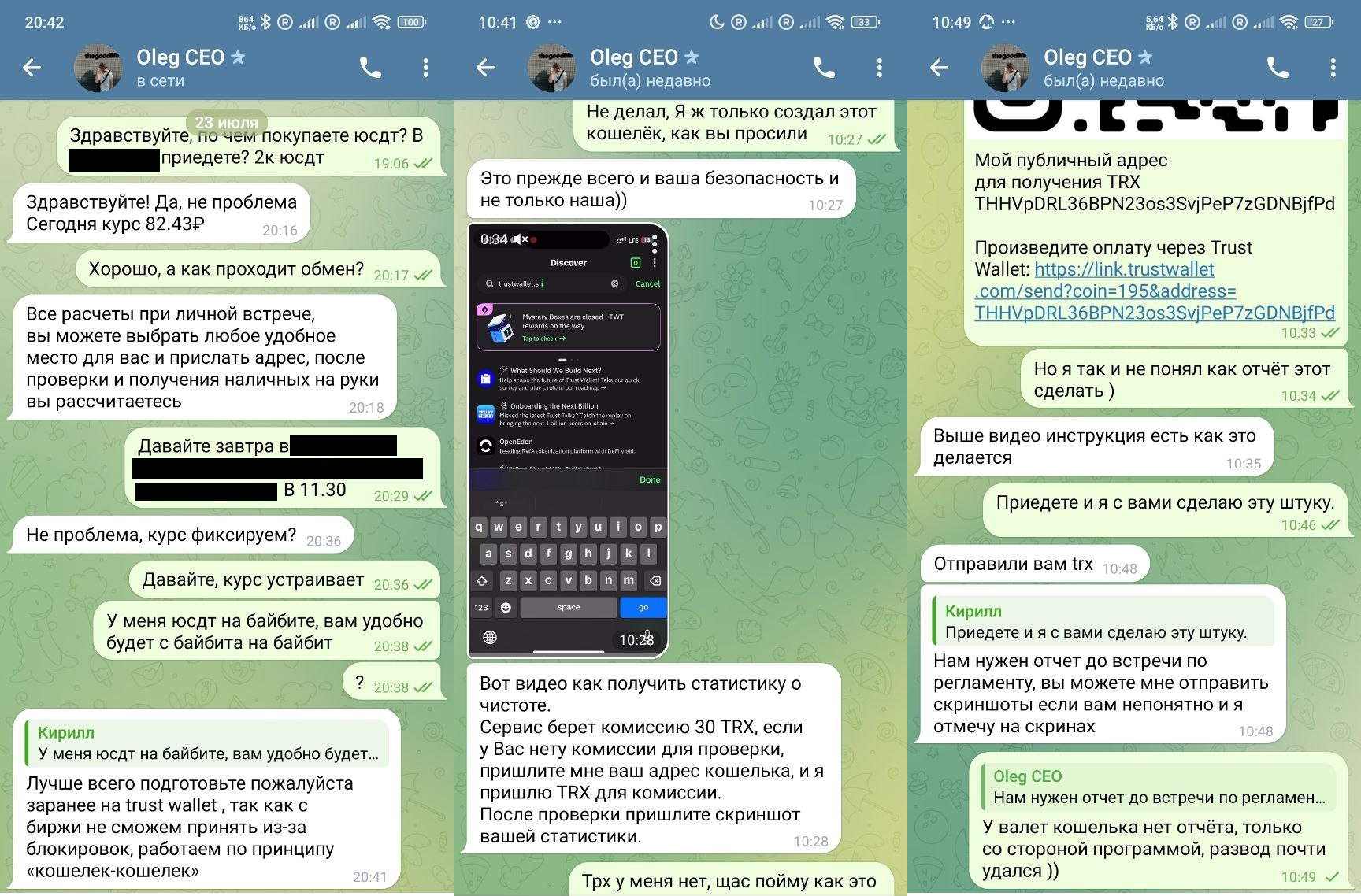
Conversation with the scammer
We contacted the author of the ad and began discussing the transaction details. He confirmed that he was willing to travel to the specified address. Then we fixed the exchange rate. After that, the first suspicious moment occurred. For some reason, the cryptocurrency buyer did not want to accept assets from the Bybit exchange wallet and requested that we transfer the coins to Trust Wallet. We transferred USDT to Trust Wallet.
The culmination of the scam
A few hours before the meeting, the scammer began the active phase of the scam. He said that before leaving for the deal, he had to check the purity (legality) of the cryptocurrency. The scammer shared a video tutorial on how to check coins for purity. In this tutorial, he connects an unknown decentralized application (dApp) to his Trust Wallet, which supposedly checks coins for legality.
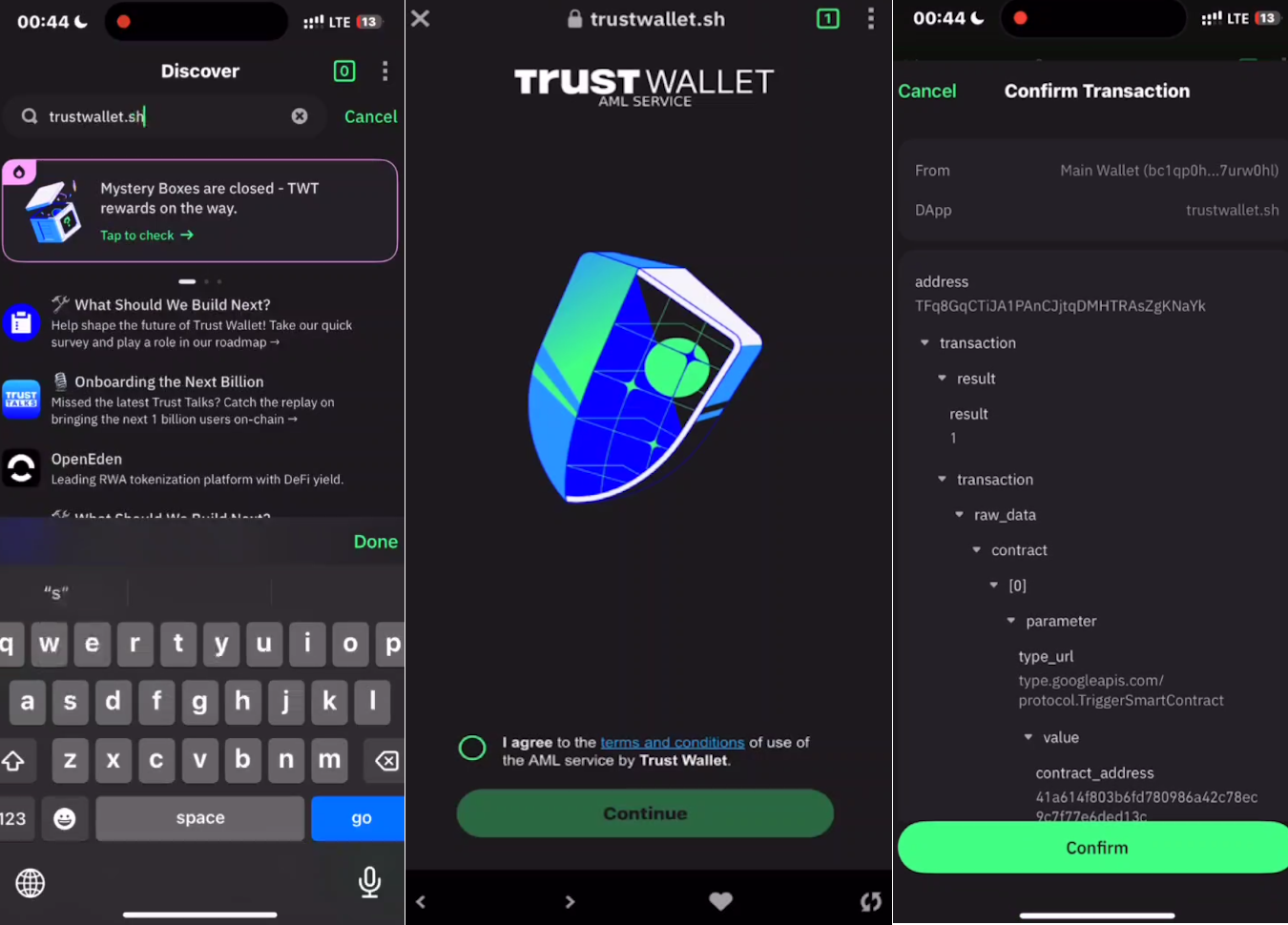
The process of connecting a dangerous application from the scammer’s video tutorial
When you try to connect to the dangerous app, Trust Wallet warns you that you’re doing it at your own risk. This means there’s a high chance you’ll lose your assets. The scam works as follows: once you connect your wallet to the malicious app, it transfers all the cryptocurrency stored in it to the scammer’s address.
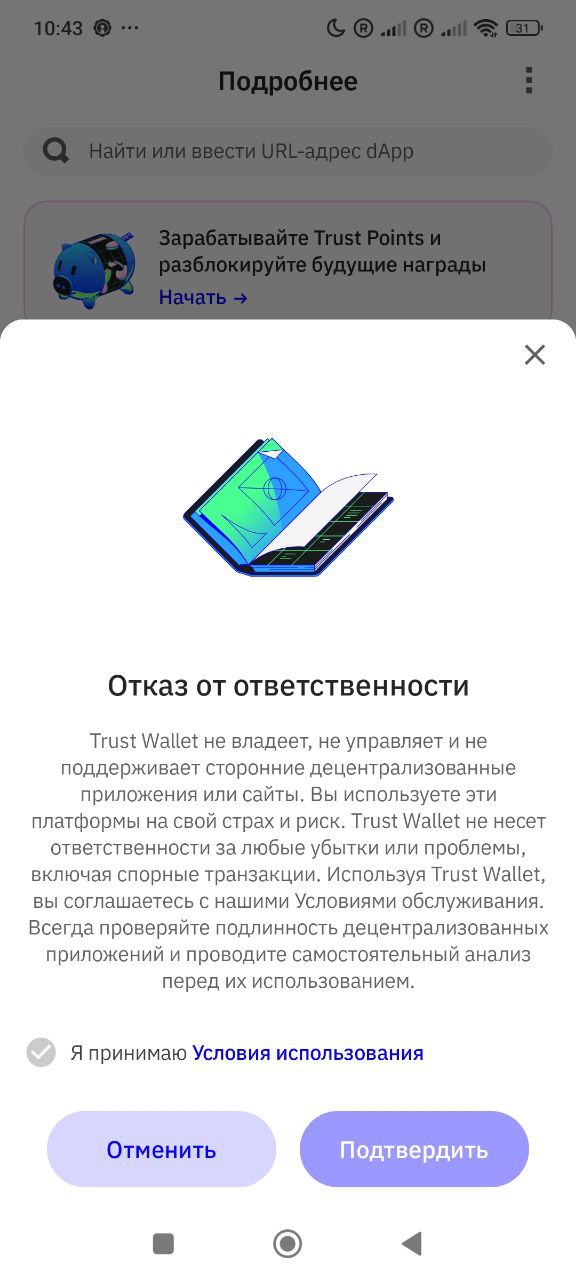
Trust Wallet warning when attempting to connect to a dangerous application
One of the scammer’s tricks is that they “give” us 30 TRX (about $9) to pay for the coin purity verification fee. When we try to “skip” the verification and make a transaction without it, the scammer starts to “pressure” us by saying that without this procedure, they cannot make the exchange.
On-chain analysis
The scammer’s address on the Tron network (TFq8GqCTiJA1PAnCJjtqDMHTRAsZgKNaYk) shows that he was most active in 2023. The attacker used a large number of intermediate addresses to distribute cryptocurrency and hide its source. The address is also linked to the Gate and Bitmart exchanges.
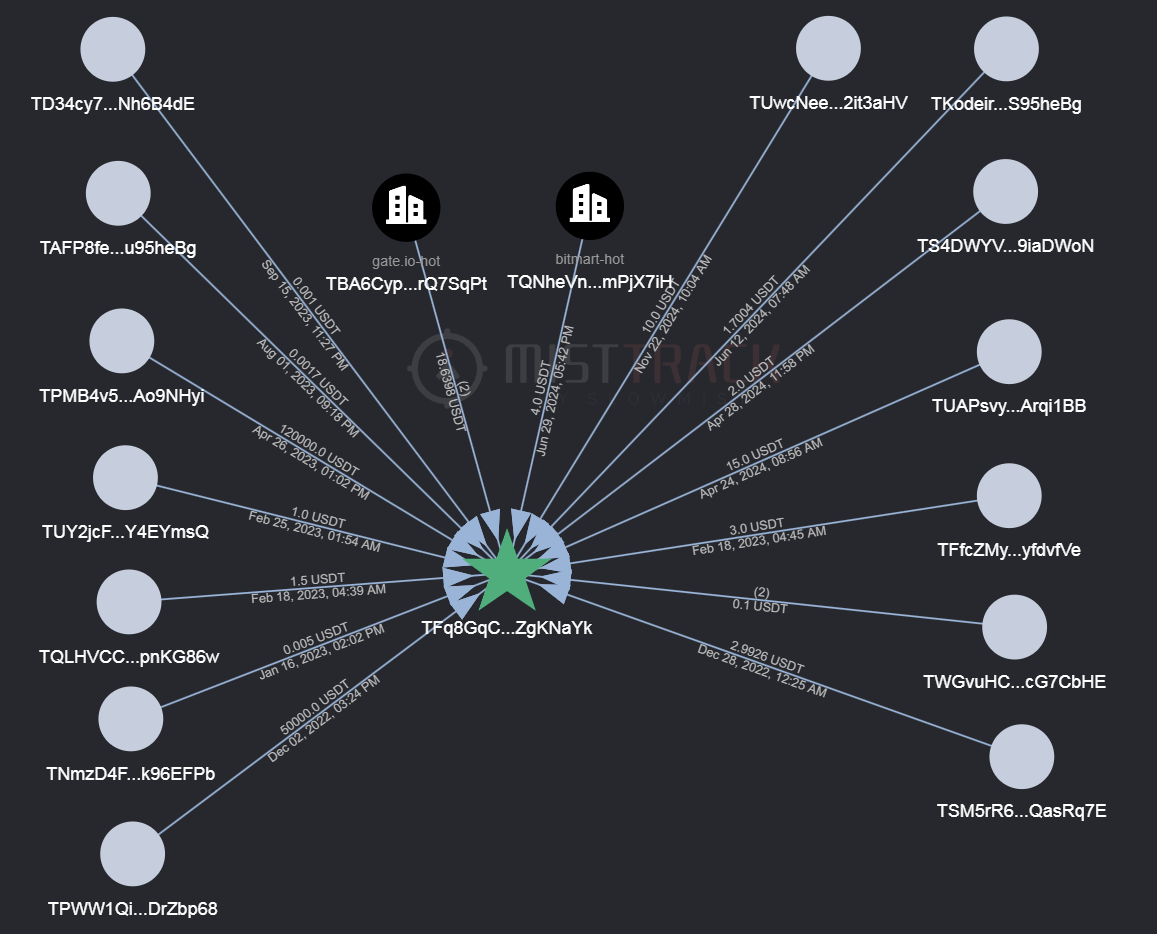
Graph of the scammer’s address connections. Visualization: MistTrack

Useful material?
 Telegram
  Twitter
 Research
One and the same cryptocurrency address received two completely opposite assessments from different analytics systems: from an ordinary gambling service to an extremely severe criminal offense. This story has become the starting point for a broader conversation about what the scientific standards of blockchain analysis should look like — and why errors in systems like these can shape the fates of real people.
Jul 1, 2026
Research
The blockchain has helped uncover the ties between cryptocurrency fundraising campaigns, exchangers in Syria, and intermediaries in several countries around the world. A telltale pattern has emerged in which the same addresses were used across multiple donation drives at once
Jun 24, 2026
Research
Four Iranian cryptocurrency exchanges accounted for roughly 78% of all digital asset volume tied to the country in 2025. They have now become the focal point of the largest U.S. sanctions campaign against Iran's cryptocurrency infrastructure.
Jun 5, 2026
Research
A financial system is already up and running on public blockchains, with loans, analogues of U.S. Treasuries, and automated capital markets. More than $551 billion has flowed through DeFi protocols — but most of that activity has nothing to do with the real economy and everything to do with the speculative build-up of risk.
May 29, 2026
Research
Around 97% of Chinese suppliers of chemicals used to make fentanyl accept payment in cryptocurrency. The volume of such transactions continues to grow alongside the global market for synthetic drugs
May 22, 2026
Research
For the first time, the new law makes blockchain analytics an officially mandatory tool of financial oversight in the United States. Authorities will also gain the power to restrict transactions with foreign crypto services tied to money-laundering risks.
May 20, 2026
Cryptocurrency rates
-

Bitcoin
$84 545
BTC
-2.39%
-

Ethereum
$2 674.98
ETH
-2.31%
-

BNB Smart Chain
$766.36
BSC
-1.91%
-

Ripple
$1.42
XRP
+1.04%
-

TRON
$0.334257
TRX
-0.26%
-

Zcash
$1 314.51
ZEC
-4.16%
-

Dogecoin
$0.092995
DOGE
-3.47%
-

Cardano
$0.218269
ADA
+2.11%
-

Stellar XLM
$0.184461
XLM
+2.83%
-

Bitcoin Cash
$309.77
BCH
-1.37%