


Ethereum developers have proposed to increase the gas limit to scale the network
The solution will reduce transaction fees by 15-33%

21.03.2024 - 08:18
590
3 min
0
What’s new? Ethereum developer Eric Connor and former head of smart contracts at MakerDAO Mariano Conti unveiled the “Pump the gas” initiative to increase Ethereum’s gas limit from 30 million to 40 million, which is designed to scale the underlying blockchain. According to them, raising the limit will reduce transaction fees by around 15-33%.
What else is known? The gas limit is the maximum amount of transaction fees. Gas is the fee in ETH coins required to conduct a transaction or execute a smart contract on the network. The authors of the initiative explain that each transaction has a predefined gas fee, and contracts have a gas limit that cannot be exceeded during execution. This prevents the network from being overloaded by malicious contracts or excessive resource consumption.
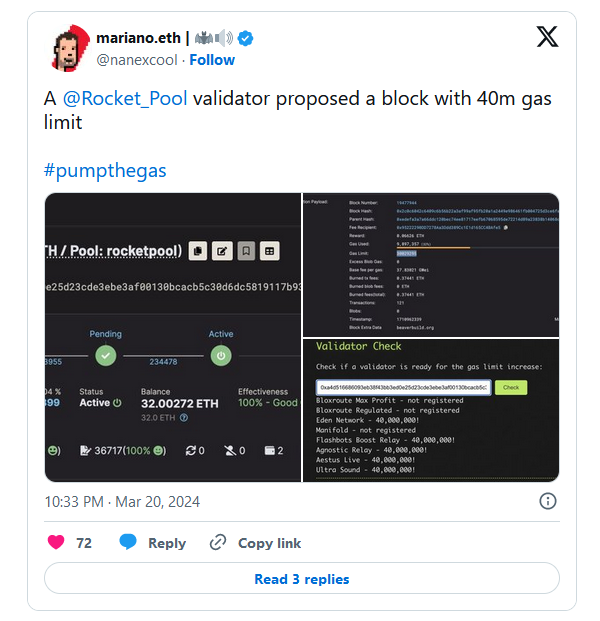
Connor and Conti encouraged individual stakers and staking pools, as well as Ethereum client teams, to join the initiative. On March 20, for example, validator Rocket Pool already offered a block with a gas limit of 40 million.
Also, the authors of the initiative recalled that the successful March 13 Dencun hard fork, which introduced a mechanism for storing compressed large arrays of binary data (blobs), reduced fees in L2 networks, but not in the main blockchain. They said the combination of blobs and an increase in the gas limit could help scale both L2 networks and the Ethereum main blockchain.

Fees on Ethereum-based L2 networks dropped by 99% after the Dencun hard fork
The Optimism blockchain demonstrates the best result
Back in January, Ethereum co-founder Vitalik Buterin proposed to increase the gas limit from 30 million set in August 2021 to 40. Back then he was supported by Jesse Pollack, the developer of the Layer 2 (L2) Base network from crypto exchange Coinbase. He noted that the network has a safety margin and that raising the limit will be beneficial to all parties.
After the Dencun hard fork, activity in Ethereum increased to a 12-month-high, which in turn led to an increase in the amount of burned ETH paid as transaction fees.

Useful material?
 Telegram
  Twitter
 Incidents
Developers warned of potential risks to bridges across the ecosystem and asked exchanges for assistance.
Jun 22, 2026
Incidents
The defendant helped move funds stolen through investment scams and earned at least $4 million for his role in the operation.
Jun 10, 2026
Incidents
The company is linking the incident to a compromised private key on a service wallet, rather than a smart contract exploit
May 22, 2026
Incidents
Following the incident, the project temporarily halted trading operations and node activity.
May 15, 2026
Incidents
The user spent weeks unsuccessfully trying to guess the password until Claude helped find an old wallet backup file
May 14, 2026
Crypto regulations
Authorities are introducing mandatory registration for companies handling cross-border crypto transactions
May 8, 2026
Cryptocurrency rates
-

Bitcoin
$85 595
BTC
+0.06%
-

Ethereum
$2 702.74
ETH
+0.07%
-

BNB Smart Chain
$781.22
BSC
-1.07%
-

Ripple
$1.42
XRP
+1.04%
-

TRON
$0.336093
TRX
+0.3%
-

Zcash
$1 339.22
ZEC
+2.02%
-

Dogecoin
$0.094814
DOGE
-0.13%
-

Cardano
$0.218269
ADA
+2.11%
-

Stellar XLM
$0.184461
XLM
+2.83%
-

Bitcoin Cash
$314.66
BCH
-0.96%