

Russian infrastructure for supporting crypto extortionists has been exposed
US authorities have imposed restrictive measures against servers that were controlled by Russian entities and used to run ransomware programs
24.11.2025
540
4 min
0
The US Department of the Treasury, in conjunction with Australian and British authorities, has announced sanctions against Media Land, a Russian company that provides so-called “bulletproof hosting.” Such services help hide websites and servers used by criminals to spread viruses, ransomware, and other forms of cybercrime. GetBlock AML Research publishes details of the operation.
Several related companies and individuals have also been sanctioned, including Media Land director Alexander Volosovik. According to the authorities, he advertised these services on underground internet forums under the pseudonym Yalishanda.
The sanctions also affected Hypercore Ltd., which the US authorities consider to be a “front company” for the Aeza group, another major secure hosting provider that had already been added to the US sanctions list (in the summer of 2025) and the UK sanctions list (today). After being added to the sanctions list, Aeza attempted to conceal its activities by changing its name and disguising its ownership structure. As a result, two new successor companies were sanctioned, as well as Maksim Makarov, the new director of Aeza, and Ilya Zakirov, who is associated with its operations.

How Russian hosting provided services to cybercriminals: on-chain analysis
The service assisted in spreading malware to extort and steal confidential data
What is bulletproof hosting?
Bulletproof hosting is a type of internet service where a company provides a platform that is difficult for law enforcement agencies to shut down or block. Unlike regular hosting services, which are required to respond to complaints and cooperate with the authorities, such companies ignore complaints and help hide illegal content and activities of their clients.
The main idea behind such services is resistance to blocking. If the police or cyber specialists try to shut down a website, bulletproof hosting can:
- quickly change IP addresses;
- move servers to another country;
- ignore official requests for blocking.
They often operate in countries where the fight against cybercrime is underdeveloped, making them difficult to stop.
Complete anonymity is an important part of their business. Customers can pay with cryptocurrency and use fake data, allowing criminals to remain undetected.
Such hosting services play a key role in cybercrime around the world. They host:
- ransomware servers,
- phishing sites,
- programs that spread malware,
- infrastructure for large botnets,
- pages that mimic banks or government services,
- dark websites for selling data, weapons, and drugs.
Media Land / Yalishanda / Volosovik
According to investigations, since 2015, Alexander Volosovik and his partners have been advertising secure hosting services under the Abushost brand on the underground forums Exploit and XSS. Abushost provided criminals with servers and IP addresses that were almost impossible to block. This made such services an ideal platform for ransomware, data theft, and other online crimes.
| Alexander Volosovik’s address included in the OFAC sanctions list |
| 18dLDAWi8LmrHbEq3QzDJb9SLxCf4uimXB |
Analytical data shows that wallets associated with Yalishanda and Abushost received more than $2 million. These wallets were linked to large groups distributing ransomware viruses, such as BlackSuit, Black Basta, LockBit, and MedusaLocker. It was also noted that the money passed through many intermediate cryptocurrency wallets and large exchanges, which shows that such hosting providers are part of a broader criminal infrastructure.
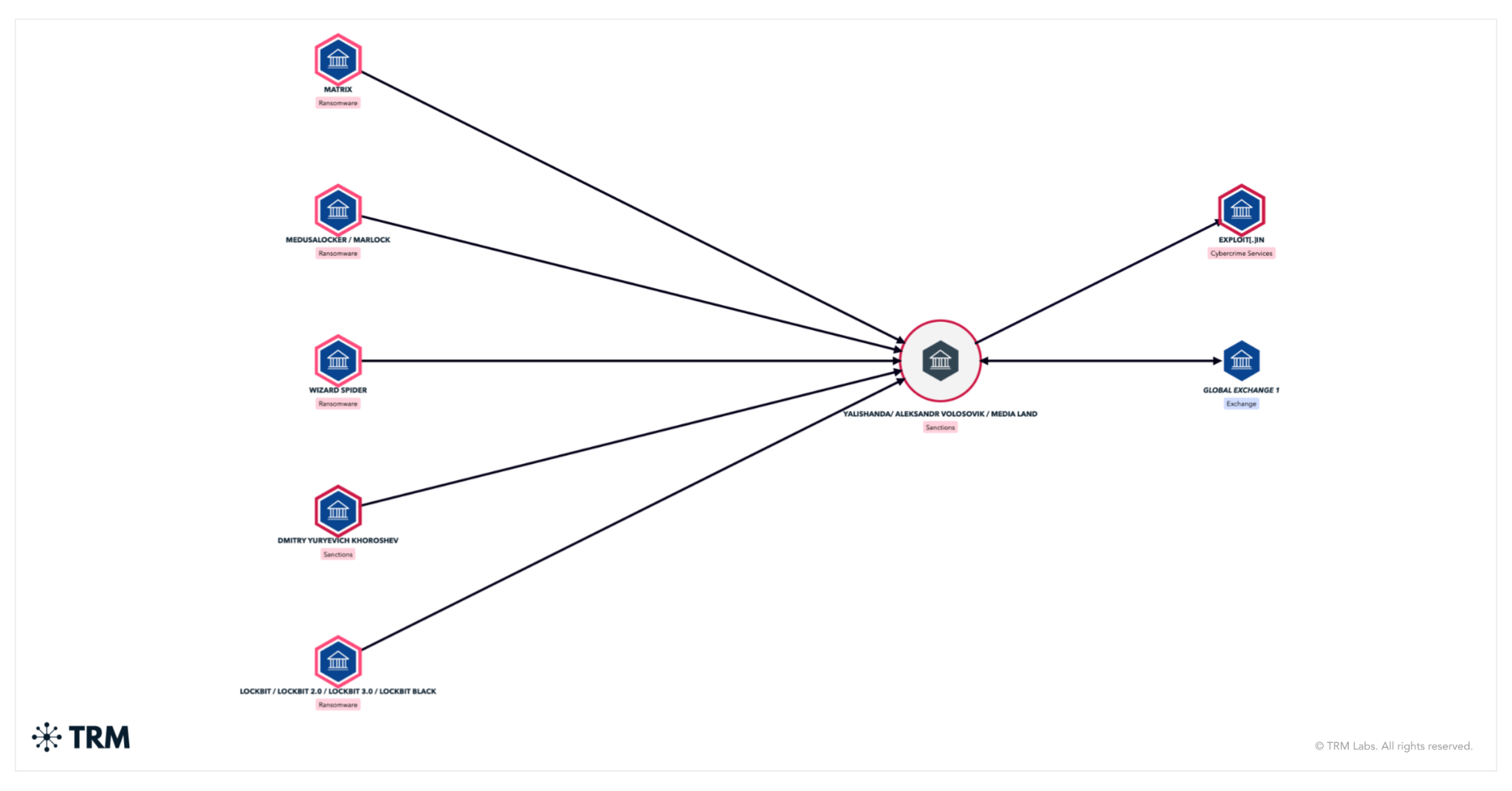
Connection between Volosovik’s address and ransomware groups. Visualization: TRM Labs
Fighting cybercrime
The stories of Media Land and Yalishanda show that companies providing hidden infrastructure are key accomplices of hackers: they create the “skeleton” for ransomware attacks, malware distribution, and mass data theft. By targeting sanctions at these technical intermediaries, authorities in various countries are trying to move from reaction to prevention — making the work of cybercriminals more expensive, more difficult, and more dangerous.

Useful material?
 Telegram
  Twitter
 Research
One and the same cryptocurrency address received two completely opposite assessments from different analytics systems: from an ordinary gambling service to an extremely severe criminal offense. This story has become the starting point for a broader conversation about what the scientific standards of blockchain analysis should look like — and why errors in systems like these can shape the fates of real people.
Jul 1, 2026
Research
The blockchain has helped uncover the ties between cryptocurrency fundraising campaigns, exchangers in Syria, and intermediaries in several countries around the world. A telltale pattern has emerged in which the same addresses were used across multiple donation drives at once
Jun 24, 2026
Research
Four Iranian cryptocurrency exchanges accounted for roughly 78% of all digital asset volume tied to the country in 2025. They have now become the focal point of the largest U.S. sanctions campaign against Iran's cryptocurrency infrastructure.
Jun 5, 2026
Research
A financial system is already up and running on public blockchains, with loans, analogues of U.S. Treasuries, and automated capital markets. More than $551 billion has flowed through DeFi protocols — but most of that activity has nothing to do with the real economy and everything to do with the speculative build-up of risk.
May 29, 2026
Research
Around 97% of Chinese suppliers of chemicals used to make fentanyl accept payment in cryptocurrency. The volume of such transactions continues to grow alongside the global market for synthetic drugs
May 22, 2026
Research
For the first time, the new law makes blockchain analytics an officially mandatory tool of financial oversight in the United States. Authorities will also gain the power to restrict transactions with foreign crypto services tied to money-laundering risks.
May 20, 2026
Cryptocurrency rates
-

Bitcoin
$80 800
BTC
-1.24%
-

Ethereum
$2 377.76
ETH
-1.27%
-

BNB Smart Chain
$738.87
BSC
-0.02%
-

Ripple
$1.42
XRP
+1.04%
-

TRON
$0.329564
TRX
+0.14%
-

Zcash
$1 168.02
ZEC
-4.62%
-

Dogecoin
$0.078631
DOGE
-1.17%
-

Cardano
$0.218269
ADA
+2.11%
-

Stellar XLM
$0.184461
XLM
+2.83%
-

Bitcoin Cash
$276.99
BCH
-2.38%