

Ethereum-based Blast project team launches a testnet and announces an airdrop
Since its launch, users have invested over $1,3 billion in the project
17.01.2024 - 10:05
898
3 min
0
What’s new? Blast, a project from the creators of the Blur NFT marketplace, has officially launched testnet. Since launching on November 21, Blast has attracted over 100 000 users and its total value locked (TVL) has crossed the $1,3 billion mark. The team also plans to hold an airdrop in the future, with 50% of the coins allocated to it going to the winners of the Big Bang contest. Developers of decentralized applications (DApps) will be able to participate in it.
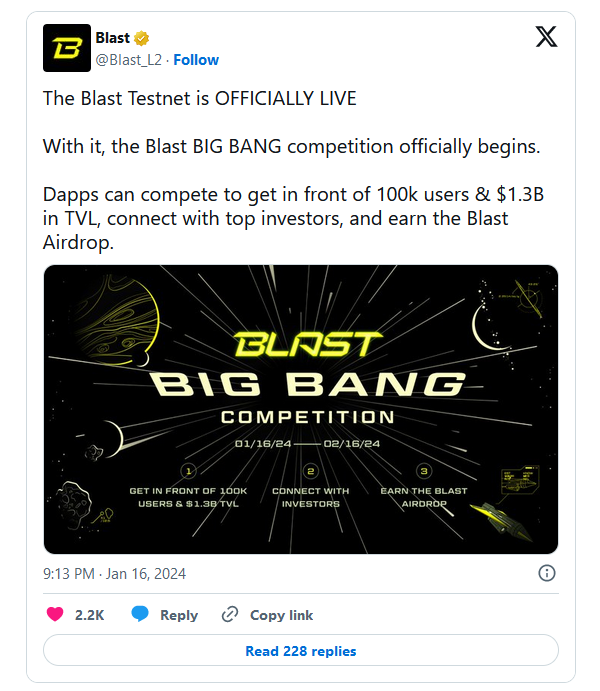
What else is known? To participate in the contest, development teams have until February 16 to join the Blast Builders platform and submit their projects. Following a panel of judges (Blast creators and investors) on February 20, winners will be selected in eight categories based on their concept, execution, and distinctive features within the Blast network. Early and late-stage projects will be evaluated separately.
Developers of decentralized exchanges (DEXs) for spot and open-ended futures trading, lending protocols, NFT collections and blockchain games, social and gambling platforms, as well as infrastructure solutions will be able to compete for the win. The winner in the “mixed” category will be the team that comes up with a unique solution for making money within the network or for distributing fee revenue.
After the testnet launch, the Pyth price oracle network and the QuickNode blockchain development platform have already connected to Blast.
L2-network Blast, based on the Ethereum blockchain and Optimistic Rollup scaling technology, is positioned as the first such project with native yield in ETH and stablecoins. Thus, funds blocked in the protocol are automatically sent to staking or treasury bond tokenization protocols. The launch of the mainnet is expected on February 24 next year, at which time the withdrawal of funds will also be opened.
The project raised over $500 million in just five days, a record among L1 and L2 blockchains. Arbitrum and Solana networks once needed 13 and 25 days to reach this mark, respectively. A month later, users invested $1 billion in Blast.
Polygon Labs and SlowMist analysts stated that the project is not an L2 solution and is simply a smart contract for accepting deposits and investing them in revenue-generating protocols, which is managed by five anonymous addresses. In response, the Blast team assured that they will take measures to increase protection against the exploit.

Useful material?
 Telegram
  Twitter
 Incidents
Developers warned of potential risks to bridges across the ecosystem and asked exchanges for assistance.
Jun 22, 2026
Incidents
The defendant helped move funds stolen through investment scams and earned at least $4 million for his role in the operation.
Jun 10, 2026
Incidents
The company is linking the incident to a compromised private key on a service wallet, rather than a smart contract exploit
May 22, 2026
Incidents
Following the incident, the project temporarily halted trading operations and node activity.
May 15, 2026
Incidents
The user spent weeks unsuccessfully trying to guess the password until Claude helped find an old wallet backup file
May 14, 2026
Crypto regulations
Authorities are introducing mandatory registration for companies handling cross-border crypto transactions
May 8, 2026
Cryptocurrency rates
-

Bitcoin
$82 956
BTC
-1.24%
-

Ethereum
$2 574.04
ETH
-1.65%
-

BNB Smart Chain
$771.64
BSC
+0.81%
-

Ripple
$1.42
XRP
+1.04%
-

TRON
$0.335877
TRX
+0.7%
-

Zcash
$1 317.15
ZEC
+0.03%
-

Dogecoin
$0.088893
DOGE
-1.72%
-

Cardano
$0.218269
ADA
+2.11%
-

Stellar XLM
$0.184461
XLM
+2.83%
-

Bitcoin Cash
$298.94
BCH
-2.07%