

Fees on Ethereum-based L2 networks dropped by 99% after the Dencun hard fork
The Optimism blockchain demonstrates the best result

14.03.2024 - 08:30
783
2 min
0
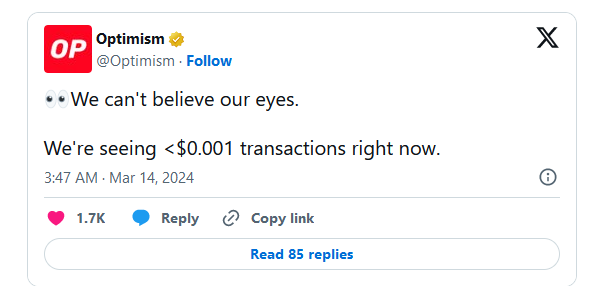
What’s new? After the Dencun hard fork in the Ethereum main blockchain, with which the EIP-4844 enhancement was introduced, transaction fees dropped significantly in Layer 2 (L2) networks based on it. For example, the average fee on the Optimism network dropped by 99% to less than $0,001, which was the best result among Ethereum-based L2 networks, according to the L2 Fees portal.
What else is known? According to data from analytics platform Dune, between 00:00 and 01:00 UTC, Optimism had an average transaction fee of $0,05 and a median of $0,0038; Base had an average of $0,064 and a median of $0,0008; Arbitrum had $0,5 and $0,3553; and zkSync Era had $0,161 and $0,0936, respectively.
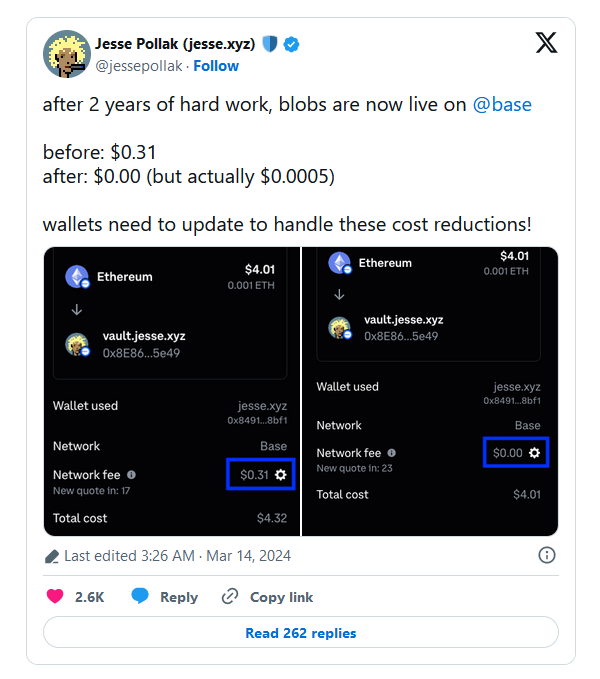
According to Base developer Jesse Pollak, fees on the network dropped from $0,31 to $0,0005 thanks to the upgrade.
The Dencun upgrade enabled the introduction of proto-danksharding into the mainnet, which scales the blockchain and reduces the cost of gas by introducing a new mechanism for storing compressed large arrays of binary data (blobs).
Ethereum co-founder Vitalik Buterin explained that blobspace transactions are similar to regular transactions, except that they carry an additional piece of data called a blob object. “Blobs are extremely large (~125 kB), and can be much cheaper than similar amounts of calldata,” he added.
By the time of writing, 3788 blobs have been used. It is expected that L2 networks using them will face increasing fees in the future. As more Ethereum scaling solutions adopt blobs, competition for storage space increases, which may lead to a slight increase in transaction costs.

Useful material?
 Telegram
  Twitter
 Incidents
In 104 minutes, the attacker emptied 1,404 addresses before validators halted the network and froze almost all of the loot.
Oct 19, 2026
Incidents
Developers warned of potential risks to bridges across the ecosystem and asked exchanges for assistance.
Jun 22, 2026
Incidents
The defendant helped move funds stolen through investment scams and earned at least $4 million for his role in the operation.
Jun 10, 2026
Incidents
The company is linking the incident to a compromised private key on a service wallet, rather than a smart contract exploit
May 22, 2026
Incidents
Following the incident, the project temporarily halted trading operations and node activity.
May 15, 2026
Incidents
The user spent weeks unsuccessfully trying to guess the password until Claude helped find an old wallet backup file
May 14, 2026
Cryptocurrency rates
-

Bitcoin
$79 767
BTC
-0.3%
-

Ethereum
$2 312.18
ETH
-0.27%
-

BNB Smart Chain
$737.23
BSC
-0.55%
-

Ripple
$1.42
XRP
+1.04%
-

TRON
$0.328319
TRX
-0.52%
-

Zcash
$1 222.7
ZEC
+1.78%
-

Dogecoin
$0.077505
DOGE
+0.64%
-

Cardano
$0.218269
ADA
+2.11%
-

Stellar XLM
$0.184461
XLM
+2.83%
-

Bitcoin Cash
$279.6
BCH
-0.5%