

Brazil’s regulator has admitted the second SOL ETF to trading
The product was created by the investment company Hashdex jointly with the bank BTG Pactual

21.08.2024 - 12:41
698
3 min
0
What’s new? Brazil’s Securities and Exchange Commission (CVM) has admitted the second exchange-traded fund (ETF) based on the native token of the Solana (SOL) blockchain to trading. The new product, which is in the pre-launch phase, will be offered by local company Hashdex with $962 million in assets under management in conjunction with investment bank BTG Pactual.
What else is known? Hashdex has previously launched a fund based on the US Nasdaq stock exchange’s crypto index, as well as ETFs based on bitcoin and Ethereum. The new product, like the previous ones, will be available on B3, Latin America’s largest stock exchange.
The first SOL ETF was approved by Brazil’s regulator in early August, is managed by investment firm QR Asset in conjunction with fintech company Vortx, and is backed by the CME CF Solana Dollar Reference Rate index created by CF Benchmarks and backed by the Chicago Mercantile Exchange (CME).

Brazil’s tax authority will ask foreign crypto exchanges for information about clients and operations
The country’s tax on crypto income has been set at 15% since the beginning of the year
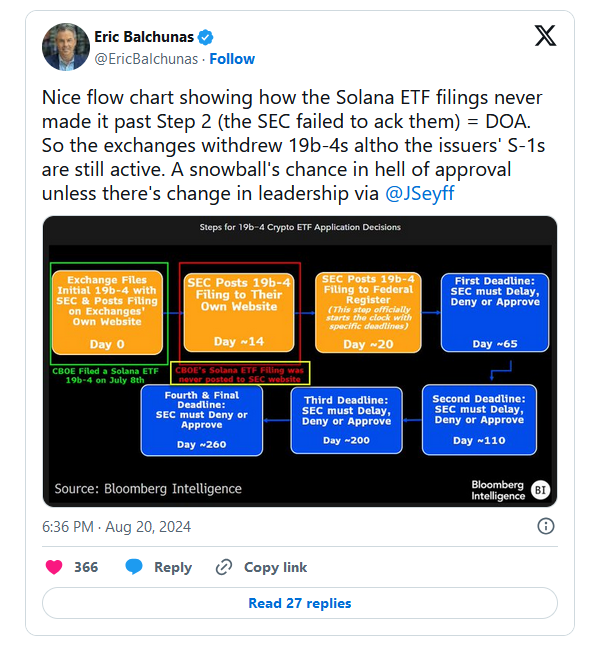
As for the United States, on August 20, securities regulator SEC rejected applications to launch spot SOL ETFs from VanEck and 21Shares. Officials expressed concerns that the asset may fall under the definition of a security, and therefore commodity funds cannot be launched based on it.
Bloomberg analyst Eric Balchunas said on this occasion that now the chance of launching such products in the US in 2024 is close to zero. There is an equally slim chance of them being allowed into the market in 2025, assuming Kamala Harris wins the presidential election.

Useful material?
 Telegram
  Twitter
 Incidents
In 104 minutes, the attacker emptied 1,404 addresses before validators halted the network and froze almost all of the loot.
Oct 19, 2026
Incidents
Developers warned of potential risks to bridges across the ecosystem and asked exchanges for assistance.
Jun 22, 2026
Incidents
The defendant helped move funds stolen through investment scams and earned at least $4 million for his role in the operation.
Jun 10, 2026
Incidents
The company is linking the incident to a compromised private key on a service wallet, rather than a smart contract exploit
May 22, 2026
Incidents
Following the incident, the project temporarily halted trading operations and node activity.
May 15, 2026
Incidents
The user spent weeks unsuccessfully trying to guess the password until Claude helped find an old wallet backup file
May 14, 2026
Cryptocurrency rates
-

Bitcoin
$81 308
BTC
-3.51%
-

Ethereum
$2 380.97
ETH
-4.33%
-

BNB Smart Chain
$730.16
BSC
-2.4%
-

Ripple
$1.42
XRP
+1.04%
-

TRON
$0.3278
TRX
-1.28%
-

Zcash
$1 215.74
ZEC
-9.48%
-

Dogecoin
$0.078433
DOGE
-5.37%
-

Cardano
$0.218269
ADA
+2.11%
-

Stellar XLM
$0.184461
XLM
+2.83%
-

Bitcoin Cash
$273.64
BCH
-4.4%