

El Salvador’s national bitcoin office has launched blockchain courses for officials
The courses are part of the program of the Higher School of Innovation in Public Administration
22.08.2024 - 15:45
11756
3 min
0
Last updated on Nov 19, 2024
What’s new? El Salvador’s National Bitcoin Office (ONBTC), established at the end of 2022 to develop crypto projects, has launched blockchain courses for 80 000 civil servants. The courses are part of the Higher School of Innovation in Public Administration (ESIAP) program established by President Nayib Bukele in 2021 to raise the standards of public administration. ONBTC described the cryptocurrency training as essential for public sector employees.
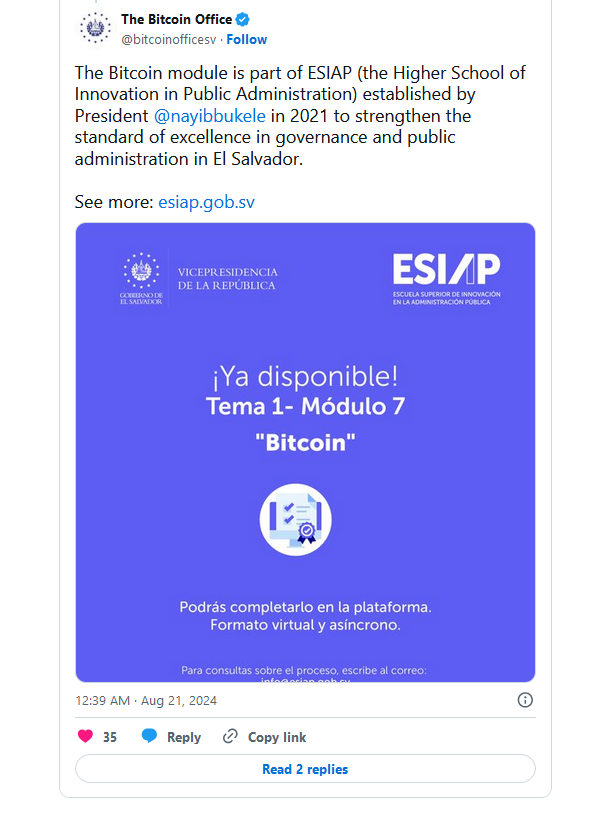
What else is known? The program includes nine training modules covering bitcoin itself, as well as blockchain technology, cybersecurity, and artificial intelligence. At the end of the courses, participants will receive certificates of completion in these areas.
ONBTC head Stacy Herbert noted that this program is just the beginning. She said the project is not time-consuming, but will ensure the long-term success of El Salvador’s blockchain policy.
The new courses are part of El Salvador’s broader effort to promote bitcoin education throughout the country. Since the country became the first in the world to recognize bitcoin as legal tender in 2021, crypto education initiatives such as Cuboplus, My First Bitcoin, and Node Nation have been implemented and are now part of the public school curriculum.
Earlier, El Salvador, jointly with Tether, the issuer of USDT, the largest cryptocurrency in the crypto market with a capitalization of $117,6 billion, launched a program to grant citizenship for crypto-investments of $1 million. Up to a thousand applicants will be able to participate annually.
Tether’s parent company is also participating in the development of cryptocurrency laws with officials in El Salvador.
El Salvador authorities have mined 473,5 BTC in geothermal energy since 2021
In total, the government’s accounts hold coins worth $360 million at the current exchange rate
The new initiative confirms that El Salvador continues to pursue a bitcoin strategy that initially drew criticism from international observers.
Notably, the International Monetary Fund (IMF) recently admitted that the predicted negative consequences of bitcoin legalization in El Salvador did not materialize. Although earlier, representatives of the fund refused for this reason to provide the state with a loan and urged government officials to stop investing in the asset. In turn, the Vice President of El Salvador last year called the legalization of BTC the main reason for the growth of the economy.
El Salvador’s bitcoin investment return was 35% as officials continued to buy the asset during market downturns. According to Nayibtracker, the government currently owns 5848 BTC, with unrealized gains exceeding $47 million.

Useful material?
 Telegram
  Twitter
 Incidents
In 104 minutes, the attacker emptied 1,404 addresses before validators halted the network and froze almost all of the loot.
Oct 19, 2026
Incidents
Developers warned of potential risks to bridges across the ecosystem and asked exchanges for assistance.
Jun 22, 2026
Incidents
The defendant helped move funds stolen through investment scams and earned at least $4 million for his role in the operation.
Jun 10, 2026
Incidents
The company is linking the incident to a compromised private key on a service wallet, rather than a smart contract exploit
May 22, 2026
Incidents
Following the incident, the project temporarily halted trading operations and node activity.
May 15, 2026
Incidents
The user spent weeks unsuccessfully trying to guess the password until Claude helped find an old wallet backup file
May 14, 2026
Cryptocurrency rates
-

Bitcoin
$81 099
BTC
-0.28%
-

Ethereum
$2 384.94
ETH
-0.09%
-

BNB Smart Chain
$738.9
BSC
+1.16%
-

Ripple
$1.42
XRP
+1.04%
-

TRON
$0.329648
TRX
+0.45%
-

Zcash
$1 182.83
ZEC
-2.94%
-

Dogecoin
$0.078585
DOGE
-0.17%
-

Cardano
$0.218269
ADA
+2.11%
-

Stellar XLM
$0.184461
XLM
+2.83%
-

Bitcoin Cash
$282.2
BCH
+2.69%