

Aave Labs enters the European stablecoin market with a MiCA license
The company also plans to compete with exchanges and fintech platforms by offering zero fees.

14.11.2025 - 12:30
290
3 min
0
Key poiyns:
- Aave Labs has received MiCA authorization from the Central Bank of Ireland.
- The Push service can offer regulated conversion of euros into cryptocurrencies, including the GHO stablecoin.
- The license gives the project access to the entire EEA and makes it one of the first major DeFi companies to operate in compliance with MiCA.
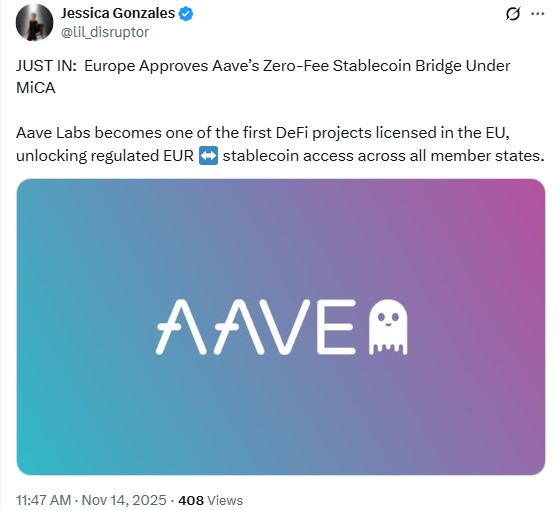
Aave Labs has become one of the first major companies in the decentralized finance space to obtain authorization under the European MiCA regulation. This has paved the way for the project to offer fully regulated stablecoin trading across the European Economic Area (EEA).
Thanks to this approval, Push, Aave Labs’ platform for converting fiat currencies into cryptocurrency, can now offer services for exchanging euros for digital assets, including its own overcollateralized stablecoin, GHO. The license was issued by the Central Bank of Ireland to Aave’s subsidiary, Push Virtual Assets Ireland Limited, which is responsible for the project’s European operations.
The license for Aave Labs came just a few months after Kraken exchange received similar MiCA approval on June 25.
The license coincided with the active growth of the global stablecoin market. In 2025, the total supply of such assets exceeded $300 billion. Stable demand for crypto assets pegged to fiat currencies is driving interest in regulated conversion channels among both institutional players and private users.
Advantages of the license
After receiving MiCA approval, the Push service will be able to provide controlled and secure euro inflows and outflows for GHO and other stablecoins integrated into the Aave product ecosystem. Aave Labs also stated that the launch of the service will be accompanied by zero conversion fees, making the offer competitive compared to fintech companies and centralized exchanges, which often charge significant fees or spreads.
However, company representatives did not specify whether the zero-fee model would be permanent or whether it would be used as a temporary incentive mechanism.
In October, Swiss startup Relai received a MiCA license from the French regulator AMF, becoming one of the first specialized bitcoin companies with such a license in Europe.

Useful material?
 Telegram
  Twitter
 Incidents
In 104 minutes, the attacker emptied 1,404 addresses before validators halted the network and froze almost all of the loot.
Oct 19, 2026
Incidents
Developers warned of potential risks to bridges across the ecosystem and asked exchanges for assistance.
Jun 22, 2026
Incidents
The defendant helped move funds stolen through investment scams and earned at least $4 million for his role in the operation.
Jun 10, 2026
Incidents
The company is linking the incident to a compromised private key on a service wallet, rather than a smart contract exploit
May 22, 2026
Incidents
Following the incident, the project temporarily halted trading operations and node activity.
May 15, 2026
Incidents
The user spent weeks unsuccessfully trying to guess the password until Claude helped find an old wallet backup file
May 14, 2026
Cryptocurrency rates
-

Bitcoin
$81 385
BTC
-1.68%
-

Ethereum
$2 379.56
ETH
-2.22%
-

BNB Smart Chain
$726.83
BSC
+0.13%
-

Ripple
$1.42
XRP
+1.04%
-

TRON
$0.331882
TRX
+0.29%
-

Zcash
$1 126.24
ZEC
-3.4%
-

Dogecoin
$0.078807
DOGE
-1.15%
-

Cardano
$0.218269
ADA
+2.11%
-

Stellar XLM
$0.184461
XLM
+2.83%
-

Bitcoin Cash
$273.57
BCH
-1.69%