

Hacker drains $1.34 million from legacy Raydium liquidity pools
The project team said all affected users will be fully reimbursed from the protocol’s treasury.

11.06.2026 - 10:20
468
2 min
0
Key points:
- Decentralized exchange Raydium lost approximately $1.34 million after an attacker exploited a vulnerability in its legacy AMM V3 protocol, which was retired in 2021.
- The attacker drained roughly 150,000 RAY, 5,600 SOL, and 900,000 USDC from several inactive liquidity pools that were not connected to the platform’s current infrastructure.
Solana-based decentralized exchange Raydium has disclosed an exploit involving its deprecated AMM V3 automated market maker. The attacker drained approximately $1.34 million in assets from several inactive liquidity pools.
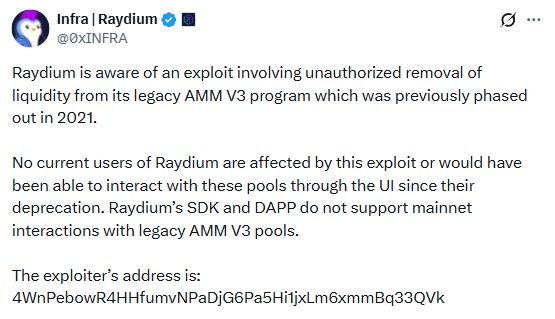
According to preliminary estimates, the affected pools included RAY-SOL, USDC-RAY, and SRM-RAY. The attacker withdrew approximately 150,000 RAY, 5,600 SOL, and nearly 900,000 USDC.
The project team said all user losses will be fully covered by the protocol treasury.
Current Raydium Infrastructure Was Not Affected
Raydium emphasized that the vulnerability was limited to the AMM V3 program, which was decommissioned in 2021. Since then, it has not been accessible through Raydium’s official interface and has not been supported by the platform’s core services.
According to the development team, the issue stemmed from insufficient validation of LP tokens. This allowed the attacker to bypass intended safeguards and gain access to funds held in the legacy liquidity pools.
Raydium stated that its active programs on the Solana mainnet were not affected by the incident. The protocol’s current infrastructure is also undergoing an additional security review.
Despite the exploit, market reaction was muted. Raydium’s native token RAY remained largely unaffected and actually gained more than 2% over the past 24 hours.

Useful material?
 Telegram
  Twitter
 Incidents
Developers warned of potential risks to bridges across the ecosystem and asked exchanges for assistance.
Jun 22, 2026
Incidents
The defendant helped move funds stolen through investment scams and earned at least $4 million for his role in the operation.
Jun 10, 2026
Incidents
The company is linking the incident to a compromised private key on a service wallet, rather than a smart contract exploit
May 22, 2026
Incidents
Following the incident, the project temporarily halted trading operations and node activity.
May 15, 2026
Incidents
The user spent weeks unsuccessfully trying to guess the password until Claude helped find an old wallet backup file
May 14, 2026
Crypto regulations
Authorities are introducing mandatory registration for companies handling cross-border crypto transactions
May 8, 2026
Cryptocurrency rates
-

Bitcoin
$83 504
BTC
-0.11%
-

Ethereum
$2 506
ETH
-0.58%
-

BNB Smart Chain
$743.07
BSC
-0.35%
-

Ripple
$1.42
XRP
+1.04%
-

TRON
$0.330785
TRX
+0.27%
-

Zcash
$1 251.38
ZEC
+2.89%
-

Dogecoin
$0.084705
DOGE
-0.12%
-

Cardano
$0.218269
ADA
+2.11%
-

Stellar XLM
$0.184461
XLM
+2.83%
-

Bitcoin Cash
$278.41
BCH
+2.09%