

What is Zcash? A complete guide to private cryptocurrency
We discuss the technology, economic model, mining, and the impact of upgrades.

15.01.2026
850
10 min
0
Zcash is a privacy-focused cryptocurrency that allows you to choose between transparent and fully private transactions. While most blockchains publicly disclose all transaction information, Zcash uses specialized cryptographic techniques to hide the sender, recipient, and amount of the transaction. This makes Zcash one of the most private and technically advanced projects in the industry.
Zcash offers a solution that combines blockchain transparency with a high degree of anonymity, making it an important tool for those who value digital rights and financial independence.
| Name | Zcash |
| Launch year | 2016 |
| Native token ticker | ZEC |
| Explorer | https://zcashblockexplorer.com |
| White Paper | https://github.com/zcash/zips/blob/main/protocol/p... |
| Developer website | z.cash |
| Official social media | |
| Where it is traded | Most CEXs and DEXs |
Content:
- The history of Zcash
- Zcash technology
- Upgrades and their impact on protocol functionality
- Features of Zcash
- Zcash economic model
- Protocol security
- Regulatory issues and developments
- Zcash’s prospects
The history of Zcash
Zcash was launched in October 2016 by a group of cryptographers and mathematicians led by Zooko Wilcox. It was developed by Electric Coin Company (ECC), formerly known as Zcash Company. The team was distinguished by its deep expertise in cryptography, distributed systems, and computer security.
Zcash was based on the academic protocol Zerocash, developed by researchers from MIT, the Israel Institute of Technology, and Johns Hopkins University. Zerocash was the first to propose the concept of completely hidden transactions on the blockchain based on zk-SNARKs technology. Zcash became the first large-scale implementation of this technology in a real network protocol.
Bitcoin’s influence on the architecture of Zcash
The Zcash architecture is based on the Bitcoin codebase, which allowed it to retain the core properties of the original cryptocurrency: decentralization, fixed coin supply, and the Proof-of-Work consensus mechanism. However, Zcash has significantly expanded its functionality by adding privacy and a more flexible transaction model.
| Features | Zcash | Bitcoin |
| Privacy | Optional privacy | Limited privacy |
| Fungibility | High fungibility | Lower fungibility |
| Technological mechanism | zk-SNARKs | Proof-of-Work |
| Block time | Faster transactions | Slower transactions |
The main goals of the creators
The creators of the project had two key goals:
- To make privacy accessible and secure by default, based on rigorous mathematical proofs.
- To maintain compatibility with the existing crypto ecosystem, including the ability to integrate with services and exchanges.
Zcash technology
There are two types of transactions in Zcash:
- t-transactions (transparent) — similar to regular Bitcoin transactions, the data is open.
- z-transactions (shielded) — hide all participants and the transfer amount.
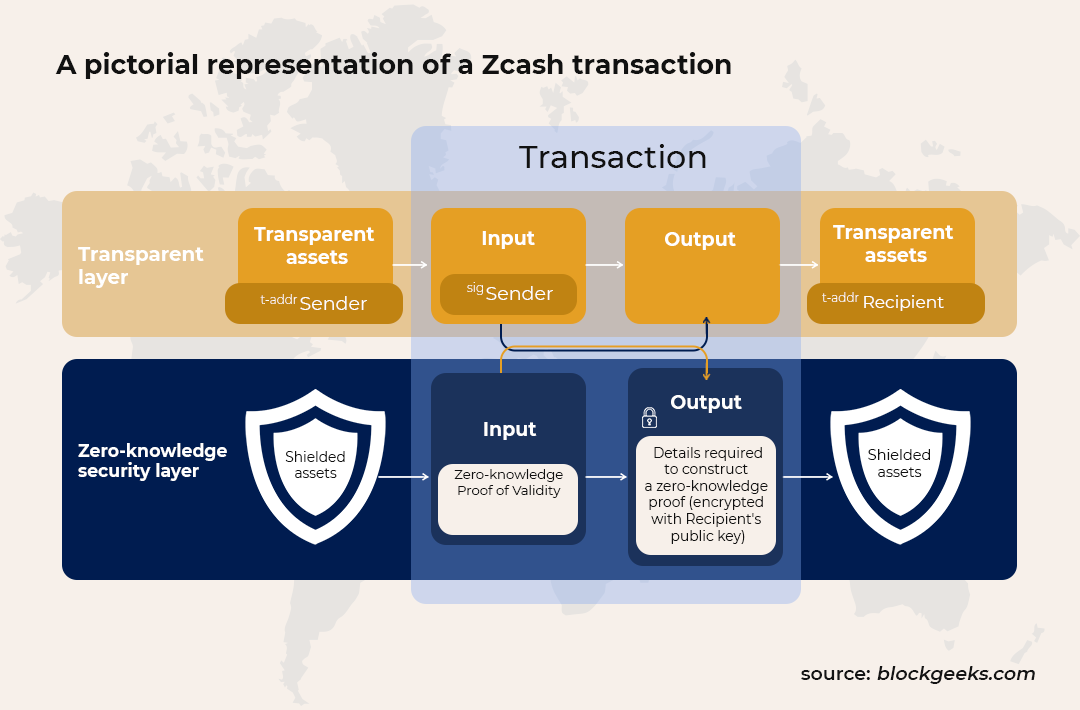
Unlike Bitcoin, where all transactions are transparent, Zcash provides a choice: users decide for themselves how private their transactions will be. Despite this, the network still maintains authentication mechanisms without disclosing personal data.
What are zk-SNARKs in simple terms?
zk-SNARKs is a “zero-knowledge” technology that allows you to prove the authenticity of information without revealing the information itself. In essence, the sender of a transaction can prove that they have the necessary amount and rights without showing their balance and address.
Thanks to zk-SNARKs, the network confirms the transaction without revealing key data, making Zcash one of the most private cryptocurrencies in the world, while protecting against fraud and double-spending.
Upgrades and their impact on protocol functionality
Since its launch, Zcash has undergone a series of network upgrades to improve privacy, performance, and governance. Each upgrade brought Zcash closer to its goal of creating fully encrypted, scalable digital money.
| Upgrade | Feature |
| Overwinter (June 2018) | The first upgrade laid the foundation for future forks. It introduced transaction versioning, replay protection, and general performance improvements. |
| Sapling (October 2018) | Sapling took a significant step forward by replacing the original Zcash zk-SNARK framework with a new one that reduced memory and computational requirements for confidential transactions by more than 90%. |
| Blossom (December 2019) | Blossom cut block formation time in half from 150 to 75 seconds, improving confirmation speed and user experience. |
| Heartwood (July 2020) | Heartwood focused on decentralization and miner privacy. Its flagship feature, Shielded Coinbase, allowed miners to receive rewards directly to shielded addresses. |
| Canopy (November 2020) | Coinciding with Zcash’s first halving, Canopy abolished the original Founder’s Reward program and introduced a new, community-managed Development Fund. |
| NU5 (May 2022) | The upgrade implemented the Halo 2 proof system, permanently eliminating the need for trusted setups and providing recursive proofs for virtually infinite scalability. |
| NU6 (November 2024) | Activated at block 2 726 400 alongside the second halving, NU6 expanded the development fund and introduced an on-chain “secure” treasury. |
| NU6.1(planned) | Scheduled after the second halving, NU6.1 will activate the Community & Coin Holders (C&C) model, which will allow token holders to manage 12% of the shielded treasury — an experiment in governance based on the actions of coin holders. |
| NU7 (planned) | NU7 offers Zcash Shielded Assets (ZSA), which allow the issuance and transfer of private tokens, as well as new transaction formats that optimize proof generation and sustainability mechanisms, such as fee burning and emission smoothing. |
Features of Zcash
Zcash completely hides transaction metadata, making blockchain analysis extremely difficult. Users can select a privacy mode depending on the specific task. It is also worth mentioning the advantages of Zcash:
- One of the most reliable protocols for maintaining anonymity and protecting privacy.
- Full fungibility makes it efficient and flexible.
- Support for democratic mining.
Mining and algorithm
Mining is carried out using the Proof-of-Work model, similar to Bitcoin, but with a different hashing mechanism.
The economics of Zcash mining can be reduced to three main indicators: revenue, capital costs, and operating expenses. Currently, miners earn 0,03 ZEC per block using specialized ASIC computer equipment, which can consume a lot of electricity.
Fees and transaction speed
Zcash offers faster confirmations and lower fees compared to Bitcoin. In terms of transaction speed and cost, it is comparable to or faster than Ethereum before the transition to PoS.
Zcash economic model
Like Bitcoin, ZEC has a fixed supply limit of 21 million coins. According to CoinDesk, as of Q4 2025, there were approximately 16,3 million ZEC in circulation, and the annual inflation rate of new supply relative to total supply is 4%. After the halving in 2024, this figure fell to almost 2,7%, and so on, to virtually zero issuance by 2032–2036, when the limit of 21 million will be reached.
Starting in November 2024, 80% of the Zcash block reward will be distributed among miners, 8% will go to the Zcash Community Grants Committee (ZCG) to fund independent teams in the Zcash ecosystem, and 12% will go to the “preserved pool” — a pool of issued funds tracked by the protocol.
The first halving in November 2020 reduced the miners’ reward from 6,25 to 3,125 ZEC/block, and the second halving in November 2024 reduced it to 1,5625 ZEC/block.
Protocol security
Security is a key aspect of the Zcash ecosystem. Similar to Bitcoin, ZEC uses blockchain to protect transaction data: each transaction is recorded in an immutable digital ledger.
An important part of the Zcash architecture is zk-SNARKs technology. It allows the network to verify transactions without revealing information about the sender, recipient, or even the transfer amount. It is thanks to zk-SNARKs that the Zcash blockchain provides privacy that is impossible in Bitcoin, where all transaction data is completely open.
An additional level of security is provided by the Equihash mining algorithm. It was developed as a fairer and decentralized mechanism for distributing computing power, which reduces the risk of mining concentration in the hands of large farms and helps maintain network stability.
At the same time, despite the high level of technological protection, users need to follow basic security rules. Loss or disclosure of a private key inevitably leads to the loss of funds. Therefore, it is important to use reliable wallets and adhere to proven methods of protecting crypto assets.
Audits and research
Zcash undergoes regular independent security audits. Any vulnerabilities discovered are fixed, including trust setup errors and problematic elements of zk-SNARKs.
Many countries are wary of privacy coins. However, Zcash strives to be compliant with regulatory requirements by offering transparent transactions at the user’s discretion.
Regulatory issues and developments
Financial instruments that provide privacy inevitably attract the attention of regulators, and Zcash is no exception.
By early 2025, at least 97 countries had introduced or updated regulations concerning privacy coins. Many of these rules do not prohibit the storage of such coins directly, but impose restrictions on exchanges and custodial services that work with them.
For example, the US has not banned privacy coins, but regulators have expressed concern. The proposed FinCEN rule (still awaiting final approval) will require exchanges and institutions to record and report any transactions over $500 using a non-hosted wallet if the transaction is confidential/encrypted.
Nevertheless, US exchanges such as Gemini and Coinbase continue to list Zcash, likely relying on Chainalysis and Elliptic’s ability to track transparent ZEC flows and the relatively low historical use of shielded transactions.
Another aspect is financial privacy. ECC and other organizations emphasize that this is not about concealing crimes, but about protecting consumers, businesses, and even national security (for example, shielded transactions can prevent fraud or economic espionage).
Zcash’s prospects
Almost ten years after its launch, the project has proven that improved zero-knowledge proofs work not only in theory but also in a real decentralized network.
ZEC use cases are no longer hypothetical. From individuals hiding everyday payments to companies protecting confidential counterparties, Zcash has demonstrated that digital money privacy is not about hiding in the shadows, but about preserving a basic right in an era of total surveillance.
The coming years will determine whether the protocol’s key features will be seen by authorities as proof that compliance and privacy can coexist, or whether ZEC will be relegated to networks where transactions are opaque by default. Its availability on major exchanges and, as a result, its relevance to the general public depend on this decision.

Useful material?
 Telegram
  Twitter
 Basics
Why Satoshi Nakamoto’s technical manifesto for a decentralized money system matters
Oct 31, 2022
Basics
Experts evaluated the development prospects of the new ecosystem and the investment attractiveness of its token
Oct 20, 2022
Basics
How to track fluctuations correctly and create an effective income strategy
Sep 13, 2022
Basics
Review of the most profitable offers from proven trading platforms
Aug 29, 2022
Basics
The Ethereum Foundation team has published a breakdown of major misconceptions about the upcoming network upgrade
Aug 18, 2022
Basics
What benefits the exchange offers, and what else is in the near future
Aug 4, 2022
Cryptocurrency rates
-

Bitcoin
$83 144
BTC
+0.54%
-

Ethereum
$2 504.69
ETH
-0.45%
-

BNB Smart Chain
$740.75
BSC
-0.64%
-

Ripple
$1.42
XRP
+1.04%
-

TRON
$0.328571
TRX
-0.4%
-

Zcash
$1 219.54
ZEC
-1.8%
-

Dogecoin
$0.084448
DOGE
-0.65%
-

Cardano
$0.218269
ADA
+2.11%
-

Stellar XLM
$0.184461
XLM
+2.83%
-

Bitcoin Cash
$272.73
BCH
-0.36%