

Cryptocurrency ETFs: what they are and how they work (bitcoin, Ethereum, altcoins)
We explain how cryptocurrency ETFs provide access to bitcoin, Ethereum, and altcoins without wallets or direct ownership of coins
09.10.2025
1369
19 min
0
An ETF (exchange-traded fund) is a fund whose shares are traded on an exchange in the same way as ordinary shares. It combines assets (shares, bonds, commodities, or other instruments) into a single instrument: by purchasing shares in the fund, investors gain exposure to the entire portfolio.
The key advantages of ETFs are ease of trading, transparency of composition (the fund’s composition and NAV — net asset value — are usually published), and mechanisms for creating/redeeming shares through authorized participants, which help keep the fund’s price close to its NAV.
Content
- What is a crypto ETF?
- Comparing crypto ETFs with traditional funds
- Types of crypto ETFs: Bitcoin, Ethereum, and altcoins
- Bitcoin ETF
- Ethereum ETF
- Altcoin ETFs: the next stage in the evolution of the crypto market
- Solana ETF
- XRP ETF
- LTC ETF
- DOGE ETF
- Why are crypto ETFs needed?
- How to invest in cryptocurrency ETFs
- Regulators and cryptocurrency ETFs: the position of the SEC and CFTC
- Where cryptocurrency ETFs are traded: the US, Canada, Europe, Asia
- Risks of cryptocurrency ETFs and their features
- Conclusions and prospects for the crypto ETF market
What is a crypto ETF?
A cryptocurrency ETF is a fund that gives investors access to cryptocurrencies (bitcoin, Ethereum, and others) through fund shares traded on a regulated exchange. Instead of buying coins directly and storing them in a wallet, investors buy fund shares that track the price of cryptocurrencies.
Crypto ETFs solve the main problem of the market — the complexity and risks of storing tokens independently. They allow investors to participate in the growth of cryptocurrencies without facing technical difficulties and security issues.
Comparing crypto ETFs with traditional funds
Crypto ETFs work on the same principles as traditional exchange-traded funds. They can be purchased through a broker, they publish their asset composition, and they charge a management fee.
The main difference is in their content: traditional ETFs hold stocks or bonds, while crypto ETFs hold digital assets or derivatives thereof. Because of this, they face specific risks: storage security, volatility, and regulatory uncertainty.
They are significantly more volatile than stock or bond funds. Their price can fluctuate by tens of percent per day — just like the price of cryptocurrencies themselves.
Types of crypto ETFs: Bitcoin, Ethereum, and altcoins
Cryptocurrency ETFs are divided by the type of underlying asset — bitcoin, Ethereum, and altcoins. Each has its own specifics and level of maturity in the market.
Bitcoin ETFs were the first to open the way for institutional investment in cryptocurrencies. They were followed by Ethereum funds, and now the focus is shifting to altcoins — Solana, XRP, Litecoin, and even Dogecoin.
Bitcoin ETF
In 2024, bitcoin officially entered the financial system after the approval of the first spot bitcoin ETFs in the United States. Although bitcoin futures ETFs existed as early as 2021, the launch of spot ETFs was a turning point — investors gained access to real BTC rather than derivative contracts.
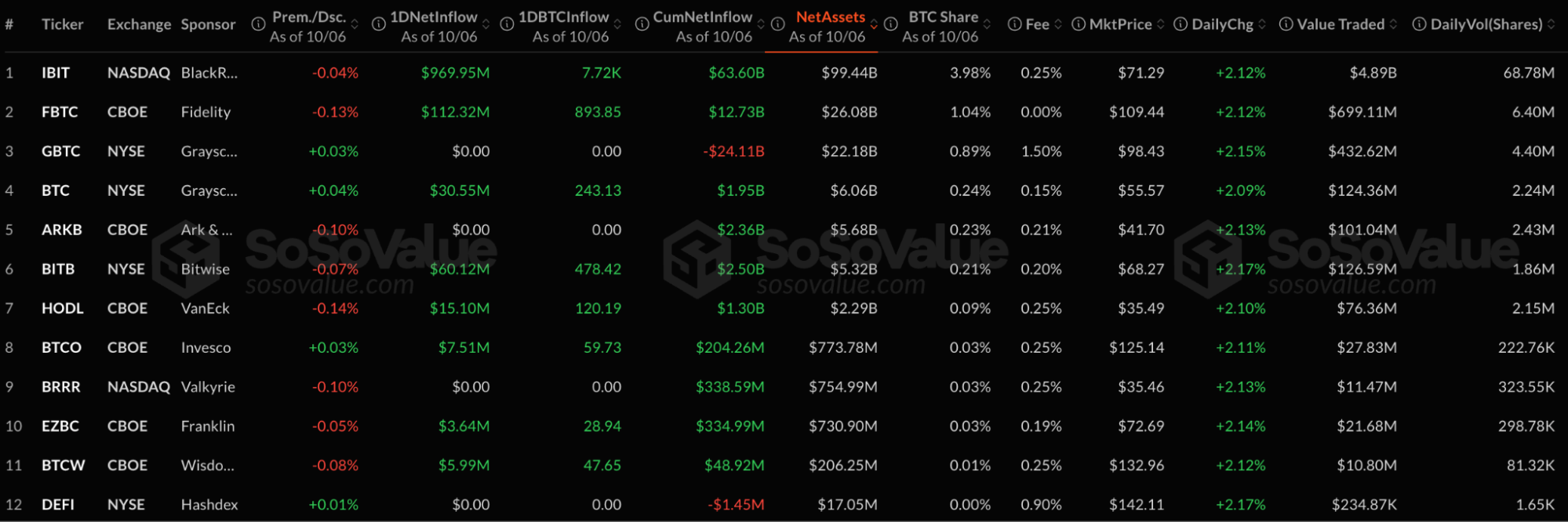
Top 5 bitcoin ETFs:
|
Company |
Ticker |
Issuer |
Number of BTC |
|
IBIT |
BlackRock |
~764 993 |
|
|
FBTC |
Fidelity Investments |
~204 382 |
|
|
GBTC |
Grayscale |
~176 921 |
|
|
BTC |
Grayscale |
~47 463 |
|
|
ARKB |
ARK Invest & 21Shares |
~43 968 |
Ethereum ETF
Following the success of bitcoin ETFs, the next step was Ethereum funds. Although bitcoin is often referred to as “digital gold,” Ethereum is the foundation of the DeFi ecosystem and smart contracts.
Spot ETH ETFs were approved in July 2024. Ahead of the launch, the price of Ethereum rose to nearly $4000, mirroring the dynamics of bitcoin after the release of its ETF.
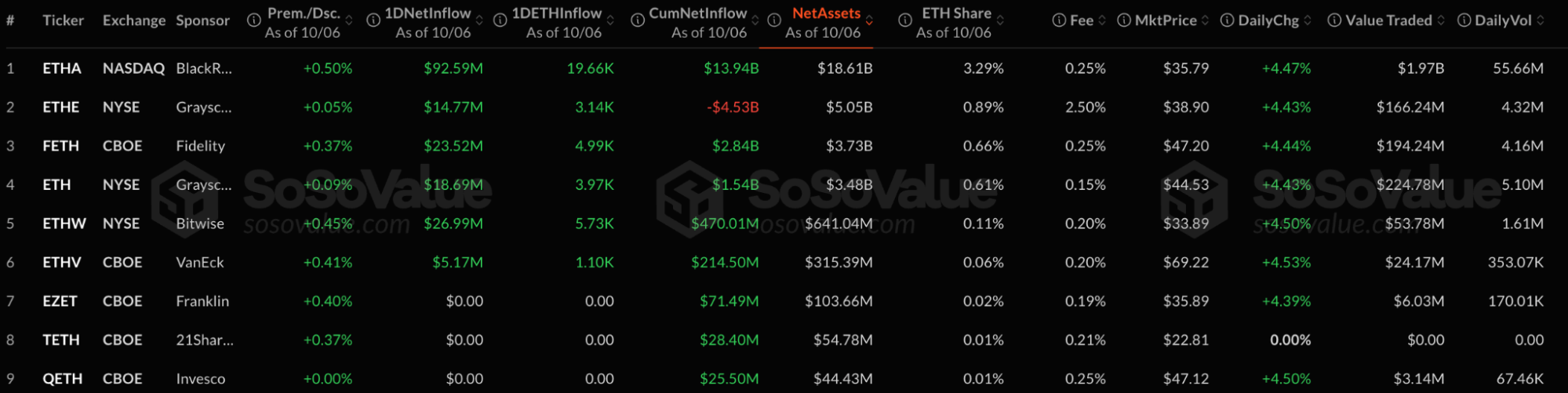
Top 5 ETH ETFs:
|
Company |
Ticker |
Issuer |
Number of ETH |
|
ETHA |
BlackRock |
~3,77 million |
|
|
ETHE |
Grayscale |
~1,22 million |
|
|
FETH |
Fidelity |
~512 567 |
|
|
ETHV |
VanEck |
~55 691 |
|
|
CETH |
21Shares US LLC |
~4600 |
Altcoin ETFs: the next stage in the evolution of the crypto market
Following the approval of spot ETFs for Bitcoin and Ethereum, management companies have shifted their attention to altcoins. Major issuers are applying to launch funds that will track the value of Litecoin, XRP, Solana, Dogecoin, Cardano, and other popular assets.
The growing interest is since the US Securities and Exchange Commission (SEC) is gradually softening its stance on cryptocurrencies and strengthening market oversight. Storage and reporting infrastructure has become more reliable, and experience with BTC and ETH has shown that ETFs can be transparent and secure.
On October 7, CoinShares launched an altcoin ETF in the United States, the first fund to provide access to altcoins through traditional brokerage accounts. The ETF includes DOT, SOL, SEI, AVAX, SUI, APT, NEAR, and TON assets.

What is Solana
Solana is the first Web-scale blockchain capable of supporting the future growth of decentralized applications, exchanges, and platforms
Solana ETF
Solana’s popularity has skyrocketed over the past year. Thanks to its high transaction speed and scalability, it is increasingly being called Ethereum’s main competitor in the field of smart contracts and DeFi.
Investor interest has prompted management companies to file applications for spot ETFs. Proposals from VanEck, 21Shares, Bitwise, and Franklin Templeton are currently under review.

SEC approves applications from Canary, VanEck, Bitwise, and 21Shares for spot Solana ETFs
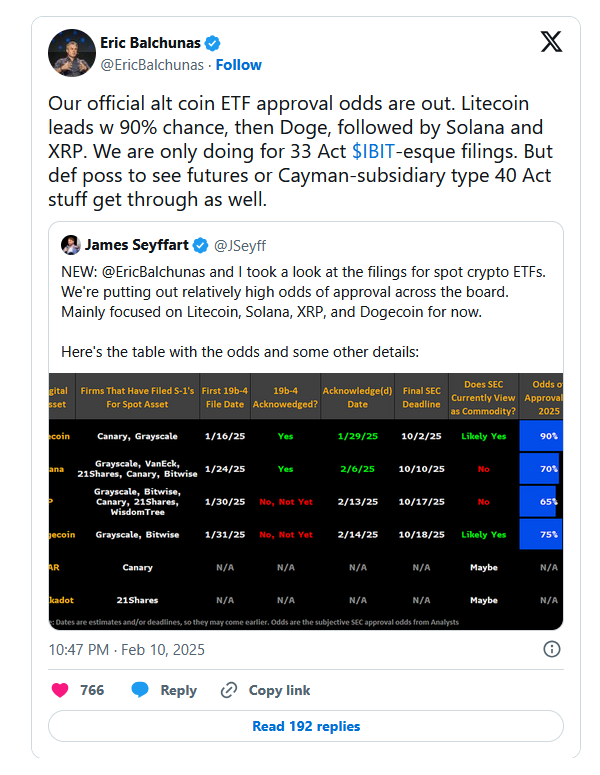
Analysts are optimistic that altcoins will get ETF approval in 2025
|
Company |
Details |
|
VanEck Solana Trust |
Filing date: June 2024. VanEck filed an S-1 registration statement with the SEC to launch a spot Solana ETF that would directly track the price of SOL shares. |
|
1Shares Core Solana ETF |
Filing date: June 2024. 21Shares filed an S-1 application with the SEC to list a spot Solana ETF on the Cboe BZX exchange, following VanEck’s lead. |
|
Bitwise Solana ETF |
Filing date: November 2024. Bitwise initially filed to create a Delaware public trust for a Solana ETF, but later withdrew it and filed a new Form S-1. |
|
Franklin Templeton Solana ETF |
Filing date: March 2025. Franklin Templeton filed Form S-1 and 19b-4 with the SEC to launch a spot Solana ETF on the Cboe BZX exchange. |
The main obstacle is Solana’s uncertain regulatory status. The SEC has not yet decided whether to consider it a security. Because of this, final approval of the funds may be delayed. Nevertheless, Bloomberg Intelligence analysts estimate the probability of Solana ETF approval at 75%, making it the leading candidate among altcoins for launch in the US.

Ripple and RLUSD: A new look at stablecoins
We talk about the features of the stablecoin from the company that created the XRP token with a capitalization of $151 billion
XRP ETF
XRP has long been under regulatory pressure due to a legal dispute between Ripple and the SEC. After the case was closed in August 2025, with both sides voluntarily withdrawing their appeals, interest in launching an XRP ETF surged. Despite the ongoing uncertainty surrounding XRP’s status, the regulator received numerous applications from companies in early 2025.
|
Company |
Details |
|
Bitwise XRP ETF |
Filing date: October 2024. Bitwise Asset Management filed a Form S-1 registration statement with the SEC, marking the first official proposal for an XRP ETF in the US. |
|
WisdomTree XRP ETF |
Filing date: December 2024. WisdomTree, a global asset management company, filed Form S-1 with the SEC to list a spot XRP ETF on the CBOE BZX exchange. |
|
CoinShares XRP ETF |
Filing date: January 2025. European crypto investment company CoinShares filed Form S-1 with the SEC for a spot XRP ETF. |
According to Bloomberg, the probability of XRP ETF approval is estimated at 65%, and according to Polymarket, it is 81%.
LTC ETF
If bitcoin is considered “digital gold,” then Litecoin is “digital silver.” LTC consistently maintains its position as one of the oldest and most actively traded cryptocurrencies on the market. Launched in 2011 by Charlie Lee, Litecoin was designed for faster transactions and lower fees compared to BTC, making it ideal for everyday transactions.
Applications to launch LTC ETFs have been submitted by Canary Capital, CoinShares, and Grayscale.
Analysts estimate the probability of the product being approved in 2025 at 90%, making Litecoin one of the most promising candidates among altcoins after Solana and XRP.

Dogecoin - what is this?
This cryptocurrency confidently occupies the top positions in terms of frequency of references on the network, not much inferior to bitcoin or, for example, Ethereum
DOGE ETF
Dogecoin started as a meme coin but has become one of the most recognizable and stable assets on the market. Its market capitalization is consistently in the top 10 cryptocurrencies, and its liquidity makes DOGE an attractive candidate for institutional instruments.
High liquidity, broad exchange support, and an active user base make it an increasingly attractive asset for institutional products. Among the applications submitted are: Rex Shares Osprey Dogecoin ETF, Grayscale Dogecoin Trust, and Bitwise Dogecoin ETF.
According to Bloomberg ETF analyst Eric Balchunas, the probability of Dogecoin ETF approval is about 75%.
Why are crypto ETFs needed?
Cryptocurrency ETFs allow you to invest in cryptocurrencies without having to buy and store coins yourself. This reduces technical barriers: there is no need to create a wallet, manage private keys, or interact with crypto exchanges.
Key advantages:
- No requirement to store private keys: funds provide custodial services (special storage facilities, cold storage).
- No KYC/AML complications on crypto exchanges: access via a standard brokerage account.
- Liquidity and transparency: ETFs are traded in real time, and their price and composition are public. Managers publish reports and NAV, which makes the instrument understandable and regulated.
- Possibility of investing through retirement/tax accounts: in some jurisdictions, ETFs can be held in IIAs/401(k)/IRAs, which simplifies tax planning (depending on local regulations)
How to invest in cryptocurrency ETFs
You can invest in crypto ETFs through brokers, just like buying stocks or bonds. It all depends on the type of investor: retail or institutional.
Retail investors
They open a standard brokerage account and buy fund shares on the exchange.
Advantages:
— no need to manage private keys;
— small amounts can be invested;
— market and limit orders, stop losses, and other tools are available.
Institutional investors
Large funds, hedge funds, and pension organizations use ETFs to add crypto exposure to portfolios where direct ownership of coins is prohibited by internal rules. To do this, they work with custodial services that provide storage and settlement.
The role of authorized participants (APs)
APs create/redeem ETF shares by interacting with the management company and maintaining the ratio of the ETF price to NAV.
How trading works
ETFs are traded in real time. The price may deviate slightly from the NAV, but arbitrage mechanisms and the activities of APs quickly even out the difference.
Regulators and cryptocurrency ETFs: the position of the SEC and CFTC
Crypto ETFs remain one of the most discussed topics at the intersection of traditional finance and digital assets. Their launch directly depends on the position of regulators — primarily the SEC and CFTC.
US Securities and Exchange Commission
The SEC takes the most cautious stance on crypto ETFs. The main reasons are:
- Risks of market manipulation. The Commission has repeatedly pointed to the high probability of price manipulation on cryptocurrency exchanges, which makes it difficult to ensure transparency.
- Insufficient investor protection. The SEC believes that retail investors may not be sufficiently informed about the specifics of cryptocurrencies and the risks associated with them.
- Lack of clear infrastructure. Issues of storage, custody solutions, and supply transparency remain problematic.
In May 2025, the SEC already postponed decisions on applications from 21Shares and Grayscale to launch ETFs based on XRP and Dogecoin.
Commodity Futures Trading Commission (CFTC)
Unlike the SEC, the CFTC traditionally considers cryptocurrencies (in particular, bitcoin and ETH) to be commodities rather than securities. This makes it more loyal to innovative products based on them.
Futures contracts for cryptocurrencies traded on the CME and CBOE are already operating under the CFTC’s supervision. At the same time, the regulator emphasizes the need for strict oversight of platforms where assets are settled and stored.
Regulators recognize the importance of crypto ETFs for the institutionalization of the digital asset market, but their caution is explained by the need to protect investors and ensure transparency. In the coming years, we can expect a gradual softening of positions and more active introduction of such instruments, especially against the backdrop of international competition.
Where cryptocurrency ETFs are traded: the US, Canada, Europe, Asia
Cryptocurrency ETFs are already operating in many countries, although their listing and regulatory conditions vary significantly.
- US — Bitcoin futures ETFs appeared first; then, in a number of cases, the regulator allowed products with broader placement conditions.
- Canada — one of the first countries to launch spot ETFs on bitcoin and ether (e.g., products from Purpose and other providers). Most often, such products were registered and traded on the Toronto Stock Exchange (TSX).
- Europe — there is a market for cryptocurrency ETPs/ETNs/ETFs (providers — 21Shares, CoinShares, and others) that are traded on European exchanges (SIX, XETRA, Frankfurt Stock Exchange, etc.).
- Asia — the situation varies from country to country: some exchanges and regulators are more conservative; in several jurisdictions (Singapore, Hong Kong), there have been discussions and mechanisms for listing crypto products, but the conditions are stricter than in Canada.
The widespread adoption of crypto ETFs depends on regulators, custodial storage infrastructure, and investor demand. The more management companies enter the market and the lower the fees, the faster this sector will grow.
Risks of cryptocurrency ETFs and their features
Cryptocurrency ETFs simplify access to digital assets, but carry their own risks.
Regulatory dependence
The main risk is regulatory decisions. Bans or strict restrictions in a particular jurisdiction can affect the structure of funds and access to them.
Market volatility
Cryptocurrency prices fluctuate wildly, which immediately impacts the value of ETFs. Investors should be prepared for sharp declines and equally rapid recoveries.
Differences from direct cryptocurrency ownership
- Pros: no need to store private keys, easier accounting and reporting, assets can be held through a standard brokerage account.
- Cons: investors do not own the coins directly, cannot participate in DeFi or staking, and the fund charges a fee and may lag behind the price of the underlying asset (tracking error).
Custodial and technological risks
Custodians are responsible for storing assets, but there is still a risk of hacker attacks, management errors, or loss of access. Insurance and audits partially reduce these risks, but do not eliminate them entirely.
Fees and deviations from asset prices
Each fund charges a management fee (expense ratio), which reduces net returns. In addition, there may be deviations between the price of an ETF and the value of the underlying asset due to operating costs and replication delays.
Conclusions and prospects for the crypto ETF market
Cryptocurrency ETFs make digital assets more accessible. They allow investors to invest in bitcoin, Ethereum, and altcoins without wallets or technical difficulties.
Investors get a familiar instrument — exchange-traded fund shares with a transparent structure, reporting, and regulated custodians. This lowers the barrier to entry and simplifies portfolio diversification.
The market outlook looks promising: the number of management companies is growing, fees are falling, and regulators are gradually softening their stance. However, the sector’s success depends on regulation, further development of storage infrastructure, and the maturity of underlying cryptocurrencies.
For conservative investors, crypto ETFs are a safe way to enter the market. For more risk-tolerant players, they are another tool for speculation and hedging.

Useful material?
 Telegram
  Twitter
 Basics
Why Satoshi Nakamoto’s technical manifesto for a decentralized money system matters
Oct 31, 2022
Basics
Experts evaluated the development prospects of the new ecosystem and the investment attractiveness of its token
Oct 20, 2022
Basics
How to track fluctuations correctly and create an effective income strategy
Sep 13, 2022
Basics
Review of the most profitable offers from proven trading platforms
Aug 29, 2022
Basics
The Ethereum Foundation team has published a breakdown of major misconceptions about the upcoming network upgrade
Aug 18, 2022
Basics
What benefits the exchange offers, and what else is in the near future
Aug 4, 2022
Cryptocurrency rates
-

Bitcoin
$83 637
BTC
+0.86%
-

Ethereum
$2 533.74
ETH
+1.17%
-

BNB Smart Chain
$753.65
BSC
+0.51%
-

Ripple
$1.42
XRP
+1.04%
-

TRON
$0.329974
TRX
-0.17%
-

Zcash
$1 275.82
ZEC
+4.57%
-

Dogecoin
$0.086674
DOGE
+1.08%
-

Cardano
$0.218269
ADA
+2.11%
-

Stellar XLM
$0.184461
XLM
+2.83%
-

Bitcoin Cash
$286.05
BCH
+2.18%