

What data do crypto exchanges share with regulators and why is it necessary?
We examine what information government agencies receive and how this affects users

07.10.2025
919
8 min
0
Cryptocurrency exchanges have long ceased to be a “gray area” and have become part of the global financial system. As the market has grown, so has the attention of regulators. To ensure security, transparency, and compliance with legal requirements, exchanges implement KYC and AML procedures, transfer data about their clients, and cooperate with government agencies. Let’s take a look at how crypto exchanges interact with regulators, what data is transferred, and what difficulties may arise in complying with regulatory requirements.
Content:
- What are KYC and AML: key concepts
- Why AML and KYC are important in the crypto industry
- Regulatory authorities and their impact on the crypto market
- What data are crypto exchanges required to share
- Key challenges in KYC/AML compliance
- Prospects and balance between control and freedom
What are KYC and AML: key concepts
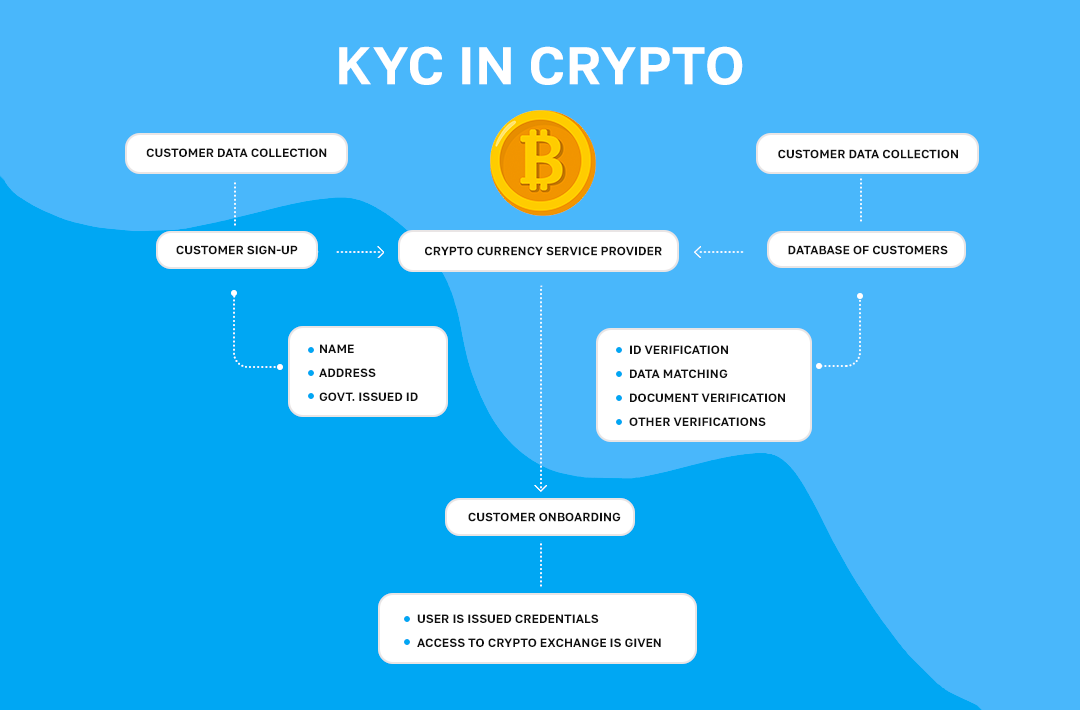
KYC (Know Your Customer) is a set of procedures for identifying and verifying the identity of customers.
Its purpose is to establish who is behind each transaction. For example, Coinbase uses a strict but user-friendly KYC process, requiring identity verification with supporting documents and biometric verification.
AML (Anti-Money Laundering) is a set of measures against money laundering and terrorist financing.
Exchanges analyze transactions, identify anomalies, and report unusual or suspicious transfers. Artificial intelligence helps recognize atypical transfers and behavior patterns.
Why AML and KYC are important in the crypto industry
Cryptocurrencies were originally created to be anonymous and decentralized, which made them a convenient tool for those who want to hide the origin of their funds. But it is this feature that has turned them into a threat to the legal financial system.
Without effective KYC/AML procedures, crypto exchanges become a platform for:
- money laundering;
- terrorist financing;
- circumventing international sanctions;
- tax evasion.
To mitigate these risks, most governments have required crypto platforms to verify users, monitor suspicious transactions, and report them to regulatory authorities.

India blocks 25 offshore crypto exchanges for violating AML requirements
Illegal platforms have been restricted for Indian users
Regulatory authorities and their impact on the crypto market
The crypto market is regulated by a number of national and international bodies. Each is responsible for oversight, transparency, and compliance with financial standards in its jurisdiction. Below are the key structures that influence the operation of crypto exchanges around the world.
1. FATF (Financial Action Task Force)
The FATF is an international organization that sets standards for combating money laundering and terrorist financing. In 2019, the FATF updated its “Guidance for a Risk-Based Approach to Virtual Assets and Virtual Asset Service Providers” and required exchanges to comply with the “Travel Rule” — to transfer data about the sender and recipient of each transaction.
2. SEC (U.S. Securities and Exchange Commission)
The U.S. Securities and Exchange Commission is responsible for enforcing laws related to trading digital assets that may be considered securities. The SEC actively prosecutes companies that violate token issuance and listing rules.
SEC to create incentives for crypto projects by the end of the year
This step will help ensure flexibility and support for the crypto business in the US
3. FinCEN (Financial Crimes Enforcement Network)
Monitors compliance with AML requirements. Crypto exchanges are required to register with FinCEN as money service businesses and implement internal anti-money laundering programs.

FinCEN: $312 billion passed through US banks in Chinese money laundering schemes
The report describes the scale of Chinese money laundering networks’ operations and their links to Mexican cartels, real estate, and human trafficking
4. EU and 5AMLD (Fifth Anti-Money Laundering Directive)
The European Union requires crypto providers to register, identify customers, and report suspicious transactions.
|
Regulator |
KYC requirements |
AML requirements |
Features |
|
FATF |
Travel Rule |
SAR |
International standard |
|
FinCEN |
KYC for any deposit/withdrawal |
AML policies, reports |
United States |
|
EC 5AMLD |
Mandatory registration of providers |
Automatic data transfer |
EU |
5. Regulators in Asia
- Japan: FSA (Financial Services Agency) licenses crypto exchanges.
- South Korea: FSC (Financial Services Commission) requires strict KYC and partnerships with banks.
- Singapore: MAS (Monetary Authority of Singapore) regulates crypto services under the Payment Services Act and monitors KYC/AML compliance.
What data are crypto exchanges required to share
Compliance with regulatory requirements requires crypto exchanges to collect and transfer large amounts of data about users and their transactions. The specific list depends on the jurisdiction, type of license, and nature of the transactions. Below are the main categories of information that are most often submitted to government agencies.
1. Sources of funds
- Full name, date of birth, citizenship;
- residential address;
- scan of passport or other document;
- selfie with the document.
2. Banking information
- source of funds;
- bank details;
- history of deposits and withdrawals.
3. Details of cryptocurrency transactions
- sender and recipient wallet addresses;
- amounts, dates, and purposes of transfers;
- tokens used.
4. Technical and behavioral data
-
IP address;
-
geolocation;
-
device and browser information;
-
behavioral anomalies.
5. Suspicious Activity Reports (SAR)
When abnormal activity is detected, exchanges are required to send SARs, or Suspicious Activity Reports, which detail all circumstances that raise suspicion.
Key challenges in KYC/AML compliance
Despite the importance of KYC/AML compliance and interaction with regulators, the process is accompanied by a number of challenges for both exchanges and users.
1. Privacy and data protection
Users fear data leaks. Exchanges must protect personal information while complying with regulatory requirements.
2. High costs
KYC/AML compliance requires significant investment in technology, personnel, and training. This increases operating costs, especially for small and new exchanges.
3. Different jurisdictional requirements
Exchanges operating in multiple countries must comply with several legal systems at once, which creates bureaucratic and legal complexities.
4. Loss
Strict KYC procedures scare away part of the audience, especially those who value anonymity and freedom. Some investors prefer decentralized platforms without mandatory identification.
5. Technological difficulties
The Travel Rule requires data exchange between platforms, but there is no single standard that would ensure system compatibility yet.
EU authorities will start conducting AML verification of crypto firm owners
The rules will come into full force from July 2027
Prospects and balance between control and freedom
The growth in regulation of crypto exchanges reflects the desire of states to strengthen control over the circulation of digital assets and prevent money laundering, terrorist financing, and tax evasion. The transfer of user data to regulators has already become standard practice for most centralized platforms.
But there are still serious challenges ahead. These include finding a balance between compliance with the law and protecting user privacy, the risks of data leaks, technical difficulties in different countries, and the lack of clear rules for decentralized platforms.
The crypto market is moving towards transparency and regulation. There is already a noticeable trend towards global standardization (e.g., the FATF’s Travel Rule) . This could strengthen trust among institutional investors and governments.
It is critical that regulation does not undermine the key principles of Web3 — decentralization, financial freedom, and innovation. The future of the industry depends on how effectively dialogue can be established between regulators, businesses, and the crypto community.

Useful material?
 Telegram
  Twitter
 Basics
Why Satoshi Nakamoto’s technical manifesto for a decentralized money system matters
Oct 31, 2022
Basics
Experts evaluated the development prospects of the new ecosystem and the investment attractiveness of its token
Oct 20, 2022
Basics
How to track fluctuations correctly and create an effective income strategy
Sep 13, 2022
Basics
Review of the most profitable offers from proven trading platforms
Aug 29, 2022
Basics
The Ethereum Foundation team has published a breakdown of major misconceptions about the upcoming network upgrade
Aug 18, 2022
Basics
What benefits the exchange offers, and what else is in the near future
Aug 4, 2022
Cryptocurrency rates
-

Bitcoin
$83 144
BTC
+0.54%
-

Ethereum
$2 504.69
ETH
-0.45%
-

BNB Smart Chain
$740.75
BSC
-0.64%
-

Ripple
$1.42
XRP
+1.04%
-

TRON
$0.328571
TRX
-0.4%
-

Zcash
$1 219.54
ZEC
-1.8%
-

Dogecoin
$0.084448
DOGE
-0.65%
-

Cardano
$0.218269
ADA
+2.11%
-

Stellar XLM
$0.184461
XLM
+2.83%
-

Bitcoin Cash
$272.73
BCH
-0.36%