

CrossCurve loses $3M in cross-chain bridge attack
The project team is investigating the vulnerability and has offered a reward for the return of the stolen funds.

02.02.2026 - 10:35
483
3 min
0
Key points:
- CrossCurve has confirmed a hack of its cross-chain bridge that resulted in losses of approximately $3 million across several blockchain networks.
- The attack was caused by a smart contract vulnerability that allowed attackers to forge cross-chain messages and unlock tokens.
- The project has offered hackers a 10% bounty for returning the funds and set a 72-hour window for cooperation.
The CrossCurve cross-chain bridge has reported a serious attack on its protocol. As a result of the incident, users lost around $3 million, with funds drained across multiple blockchain networks.
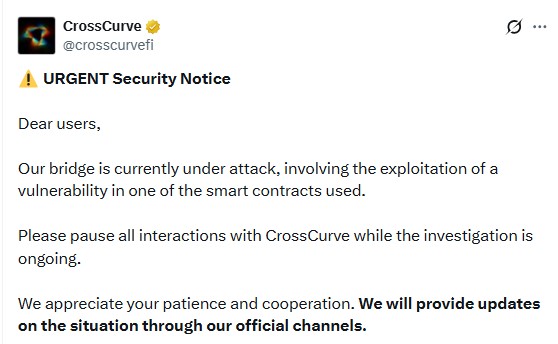
The project team said the breach was caused by a vulnerability in its smart contracts. CrossCurve quickly warned users on X and urged them to immediately stop all interactions with the protocol while the issue is being investigated.
How the Attack Happened
According to CrossCurve, a flaw in one of its smart contracts allowed a number of addresses to receive tokens that were effectively taken from other users. The team stressed that it does not believe these addresses acted with malicious intent and asked them to voluntarily return the funds. In total, ten such addresses were identified.
Blockchain security analysts at Defimon Alerts reported that the vulnerability was located in the ReceiverAxelar contract. The flaw made it possible to forge cross-chain messages and bypass gateway verification, allowing unauthorized token unlocks in the PortalV2 contract.
Hacker Bounty and Possible Escalation
CrossCurve has offered so-called white-hat hackers a bounty of 10% of the recovered funds under its Safe Harbor policy, which governs responsible vulnerability disclosure. The remaining assets must be returned to the protocol.
The project has set a 72-hour deadline to begin cooperation. If no agreement is reached and the funds are not returned within that timeframe, the team said it will move forward with stronger measures.

Ribbon Finance hack: hackers stole $2,7 million through an oracle vulnerability
The incident once again showed that price manipulation remains a serious threat to DeFi.
What this includes: Cooperation with law enforcement agencies, crypto exchanges such as Coinbase and Binance, stablecoin issuers, and blockchain analytics firms including Chainalysis, TRM Labs, and Elliptic.

AI-driven scams went “industrial” in 2025
A new report shows a sharp rise in AI-powered scams and their transformation into a systemic tool of crypto crime
Expert Commentary: Commenting on the incident, Komainu Chief Information Security Officer Andrew Morfill said the industry still lacks standardized, battle-tested smart contract templates and strict development processes. According to him, only secure, regularly updated protocols with real utility will be able to restore investor confidence in the DeFi sector.

Useful material?
 Telegram
  Twitter
 Incidents
In 104 minutes, the attacker emptied 1,404 addresses before validators halted the network and froze almost all of the loot.
Oct 19, 2026
Incidents
Developers warned of potential risks to bridges across the ecosystem and asked exchanges for assistance.
Jun 22, 2026
Incidents
The defendant helped move funds stolen through investment scams and earned at least $4 million for his role in the operation.
Jun 10, 2026
Incidents
The company is linking the incident to a compromised private key on a service wallet, rather than a smart contract exploit
May 22, 2026
Incidents
Following the incident, the project temporarily halted trading operations and node activity.
May 15, 2026
Incidents
The user spent weeks unsuccessfully trying to guess the password until Claude helped find an old wallet backup file
May 14, 2026
Cryptocurrency rates
-

Bitcoin
$84 212
BTC
+1.5%
-

Ethereum
$2 478.73
ETH
+1.29%
-

BNB Smart Chain
$747.99
BSC
+0.83%
-

Ripple
$1.42
XRP
+1.04%
-

TRON
$0.330575
TRX
-0.15%
-

Zcash
$1 324.18
ZEC
+5.18%
-

Dogecoin
$0.0821
DOGE
+0.43%
-

Cardano
$0.218269
ADA
+2.11%
-

Stellar XLM
$0.184461
XLM
+2.83%
-

Bitcoin Cash
$287.32
BCH
+0.65%