

Google has discovered AI-based malware designed to steal cryptocurrencies
A report by Google Threat Intelligence Group has revealed that hackers from North Korea and Russia are using large language models to create and disguise malicious code, including for attacks on crypto wallets

07.11.2025 - 08:35
578
3 min
0
Key points:
- The PROMPTFLUX and PROMPTSTEAL malware programs use Gemini and Qwen AI models to generate code and conceal attacks.
- The North Korean group UNC1069 used Gemini to create phishing scripts and search for crypto wallet data.
The Google Threat Intelligence Group (GTIG) has published a report documenting the first use of large language models (LLMs) in malware operating in real-world operations. Researchers identified five families of malware that use AI to generate, mask, and modify code during execution.
According to the report, attackers are no longer just using AI to increase productivity — they are creating a fundamentally new generation of malware that dynamically changes its behavior right during operation.
PROMPTFLUX and PROMPTSTEAL
One example is the PROMPTFLUX program, written in VBScript. It interacts with the Gemini API and uses it to rewrite its own code to avoid antivirus detection. According to GTIG, this program uses the Thinking Robot mechanism to regularly access the model and receive fresh instructions.
Another tool is PROMPTSTEAL, created by the Russian APT28 group. It uses the Qwen2.5-Coder model via the Hugging Face API to generate Windows commands that collect information about the system and user documents. PROMPTSTEAL masquerades as an image generation application, but in reality executes commands to collect data and send it to the attackers’ server.
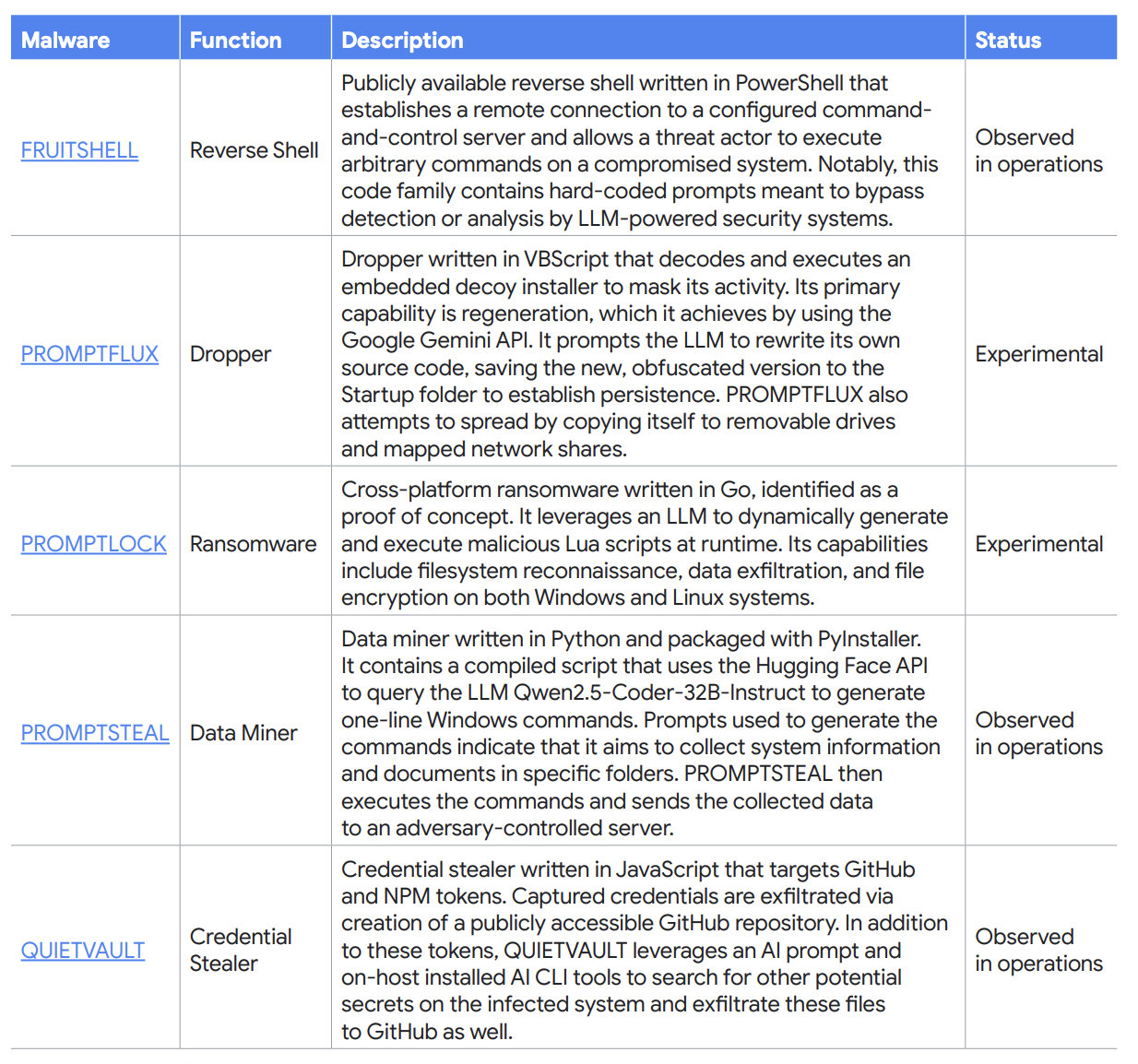
Families of malware with AI elements and their functions
GTIG notes that both tools are still in the experimental stage, but already demonstrate how AI models can be used to dynamically update malicious code and bypass defenses.
North Korean attacks and cryptocurrency theft
Google also identified activity by the North Korean group UNC1069 (also known as MASAN), which used Gemini for cyberattacks related to cryptocurrency theft. According to the report, the attackers used AI to analyze crypto wallet data, generate phishing scripts, and even create content in different languages, including Spanish, to deceive crypto exchange employees.
Google noted that these campaigns are aimed at financing the North Korean regime through the theft of digital assets. All related accounts have been blocked, and additional anti-abuse measures have been implemented in Gemini models, including stricter API control and filtering of malicious requests.
Underground AI service forums
GTIG has also recorded growth in the underground market for AI tools. Services such as EvilAI, FraudGPT, LoopGPT, and WormGPT are sold on forums, offering the generation of phishing emails, malware, and the automation of cyberattacks.
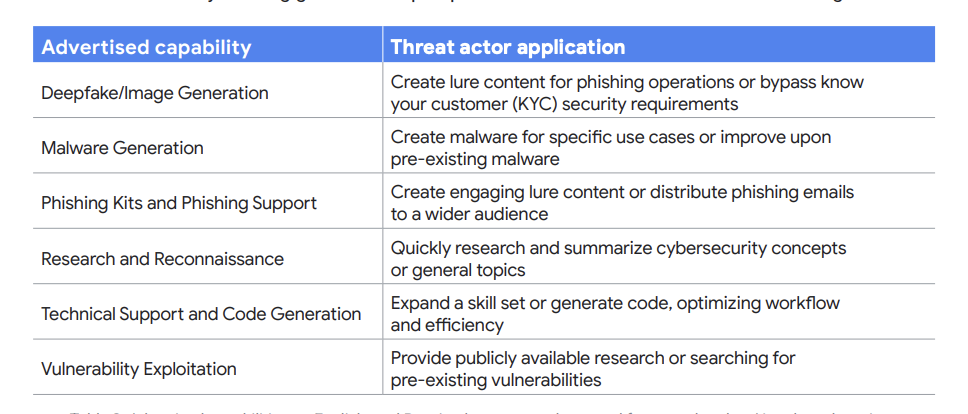
AI tools on underground forums and their applications
Google has warned that the use of LLM in cyber operations is becoming the new norm. This applies to both state-sponsored groups and criminal communities that use AI for hacking, phishing, and bypassing security measures.
The company emphasized that most of these malicious tools are still in the testing phase and are not yet capable of directly infecting devices, but the risk is growing rapidly.

Useful material?
 Telegram
  Twitter
 Incidents
Developers warned of potential risks to bridges across the ecosystem and asked exchanges for assistance.
Jun 22, 2026
Incidents
The defendant helped move funds stolen through investment scams and earned at least $4 million for his role in the operation.
Jun 10, 2026
Incidents
The company is linking the incident to a compromised private key on a service wallet, rather than a smart contract exploit
May 22, 2026
Incidents
Following the incident, the project temporarily halted trading operations and node activity.
May 15, 2026
Incidents
The user spent weeks unsuccessfully trying to guess the password until Claude helped find an old wallet backup file
May 14, 2026
Crypto regulations
Authorities are introducing mandatory registration for companies handling cross-border crypto transactions
May 8, 2026
Cryptocurrency rates
-

Bitcoin
$81 411
BTC
-0.63%
-

Ethereum
$2 421.71
ETH
-1.61%
-

BNB Smart Chain
$718.56
BSC
-1.19%
-

Ripple
$1.42
XRP
+1.04%
-

TRON
$0.336557
TRX
+0.42%
-

Zcash
$1 155
ZEC
-5.1%
-

Dogecoin
$0.079503
DOGE
-2.59%
-

Cardano
$0.218269
ADA
+2.11%
-

Stellar XLM
$0.184461
XLM
+2.83%
-

Bitcoin Cash
$272
BCH
-3.39%