

Sei Foundation intends to move 23andMe lab clients’ genetic data to blockchain
Earlier this week, 23andMe declared bankruptcy

28.03.2025 - 09:50
550
4 min
0
What’s new? Sei Foundation, a non-profit organization dedicated to the development of the Sei (SEI)blockchain, is exploring the possibility of buying bankrupt California-based personal genomics company 23andMe and transferring the genetic data of its 15 million customers onto blockchain. Earlier this year, the non-profit launched a $65 million fund to support decentralized scientific protocols (DeSci).
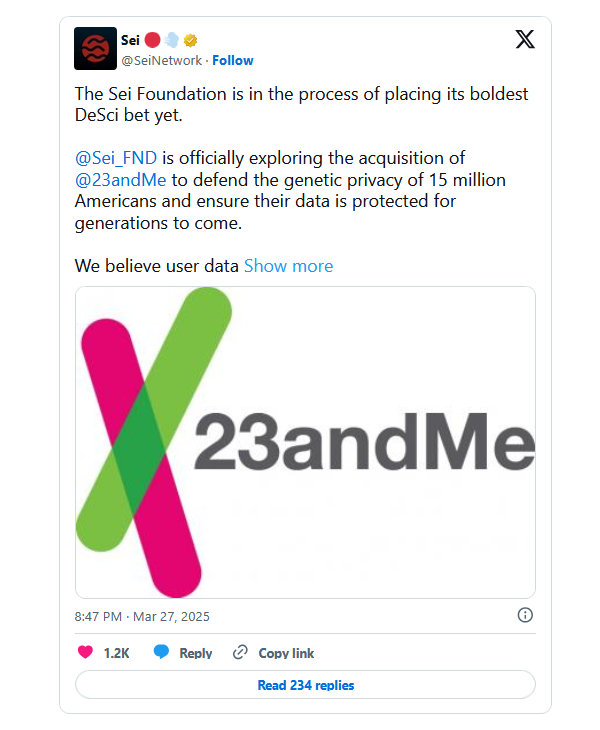
What else is known? The foundation said that the security of genetic data is a national security issue, which is especially relevant when 23andMe faces financial difficulties. The company, which performed DNA tests for customers, filed for bankruptcy in the United States this week to facilitate the sale of the business for maximum value.
23andMe founder and CEO Anne Wojcicki resigned but retained her board membership. She also intends to bid to buy out the company and relaunch it following a restructuring.
FT journalists noted that the company has never turned a profit in its 19 years of existence. In 2007, Google invested $3,9 million in 23andMe. In the same year, Wojcicki became the wife of Google co-founder Sergey Brin.
Following the bankruptcy filing, attorneys general in several states urged customers of 23andMe to remove their data from the platform. It also experienced a data breach of 6,9 million customers back in 2023, damaging its reputation.
The company’s stock is trading on the Nasdaq under the ticker ME and has lost 99,61% of its value in all time and is trading at $0,77, having added 45% on the premarket.
If the purchase goes through, Sei Foundation plans to integrate the database collected throughout 23andMe’s operation into its blockchain. The lab’s customers will be given ownership of their genetic data with a guarantee of privacy through encrypted transfers. In this way, the customers themselves will be able to monetize this data if they wish.
“This isn’t just about saving a company, it’s about building a future where your most personal data remains yours to control,” the foundation said.
SEI, the network’s native token, rose 3% on the back of the news, but by the time of writing, the daily drop was 7,3%. The asset ranks 89th in the overall cryptocurrency market capitalization ranking with a figure of $959,12 million and is trading at $0,1963. It has lost 29% of its value over the past month.
Sei: the fastest Layer 1 blockchain ever
We talk about the benefits of the network that offers a way to solve the scaling problem in the blockchain space
What is known about DeSci? DeSci projects are designed to make it easier to raise funds for scientific research and to disseminate the results of this research. In the traditional approach, scientists can face difficulties in obtaining grants for highly specialized or irrelevant research that officials consider irrelevant, as well as publishing results in scientific journals that may be controlled by stakeholders.
The use of blockchain allows DeSci projects to raise funding through crowdfunding, native token staking, and NFT sales, as well as to secure authorship of papers and eliminate the middleman between research authors and reviewers.
In addition, DeSci projects offer an alternative to the Hirsch Index (h-index), on which the reputation of scientists currently largely depends. It reflects the relevance of a scientist in the community by taking into account the number of his/her publications and references to these publications in other people’s papers. DeSci teams propose to take into account other achievements, including professional development, mentoring, and assistance in other people’s projects.
Finally, DeSci projects allow scientists around the world to come together outside of government organizations, potentially improving research productivity and overall progress.
Like decentralized finance (DeFi) protocols, DeSci protocols are managed by decentralized autonomous organizations (DAOs) that include native token holders.

Useful material?
 Telegram
  Twitter
 Incidents
In 104 minutes, the attacker emptied 1,404 addresses before validators halted the network and froze almost all of the loot.
Oct 19, 2026
Incidents
Developers warned of potential risks to bridges across the ecosystem and asked exchanges for assistance.
Jun 22, 2026
Incidents
The defendant helped move funds stolen through investment scams and earned at least $4 million for his role in the operation.
Jun 10, 2026
Incidents
The company is linking the incident to a compromised private key on a service wallet, rather than a smart contract exploit
May 22, 2026
Incidents
Following the incident, the project temporarily halted trading operations and node activity.
May 15, 2026
Incidents
The user spent weeks unsuccessfully trying to guess the password until Claude helped find an old wallet backup file
May 14, 2026
Cryptocurrency rates
-

Bitcoin
$80 822
BTC
-0.04%
-

Ethereum
$2 361.15
ETH
-0.81%
-

BNB Smart Chain
$742.68
BSC
+0.48%
-

Ripple
$1.42
XRP
+1.04%
-

TRON
$0.329119
TRX
-0.2%
-

Zcash
$1 216.99
ZEC
+3.36%
-

Dogecoin
$0.077856
DOGE
-1.17%
-

Cardano
$0.218269
ADA
+2.11%
-

Stellar XLM
$0.184461
XLM
+2.83%
-

Bitcoin Cash
$277.69
BCH
-0.57%