

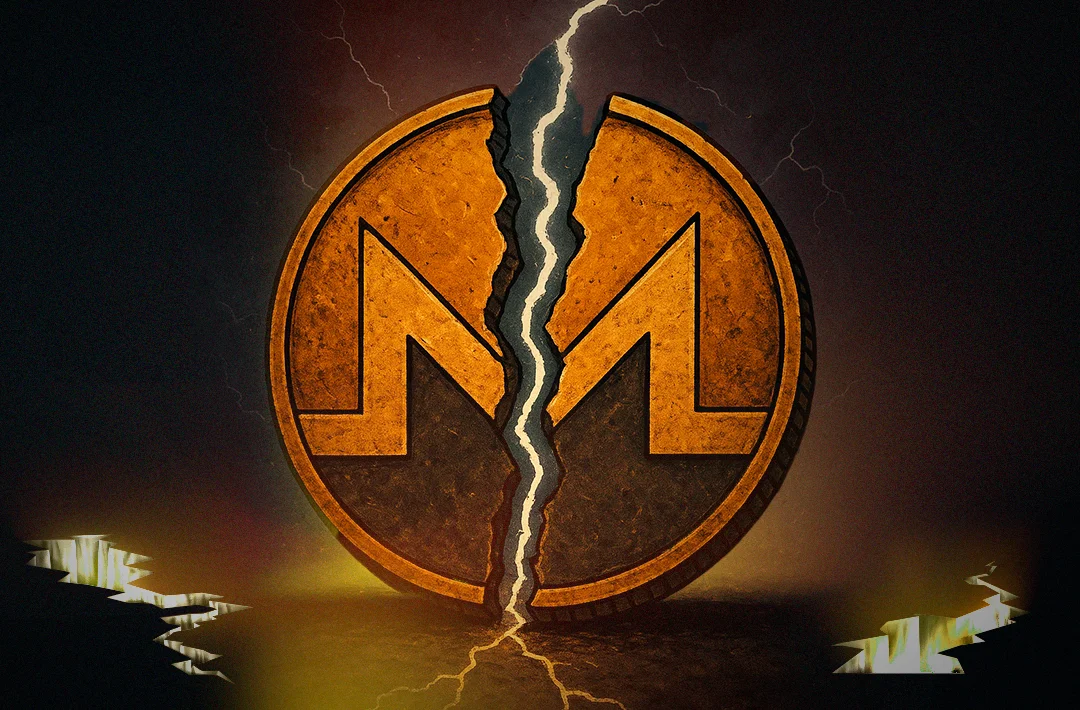
Sergey Ivancheglo’s Qubic project took control of more than 51% of Monero’s hashrate
Against this backdrop, the XMR token plummeted 7% in one day
12.08.2025 - 17:00
925
4 min
0
What’s new? The Qubic project, co-founded by IOTA’s Sergey Ivancheglov, known in the community under the nickname CFB, took control of more than 51% of the global hashrate of the privacy-oriented Monero blockchain with the XMR token. This achievement gives the project the ability to change transaction history, censor transactions, and attempt to organize double spending.

What else is known? Ivancheglov himself called this move a stress test designed to help the Monero community prepare for future network threats, but the statement sparked heated debate among developers and security experts.
“The Monero team is polishing details of their 51% attack protection. Many accused us of being sponsored by 3-letter agencies to attack this anon coin. What do you think now, after we has helped Monero to prepare for its future fights against those agencies,” Ivancheglov said.

EU authorities will ban Monero, Zcash, and other anonymous cryptocurrencies
The ban is aimed at strengthening the fight against money laundering
Qubic offered significantly higher payouts than regular Monero mining pools and attracted enough participants to exceed the 51% threshold.
A 51% attack is a situation where a single organization or coordinated group controls most of the computing power (hashrate) of a network with a Proof-of-Work (PoW) consensus algorithm.
According to Chaos Labs, Monero’s hashrate rose to 3,01 GH/s as miners sought to earn a reward of $3,13 per day compared to $0,64 in standard pools.
Over the past 30 days, Qubic’s activity has contributed to a 28% drop in the price of XMR and a 57% increase in QUBIC tokens. The model also involves a 50/50 distribution of mining profits among miners and for the purchase and burning of QUBIC tokens.
Qubic's “useful proof of work” (uPoW) model redirects Monero mining rewards, converting XMR to USDT and using the proceeds to purchase and burn QUBIC. This deflationary mechanism also serves as a source of liquidity for the project’s own ecosystem.
Thus, if the project mines 100% of Monero blocks per day, it receives about 432 XMR at $118 000 at the current exchange rate, while burning coins worth $59 000.

Monero: Behind the scenes of anonymity. How does the new generation cryptocurrency work?
We talk about how the search for a balance between privacy and government control has influenced the coin
Yu Xian, founder of cybersecurity company SlowMist, expressed doubts about the economic efficiency of Qubic. Ledger CTO Charles Guillemet also noted that other miners have no incentive to continue working, as Qubic can simply “orphan” any competing blocks, effectively becoming the sole miner.

An orphaned block can be formed as a result of a failure. For example, several blocks may be released at a certain height, each of which is then relied upon by subsequent blocks as they are mined, creating conflicting chains.
The longest chain is retained as the main chain, and the blocks that are not included in it become obsolete. Thus, orphan blocks are mined and confirmed blocks that are not included in the mainnet.
Regardless of whether these events are a hostile takeover or a stress test, XMR reacted negatively, falling 7% in a day and 13% in a week.
The asset ranks 41st in the overall cryptocurrency ranking by market capitalization with $4,7 billion and is trading at $253,81, up 32% since the beginning of the year.

Useful material?
 Telegram
  Twitter
 Incidents
In 104 minutes, the attacker emptied 1,404 addresses before validators halted the network and froze almost all of the loot.
Oct 19, 2026
Incidents
Developers warned of potential risks to bridges across the ecosystem and asked exchanges for assistance.
Jun 22, 2026
Incidents
The defendant helped move funds stolen through investment scams and earned at least $4 million for his role in the operation.
Jun 10, 2026
Incidents
The company is linking the incident to a compromised private key on a service wallet, rather than a smart contract exploit
May 22, 2026
Incidents
Following the incident, the project temporarily halted trading operations and node activity.
May 15, 2026
Incidents
The user spent weeks unsuccessfully trying to guess the password until Claude helped find an old wallet backup file
May 14, 2026
Cryptocurrency rates
-

Bitcoin
$83 434
BTC
+2.47%
-

Ethereum
$2 466.91
ETH
+3.55%
-

BNB Smart Chain
$746.25
BSC
+2.51%
-

Ripple
$1.42
XRP
+1.04%
-

TRON
$0.330575
TRX
-0.48%
-

Zcash
$1 285.35
ZEC
+13%
-

Dogecoin
$0.082049
DOGE
+3.83%
-

Cardano
$0.218269
ADA
+2.11%
-

Stellar XLM
$0.184461
XLM
+2.83%
-

Bitcoin Cash
$286.56
BCH
+4.7%