

VanEck proposes to launch bitcoin bonds with a yield of up to 282%
According to the company’s analysts, the new financial instrument will allow the US Treasury Department to reduce the cost of servicing the national debt

16.04.2025 - 14:05
561
5 min
0
What’s new? Crypto investment company VanEck, which manages the spot bitcoin exchange-traded fund HODL with $1,18 billion in assets under management, has proposed the concept of a new financial product based on the first cryptocurrency called BitBonds. As explained by Matthew Sigel, the head of digital asset research, at the Strategic Bitcoin Reserve Summit, it is a hybrid debt instrument that combines bitcoin with US Treasury bonds.
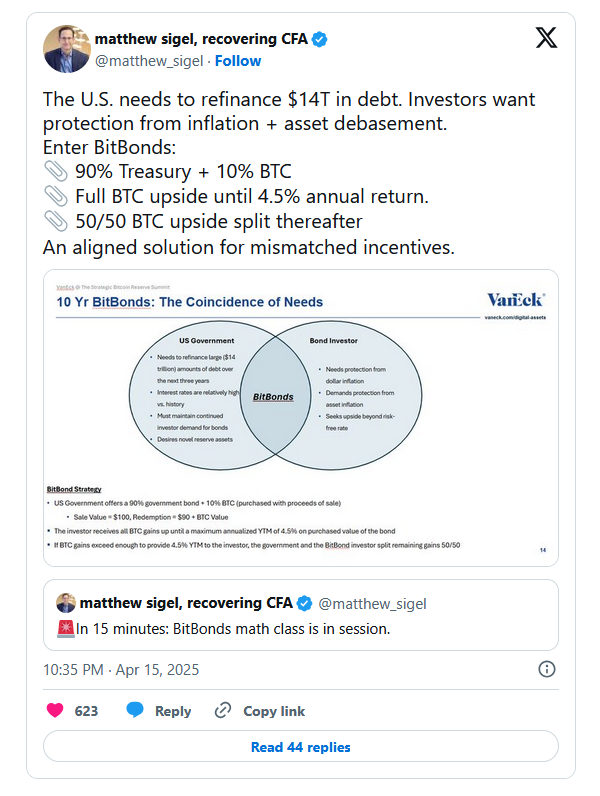
What else is known? BitBonds will be 10-year securities consisting of 90% traditional US Treasuries and 10% BTC purchased with bond proceeds.
Accordingly, at maturity, investors will receive the full value of the Treasury bonds ($90 per $100 BitBonds security) as well as the value of the bitcoin portion.
In addition, investors will receive 100% of BTC’s appreciation until the yield-to-maturity (YTM) reaches 4,5%. Returns above this threshold will be shared between the government and bondholders.
This structure is designed to reconcile the interests of bond investors, who are increasingly seeking protection against dollar depreciation and asset inflation, with the Treasury’s need to refinance at competitive rates. Sigel called the product “an aligned solution for mismatched incentives.”

Trump signs resolution to repeal the DeFi protocol tax rule
The rule was passed toward the end of Joe Biden’s presidential term
According to Sigel’s projections, a BitBonds investor’s breakeven depends on the bond’s fixed coupon and the bitcoin compound annual growth rate (CAGR). For example, the break-even BTC CAGR for bonds with a 4% coupon is 0%, while the break-even threshold is higher for lower-yielding versions: 13,1% CAGR for a 2% coupon and 16,6% for a 1% coupon. If the CAGR stays in the 30-50% range, yields rise sharply for all coupon levels, and investor returns can be as high as 282%.
According to Sigel, BitBonds may appeal to bitcoin supporters because the instrument offers asymmetric growth while maintaining a basic level of risk-free returns. However, the product’s structure means investors bear all losses if bitcoin falls.
For example, bonds with a lower coupon can lead to larger losses in scenarios where BTC loses value: a BitBond with a 1% coupon would lose 20-46%, depending on the cryptocurrency’s decline.
From the perspective of the US government, the main advantage of BitBonds will be lower borrowing costs. Even if BTC grows little or not at all, the Treasury will save on interest payments compared to traditional 4% fixed-rate bonds.

US Senate approves the appointment of crypto lawyer Paul Atkins to head the SEC
President Donald Trump nominated him
According to Sigel’s analysis, the government’s breakeven interest rate is approximately 2,6%. Issuing bonds with coupons below that level would reduce annual debt service, resulting in savings even in a zero-growth or BTC decline environment.
Sigel predicts that a $100 billion BitBonds issue with a 1% coupon and no BTC growth would save the government $13 billion over the life of the bond. If BTC reaches a CAGR of 30%, the same issuance could add more than $40 billion in additional value, mostly due to the cryptocurrency’s growth.
The analyst emphasized that this approach would create a differentiated class of government bonds, offering the US an asymmetric benefit from bitcoin growth while reducing dollar-denominated liabilities.
Despite the potential benefits, VanEck recognizes the flaws in the concept. For example, investors take the hit from a potential bitcoin decline without being able to take full advantage of the positives, and lower coupon bonds become unattractive unless BTC performs exceptionally well.

SEC discussed creating a regulatory sandbox for trading tokenized stocks
The agency will be able to use the outcome of the pilot legal regime in drafting legislation
In addition, the Treasury Department will have to issue more debt to offset the 10% that will go towards bitcoin purchases. Every $100 billion in funding would require an additional 11,1% to invest in BTC.
The proposal suggests possible improvements to the structure, including downside protection to partially shield investors from BTC’s sharp drops.

Useful material?
 Telegram
  Twitter
 Incidents
In 104 minutes, the attacker emptied 1,404 addresses before validators halted the network and froze almost all of the loot.
Oct 19, 2026
Incidents
Developers warned of potential risks to bridges across the ecosystem and asked exchanges for assistance.
Jun 22, 2026
Incidents
The defendant helped move funds stolen through investment scams and earned at least $4 million for his role in the operation.
Jun 10, 2026
Incidents
The company is linking the incident to a compromised private key on a service wallet, rather than a smart contract exploit
May 22, 2026
Incidents
Following the incident, the project temporarily halted trading operations and node activity.
May 15, 2026
Incidents
The user spent weeks unsuccessfully trying to guess the password until Claude helped find an old wallet backup file
May 14, 2026
Cryptocurrency rates
-

Bitcoin
$81 447
BTC
-0.89%
-

Ethereum
$2 383.15
ETH
-1.37%
-

BNB Smart Chain
$727.97
BSC
+0.54%
-

Ripple
$1.42
XRP
+1.04%
-

TRON
$0.331842
TRX
+0.25%
-

Zcash
$1 142.08
ZEC
+0.73%
-

Dogecoin
$0.079034
DOGE
+0.14%
-

Cardano
$0.218269
ADA
+2.11%
-

Stellar XLM
$0.184461
XLM
+2.83%
-

Bitcoin Cash
$273.62
BCH
-1.1%