

The largest public companies owning Ethereum: who is investing in the future of blockchain
We inform you about which public companies have included ETH in their investment portfolios and how this decision impacts their financial strategy

20.08.2025
502
12 min
0
In recent years, large public companies have become increasingly interested in digital assets. They view them not only as a diversification tool, but also as an important part of their financial strategy.
Bitcoin has long been the most well-known asset in this space, but Ethereum, the second-largest cryptocurrency by market capitalization with unique technological capabilities, is attracting more and more attention.
In this article, we will take a detailed look at which public companies own Ethereum, why they have included it in their balance sheets, and what role they assign to this cryptocurrency in their investment policy. We will also analyze why ETH is becoming increasingly attractive to corporate investors, despite bitcoin’s continued dominance in the market.
Content
- What is Ethereum’s treasury management strategy?
- Top public companies by Ethereum balance in 2025
- How much ETH is held by public companies?
- What is the unrealized profit of companies that own ETH?
- Should retail investors follow corporate strategies regarding ETH?
- Who owns hundreds of thousands of ETH: top private Ethereum investors
- Why do large companies continue to accumulate Ethereum
What is Ethereum’s treasury management strategy?
A treasury management strategy is the way companies manage their cash and assets. Traditionally, it includes instruments such as cash, bonds, or listed shares. With Ethereum’s treasury management strategy, a company invests part of its balance in ETH in the same way that it holds foreign currency or other financial assets.
Some companies view Ethereum as a long-term growth asset with the potential for value appreciation. Others may invest in the Ethereum ecosystem itself — through staking, decentralized finance (DeFi), or Web3 applications.
Holding ETH can also be part of a broader technology alignment strategy, positioning the company as forward-thinking and integrated with cryptocurrency.
Top public companies by Ethereum balance in 2025
In 2025, spot cryptocurrency ETFs are traded in various regions, including products approved by the Australian Securities and Investments Commission (ASIC). With increasing regulation and data storage and disclosure requirements, large investors are gaining more transparency and confidence to enter the market.
In August 2025, several public companies made headlines after adding significant amounts of ETH to their balance sheets. This indicates growing corporate interest in Ethereum.

This momentum reflects growing confidence that Ethereum’s role in supporting smart contracts, Layer 2 solutions, and digital identity tools provides it with long-term sustainability.
The CoinGecko report lists the companies with the largest amounts of ETH on their balance sheets.
|
Company |
ETH held |
|
BitMine |
1,174 million ETH |
|
SharpLink Gaming |
532 194 ETH |
|
Coinbase |
137 300 ETH |
|
Bit Digital |
121 000 ETH |
|
BTCS Inc |
70 140 ETH |
|
GameSquare |
15 630 ЕТН |
|
Intchains |
7 023 ЕТН |
|
KR1 plc |
5 500 ЕТН |
|
Exodus |
2 550 ЕТН |
|
BTC Digital Ltd |
2 135 ЕТН |
1. BitMine. A small-cap company engaged in mining bitcoins and digital assets, operating in the United States. BitMine generates revenue from mining and hosting cryptocurrencies.
The company has 1,174 million ETH on its balance sheet, worth approximately $5,08 billion. Bitmine’s goal is to collect 5% of all coins in circulation, or approximately 6 million ETH.
2. SharpLink Gaming. An American company specializing in sports betting and fantasy sports technologies. It provides data-driven solutions for gambling operators and media companies. SharpLink is also working to modernize the betting industry with smart contracts, DeFi, and blockchain-based infrastructure.
The company currently has 532 194 ETH on its balance sheet, which corresponds to a current value of $2,33 billion. More than 95% of SharpLink’s ETH assets are placed on staking and liquid staking platforms, which generate income for the company and reinforce its strategy of using ETH as its primary treasury reserve asset.
3. Coinbase. One of the largest crypto exchanges in the world, headquartered in San Francisco. It offers a platform for buying, selling, and storing digital assets such as bitcoin and Ethereum.
The crypto platform holds 137 300 ETH on its balance sheet, with a current value of $594,6 million. Coinbase stores Ethereum both to maintain liquidity and as part of its operating treasury.
4. Bit Digital. A US company engaged in the mining of digital assets. In the second quarter of 2025, Bit Digital completely liquidated its bitcoin treasury to transfer it to Ethereum. The company raised $172 million in an IPO and used the proceeds to purchase ETH.
Bit Digital owns 121 000 ETH, valued at approximately $523,9 million. A significant portion of these ETH is actively used for staking, which allows the company to generate additional revenue.
5. Blockchain Technology Consensus Solutions (BTCS). A US company engaged in blockchain infrastructure and technology, headquartered in Maryland. The company specializes in staking as a service, blockchain analytics, and creating platforms that provide investors with access to digital assets.
As of August 2025, BTCS owns 70 140 ETH. The company uses its Ethereum assets, currently valued at approximately $303,5 million, for staking and to support its blockchain infrastructure business.
6. Smaller companies with targeted strategies. Other notable players include GameSquare (15 630 ETH), Intchains (7023 ETH), KR1 plc (5500 ETH), Exodus (2550 ETH), and BTC Digital Ltd (2135 ETH).
How much ETH is held by public companies?
As of August 2025, only 12 public companies have officially disclosed information about the presence of Ethereum on their balance sheets. Collectively, these companies own 2 067 472 ETH, which is equivalent to approximately $8,9 billion.

The main holders of ETH are from countries with developed cryptocurrency regulations.
What is the unrealized profit of companies that own ETH?
Over the past year, the price of Ethereum has remained highly volatile, reflecting a sharp change in market sentiment. After reaching a local peak of over $4100 in December 2024, it had fallen to around $1383 by April 2025. By August, the asset’s value had recovered to $3700, which contributed to the stabilization of the market valuation of corporate treasury assets denominated in Ethereum.
Volatility had a direct impact on the value of treasury bonds held by public companies. For example, SharpLink’s ETH assets, purchased for $1,03 billion at an average price of $2864. Currently, these assets are valued at $1,33 billion, resulting in an unrealized gain of 29,0%.
Bitmine’s investments of 300 657 ETH, purchased for $977,3 million at an average price of $3251, now yield an unrealized profit of 13,7%.
Should retail investors follow corporate strategies regarding ETH?
The fact that a large company is buying up Ethereum does not mean that you need to rush out and do the same. But if you understand why they are doing this, you will be better able to assess whether ETH is right for you personally. Here is a brief overview of the pros and cons:
|
Pros |
Cons |
|
Diversification through a traditional trading platform. Accessing Ethereum through public companies allows you to connect to one of the most widespread blockchain networks without having to manage crypto wallets. |
ETH volatility. Although Ethereum’s price is no longer as chaotic as it was in its early years, it still experiences significant fluctuations, which can affect the value of the company’s shares. |
|
Growth potential of smart contracts. Ethereum underpins much of the innovation in Web3,from decentralized finance to gaming. If you believe in the future of this technology, investing in Ethereum treasury companies is one way to support it. |
Not all strategies regarding ETH are the same. Some companies view ETH as a strategic asset, while others may chase news or speculation. It is important to understand the reasons behind this. |
|
The importance of company risks. Even if ETH rises, a poorly managed company that owns it may remain at the same level. Always pay attention to the company’s fundamentals as well. |
Who owns hundreds of thousands of ETH: top private Ethereum investors
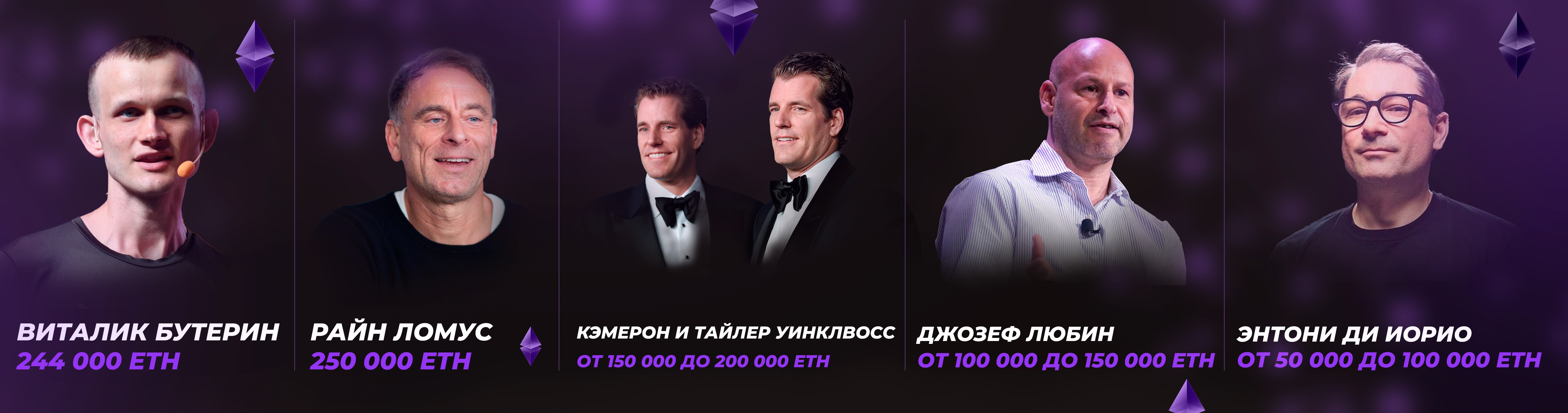
In our study, we couldn’t ignore people who own ETH worth tens of millions of dollars. This list includes the most famous personalities:
- Vitalik Buterin is the co-founder of Ethereum, one of the most prominent figures in the crypto industry, and one of the largest private holders of ETH. He previously stated that he never owned more than 0,9% of the total Ethereum supply. However, his main wallet, VB3, currently holds around 244 000 ETH, with additional funds distributed across other addresses. In total, his assets are estimated at approximately 282 057 ETH, which is almost $1,2 billion at the current exchange rate. Despite the significant amount, he is not in the top 20 due to the predominance of institutional assets and smart contracts.
- Rain Lõhmus is an Estonian banker and one of the early investors in Ethereum. Shortly after the project was launched, he lost access to his wallet. Blockchain data confirms that the wallet still holds about 250 000 ETH, which is currently worth about $1,08 billion. If he does not recover his private keys, these funds will effectively remain frozen forever.
- Cameron and Tyler Winklevoss are the founders of the Gemini exchange and some of the most prominent supporters of Ethereum. Although Gemini wallets hold around 369 000 ETH, experts estimate that the Winklevoss twins personally control between 150 000 and 200 000 ETH, worth between $653 million and $871 million. The exact figures are difficult to verify, but given their early investments and ongoing involvement in the development of Ethereum’s infrastructure, the Winklevoss twins remain one of the key private holders of ETH.
- Joseph Lubin is another co-founder of Ethereum who later founded ConsenSys, a company that plays a key role in developing infrastructure solutions and tools for the Ethereum network. Although Lubin has never disclosed the exact size of his assets, estimates based on his early involvement suggest that he may own between 100 000 and 150 000 ETH, worth between $433 million and $653 million.
- Anthony Di Iorio is a Canadian entrepreneur who participated in the financing of the Ethereum crowdsale in 2014 and was also one of its co-founders. Although he has stepped back from the business in recent years, analysts believe he may still own between 50 000 and 100 000 ETH, worth between $216 million and $433 million. Like Lubin, he does not disclose the exact structure and volume of his cryptocurrency assets.
Why do large companies continue to accumulate Ethereum
The interest of major public companies in Ethereum is not just a short-term investment, but a strategic decision that reflects their belief in the future of blockchain technology. The inclusion of ETH in corporate investment portfolios demonstrates a desire to be at the forefront of digital transformation and to use decentralized technologies in financial and technological development.
For the companies themselves, such an investment opens up access to innovative products: DeFi, NFT, and other fast-growing sectors based on Ethereum. This can serve both as asset diversification and as an element of reputation strategy, emphasizing the company’s readiness to adapt to new technological realities.
In the future, we can expect further accumulation of ETH by major market players. After Ethereum transitioned to Proof-of-Stake, it has become more energy-efficient and attractive to investors. At the same time, the use of smart contracts and blockchain solutions in business processes is growing, which increases the practical value of Ethereum.
Thus, investments in Ethereum have already become part of the long-term strategies of technology-oriented companies — and everything indicates that this trend will only intensify.

Useful material?
 Telegram
  Twitter
 Research
One and the same cryptocurrency address received two completely opposite assessments from different analytics systems: from an ordinary gambling service to an extremely severe criminal offense. This story has become the starting point for a broader conversation about what the scientific standards of blockchain analysis should look like — and why errors in systems like these can shape the fates of real people.
Jul 1, 2026
Research
The blockchain has helped uncover the ties between cryptocurrency fundraising campaigns, exchangers in Syria, and intermediaries in several countries around the world. A telltale pattern has emerged in which the same addresses were used across multiple donation drives at once
Jun 24, 2026
Research
Four Iranian cryptocurrency exchanges accounted for roughly 78% of all digital asset volume tied to the country in 2025. They have now become the focal point of the largest U.S. sanctions campaign against Iran's cryptocurrency infrastructure.
Jun 5, 2026
Research
A financial system is already up and running on public blockchains, with loans, analogues of U.S. Treasuries, and automated capital markets. More than $551 billion has flowed through DeFi protocols — but most of that activity has nothing to do with the real economy and everything to do with the speculative build-up of risk.
May 29, 2026
Research
Around 97% of Chinese suppliers of chemicals used to make fentanyl accept payment in cryptocurrency. The volume of such transactions continues to grow alongside the global market for synthetic drugs
May 22, 2026
Research
For the first time, the new law makes blockchain analytics an officially mandatory tool of financial oversight in the United States. Authorities will also gain the power to restrict transactions with foreign crypto services tied to money-laundering risks.
May 20, 2026
Cryptocurrency rates
-

Bitcoin
$84 118
BTC
-0.85%
-

Ethereum
$2 667.28
ETH
-1.36%
-

BNB Smart Chain
$765.21
BSC
-0.64%
-

Ripple
$1.42
XRP
+1.04%
-

TRON
$0.33507
TRX
-0.34%
-

Zcash
$1 300.49
ZEC
-2.33%
-

Dogecoin
$0.09108
DOGE
-4.25%
-

Cardano
$0.218269
ADA
+2.11%
-

Stellar XLM
$0.184461
XLM
+2.83%
-

Bitcoin Cash
$301.66
BCH
-2.14%