

How Mexico's Sinaloa cartel launders money through crypto. OFAC exposes the cash-out scheme
Around 97% of Chinese suppliers of chemicals used to make fentanyl accept payment in cryptocurrency. The volume of such transactions continues to grow alongside the global market for synthetic drugs

22.05.2026
405
9 min
0
On May 20, 2026, the U.S. Treasury's Office of Foreign Assets Control (OFAC) imposed sanctions on 11 individuals and two companies linked to Mexico's Sinaloa Cartel (CDS). They are accused of involvement in schemes to launder proceeds from drug trafficking. GetBlock AML Research takes an in-depth look at the scheme the cartel used to launder illicit income through cryptocurrencies.
As part of the new sanctions, six Ethereum addresses were also added to the SDN sanctions list, which U.S. authorities say were used in the cartel's financial infrastructure.
Key points:
- OFAC sanctioned 11 individuals and two companies linked to the Sinaloa Cartel. Six Ethereum addresses were added to the sanctions list alongside them.
- According to U.S. authorities, five of the six addresses belong to a single person. This approach is considered a typical scheme for splitting funds across multiple wallets to obscure the money's origin.
- American authorities stress that cryptocurrencies are just one piece of the cartels' vast money-laundering infrastructure. They are used alongside cash transactions, underground banking networks, and Chinese organizations that specialize in illicit money transfers.
- According to OFAC, more than half of all cryptocurrency addresses sanctioned by the U.S. in 2025 were tied to illegal drug trafficking.
Who was sanctioned by OFAC
The following names were added to the sanctions list:
- Castulo Bojorquez Chaparro
- Baltazar Saenz Aguilar
- Luis Arnulfo Moreno Zamora
- Amalia Margarita Romero Moreno
- Liliana Orozco Romero
- Armando de Jesus Ojeda Aviles
- Rodrigo Alarcon Palomares
- Jesus Alonso Aispuro Felix
- Noe de Jesus Castro Rocha
- Alfredo Orozco Romero
- Fredi Ismael Garcia Sandoval
Sanctions were also imposed on two companies: Gorditas Chiwas and Grupo Especial Mamba Negra, S. de R.L. de C.V. Investigators believe such commercial structures are regularly used by cartels to move and conceal financial flows.

US authorities have seized another $5,5 million from a drug cartel. Why is this important?
US law enforcement agencies continue to track schemes for laundering cryptocurrency obtained from drug trafficking
Six Ethereum addresses on the SDN list
OFAC identified six Ethereum addresses tied to the investigation.
| Address of Liliana Orozco Romero: |
| 0x14779CEC0B117d5194c750C55Ea1f42086631964 |
Why FTO status changes the rules of the game
The latest sanctions are part of a broader U.S. campaign against Mexican drug cartels. In early 2025, the U.S. State Department officially designated the Sinaloa Cartel, the CJNG cartel, and several other Mexican organizations as Foreign Terrorist Organizations (FTOs).
This has significantly expanded the powers of American authorities. The fight is no longer just about narcotics trafficking and money laundering — it now also involves the use of counter-terrorism legislation.
Under 18 USC 2339B, providing any material support to organizations on the FTO list is a federal crime. The new OFAC sanctions are part of an existing pressure regime targeting the financial networks that sustain the Sinaloa Cartel's operations.
A history of investigations: from the Los Chapitos case to $50 million networks
The current sanctions continue a series of investigations linking the Sinaloa Cartel to cryptocurrencies. The first such case dates back to September 2023, when OFAC sanctioned nine individuals connected to the Los Chapitos faction within the cartel. That investigation centered on Mario Alberto Jimenez Castro.
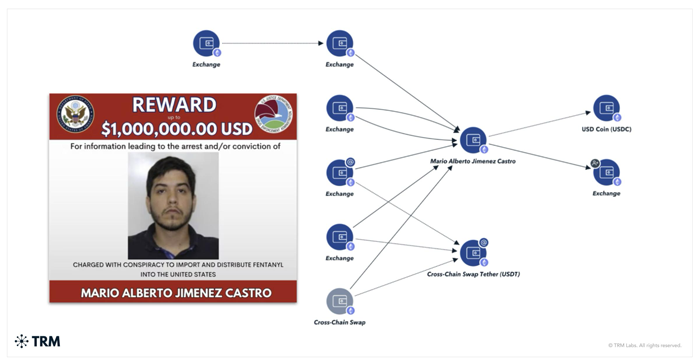
The movement of dirty cryptocurrency to accounts controlled by Mario Alberto Jimenez Castro. Visualization: TRM Labs
According to the U.S. Department of Justice, he coordinated couriers across the United States who collected cash from fentanyl sales and then converted it into cryptocurrency to be forwarded to the cartel's leadership. That was the first time OFAC publicly listed an Ethereum address tied to a Mexican drug cartel. Later investigations grew even more ambitious in scope.
In one 2024 case, authorities described a professional money-laundering network that moved more than $15 million through a single cryptocurrency account before distributing the funds across wallets on the TRON and Ethereum networks.
Operation RapTor: the collapse of the largest darknet empire in history
Law enforcers shut down Incognito Market, a darknet marketplace run by a specialist in countering illegal cryptocurrency transactions
In another investigation, federal prosecutors in Los Angeles said a network linked to the Sinaloa Cartel had laundered more than $50 million in drug proceeds through Chinese underground bankers. In that scheme, cryptocurrencies were used alongside trade-based operations and international money transfers to disguise the origin of the funds.
The laundering scheme: from cash in the U.S. to payouts in Mexico
U.S. authorities emphasize that cryptocurrencies have not replaced traditional money-laundering schemes — they have become an extension of them.
The system typically works as follows
Intermediaries in the U.S. collect large volumes of cash from drug sales. The money is then split across bank accounts or converted into stablecoins — cryptocurrencies pegged to the dollar.
The digital assets are then distributed across various cryptocurrency exchanges and wallets to make transactions harder to trace. The funds are then sent on to intermediaries in Mexico, who pay out the money to cartel structures in the local currency.
Chinese money-laundering organizations — known as CMLOs — have come to play an especially important role in this system. These networks help connect the cartels' cash in the U.S. with demand from Chinese citizens looking to move capital out of the country. Settlements between the parties are increasingly handled through cryptocurrencies.
International drug money laundering network uncovered. Three Mexican banks implicated
CIBanco, Intercam Banco, and Vector Casa de Bolsa assisted Mexican drug cartels, which the US has equated with international terrorist organizations
The commission charged by such intermediaries typically ranges from 0.5% to 5%. By bypassing traditional banking channels, these schemes allow cartels to avoid international banking oversight and significantly speed up cross-border transfers.
Buying fentanyl precursors in China with crypto
Cryptocurrencies are used not only for laundering money, but also for purchasing components used to produce narcotics. Research shows that around 97% of Chinese manufacturers of chemical precursors — the substances used to make fentanyl — accept payment in cryptocurrency.
The volume of cryptocurrency flowing to such companies rose from $30.9 million in 2023 to $39.1 million in 2025. This reflects a steady increase in demand within the global supply chain for synthetic drugs.
What crypto companies need to do: compliance after the new sanctions
Any cryptocurrency platform that handles transactions involving addresses on the new sanctions list now risks violating U.S. sanctions.
Companies are required to update their screening systems immediately and monitor activity tied to the new Ethereum addresses. U.S. authorities stress that the current sanctions are not an isolated event, but part of a sustained trend.
More than half of all cryptocurrency addresses sanctioned by OFAC in 2025 were tied to illegal drug trafficking. Platforms serving Latin American users, handling over-the-counter crypto deals, or working with high-risk foreign exchanges will now face particularly close scrutiny.
Investigators are also paying close attention to the characteristic pattern of splitting funds across multiple wallets. That means simply screening specific sanctioned addresses is no longer enough. Regulators expect companies to analyze the connections between wallets and to trace transactions even through several intermediary addresses.
Profile: the Sinaloa Cartel
The Sinaloa Cartel is one of the largest and most notorious drug trafficking organizations in the world, originating in the Mexican state of Sinaloa in the late 20th century.
The group gained global notoriety for the large-scale smuggling of cocaine, heroin, methamphetamine, and especially fentanyl into the United States and other countries — as well as for the figure of Joaquín Guzmán, known as "El Chapo," long considered one of the most powerful drug lords in history.
The cartel is known for its enormous financial resources, international supply network, armed units, and ability to infiltrate legitimate businesses, financial institutions, and cross-border money-laundering schemes. Many experts point to Sinaloa as the organization that turned the drug trade into a global, high-tech industry powered by cryptocurrencies, underground banking networks, and international logistics.

Useful material?
 Telegram
  Twitter
 Research
One and the same cryptocurrency address received two completely opposite assessments from different analytics systems: from an ordinary gambling service to an extremely severe criminal offense. This story has become the starting point for a broader conversation about what the scientific standards of blockchain analysis should look like — and why errors in systems like these can shape the fates of real people.
Jul 1, 2026
Research
The blockchain has helped uncover the ties between cryptocurrency fundraising campaigns, exchangers in Syria, and intermediaries in several countries around the world. A telltale pattern has emerged in which the same addresses were used across multiple donation drives at once
Jun 24, 2026
Research
Four Iranian cryptocurrency exchanges accounted for roughly 78% of all digital asset volume tied to the country in 2025. They have now become the focal point of the largest U.S. sanctions campaign against Iran's cryptocurrency infrastructure.
Jun 5, 2026
Research
A financial system is already up and running on public blockchains, with loans, analogues of U.S. Treasuries, and automated capital markets. More than $551 billion has flowed through DeFi protocols — but most of that activity has nothing to do with the real economy and everything to do with the speculative build-up of risk.
May 29, 2026
Research
For the first time, the new law makes blockchain analytics an officially mandatory tool of financial oversight in the United States. Authorities will also gain the power to restrict transactions with foreign crypto services tied to money-laundering risks.
May 20, 2026
Research
Working with cryptocurrencies requires more than just new technology — it demands a complete overhaul of internal processes. We explain how the financial sector is learning to control digital assets and detect threats
May 8, 2026
Cryptocurrency rates
-

Bitcoin
$81 423
BTC
-0.95%
-

Ethereum
$2 426.39
ETH
-1.84%
-

BNB Smart Chain
$719.17
BSC
-1.38%
-

Ripple
$1.42
XRP
+1.04%
-

TRON
$0.336581
TRX
+0.36%
-

Zcash
$1 163.12
ZEC
-5.26%
-

Dogecoin
$0.079871
DOGE
-2.74%
-

Cardano
$0.218269
ADA
+2.11%
-

Stellar XLM
$0.184461
XLM
+2.83%
-

Bitcoin Cash
$272.75
BCH
-3.29%