


A technical glitch at Paxos led to the accidental issuance of 300 trillion PYUSD stablecoins
The company called it an “internal technical error”

16.10.2025 - 10:00
413
2 min
0
Key points:
- Paxos mistakenly issued 300 trillion PYUSD stablecoin tokens.
- The company explained the error as a technical issue and stated that the incident had been resolved.
On October 15, stablecoin infrastructure provider Paxos mistakenly issued 300 trillion PYUSD and then burned the entire amount 22 minutes later by sending the tokens to an inaccessible wallet. Later, 300 million PYUSD were issued, and the team called the situation an “internal technical error.” .
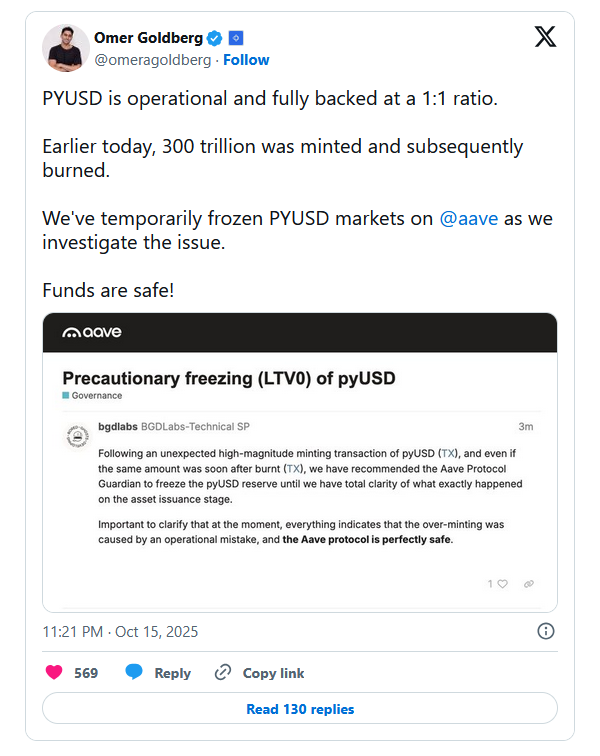
Chaos Labs founder Omer Goldberg reported that Aave temporarily suspended trading on PaPal USD after an “unexpected” large transaction involving the issuance and burning of stablecoins.
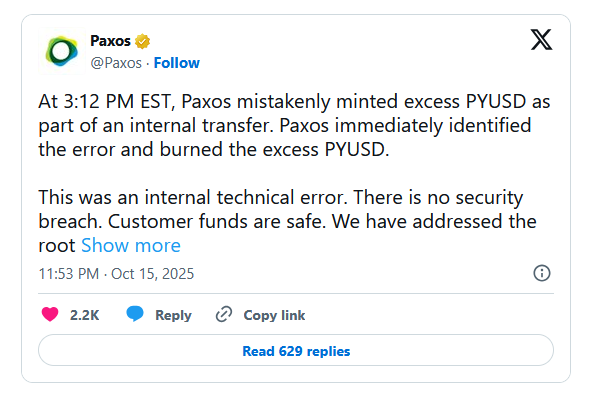
According to Etherscan, the erroneous issuance of the stablecoin was made from the Paxos hot wallet and sent to the PYUSD PayPal smart contract. The issuance volume is equivalent to $300 trillion — more than the US national debt ($37 trillion) and even global GDP ($117 trillion).
The incident briefly disrupted DeFi markets, and the PYUSD exchange rate deviated from $1, but quickly stabilized after the excess tokens were burned.
According to CoinGecko, PYUSD now ranks sixth among stablecoins in terms of capitalization — about $2,6 billion.

Useful material?
 Telegram
 Twitter
Incidents
In a single week, hackers went after PHP websites, the Railway cloud platform and a medical company, and experts started talking about a crisis that is only just beginning.
Oct 28, 2026
Incidents
In 104 minutes, the attacker emptied 1,404 addresses before validators halted the network and froze almost all of the loot.
Oct 19, 2026
Incidents
Developers warned of potential risks to bridges across the ecosystem and asked exchanges for assistance.
Jun 22, 2026
Incidents
The defendant helped move funds stolen through investment scams and earned at least $4 million for his role in the operation.
Jun 10, 2026
Incidents
The company is linking the incident to a compromised private key on a service wallet, rather than a smart contract exploit
May 22, 2026
Incidents
Following the incident, the project temporarily halted trading operations and node activity.
May 15, 2026
Cryptocurrency rates
-

Bitcoin
$74 620
BTC
+1%
-

Ethereum
$2 078.77
ETH
+1%
-

BNB Smart Chain
$686.63
BSC
+1.4%
-

Ripple
$1.42
XRP
+1.04%
-

TRON
$0.317487
TRX
-0.07%
-

Zcash
$996.43
ZEC
-5.82%
-

Dogecoin
$0.068592
DOGE
+1.15%
-

Cardano
$0.218269
ADA
+2.11%
-

Stellar XLM
$0.184461
XLM
+2.83%
-

Polkadot
$3.32
DOT
+5.27%