

Corporate bitcoin accumulations reached 847 000 BTC in the second quarter
Companies added a record 159 107 coins to their balance sheets during the reporting period

10.07.2025 - 13:55
703
4 min
0
What’s new? Corporate interest in bitcoin hit new highs in Q2 2025, with companies adding a record 159 107 coins to their balance sheets worth more than $17,6 billion at current exchange rates, according to data from investment firm Bitwise.
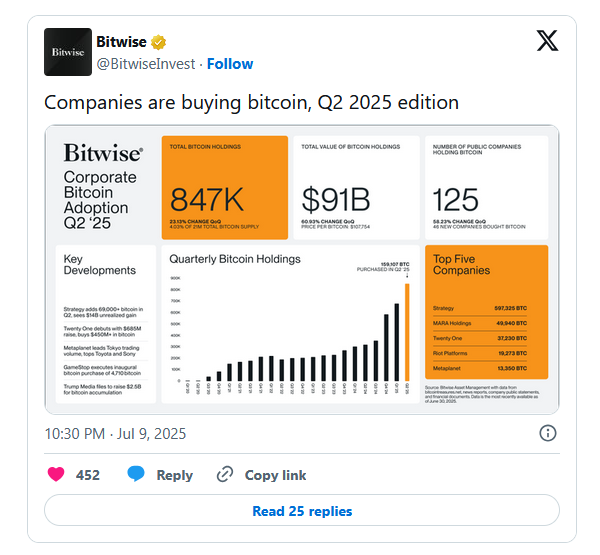
What else is known? Companies bought 23,13% more coins in the reporting period than in the previous quarter, bringing the total corporate accumulation to 847 000 BTC or about 4% of the total bitcoin supply, programmatically capped at 21 million coins.
The total value of corporate bitcoin holdings reached $91 billion by the end of the quarter, based on a closing price of $107 754, a 60,93% increase from Q1.
After that, bitcoin’s rise continued and the asset hit a new all-time high above $112 000 on July 9.

Coinbase outlines the possible negative consequences of bitcoin accumulation by publicly traded firms
The exchange’s analysts pointed out the leverage in fundraising strategies
The number of public companies investing in bitcoin also increased sharply, with 46 more in Q2 and the total number rising to 125, up 58,23% from the previous quarter.
The segment leader is Michael Saylor’s analytics software company Strategy with a stock of 597 325 coins. The company has been following a bitcoin accumulation strategy since 2020, issuing convertible bonds and shares to fund regular purchases.
The company’s stock, under the ticker MSTR, is up 43% since the beginning of the year, far outperforming the S&P 500 index’s modest 6,4% gain over the same period.

Texas will be the first state in the US to create a bitcoin reserve
The authorities will invest $10 million in the asset
The largest miner, Marathon, with a capitalization of $6,49 billion, is the second-largest corporate bitcoin holder with a balance of 49 940 BTC. Its MARA stock is up more than 10% since the beginning of the year.
New entrants in the corporate bitcoin investor segment include Twenty One, which raised $685 million and invested more than $450 million of that in BTC. In Japan, the market leader was Metaplanet with a balance of 13 350 BTC, its shares dominate the local market in terms of trading volume, overtaking such well-known companies as Toyota and Sony.

Metaplanet plans to buy a digital bank in Japan
The company will use bitcoin reserves to finance the deal
GameStop also started investing in the first cryptocurrency, accumulating 4710 BTC on its balance sheet and cementing the trend of non-crypto companies entering this market. Trump Media has also joined the race, filing to raise $2,5 billion for bitcoin investments.
This week, miner London BTC Company (formerly Vinanz) raised 1,5 million pounds sterling ($2 million) by issuing 11,5 million common shares to further accumulate cryptocurrency. So far, this strategy has not had a positive impact on the value of its securities: since the beginning of the year, they have fallen by more than 42%, and over the last day, by more than 7%.
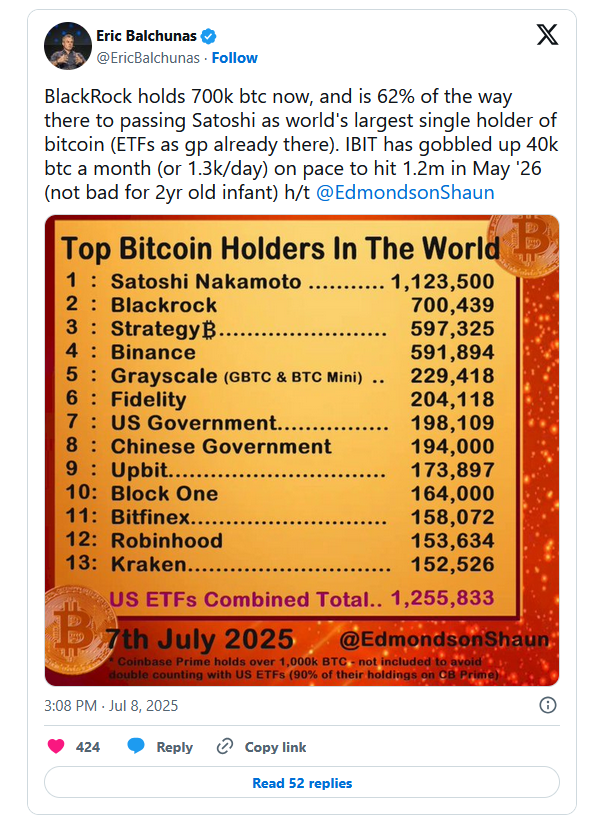
The largest holder of bitcoin remains the creator of the asset, Satoshi Nakamoto, with a balance of 1 123 500 coins. He is followed by the world’s largest investment company BlackRock with a balance of over 700 000 coins. The company purchases these bitcoins on behalf of investors for its spot exchange-traded fund IBIT, which will be launched in January 2024. Strategy sits in third place on the overall list.
Bloomberg analyst Eric Balchunas estimated that at the current pace of purchases, BlackRock’s IBIT could become the largest holder by May 2026.

Useful material?
 Telegram
  Twitter
 Incidents
In 104 minutes, the attacker emptied 1,404 addresses before validators halted the network and froze almost all of the loot.
Oct 19, 2026
Incidents
Developers warned of potential risks to bridges across the ecosystem and asked exchanges for assistance.
Jun 22, 2026
Incidents
The defendant helped move funds stolen through investment scams and earned at least $4 million for his role in the operation.
Jun 10, 2026
Incidents
The company is linking the incident to a compromised private key on a service wallet, rather than a smart contract exploit
May 22, 2026
Incidents
Following the incident, the project temporarily halted trading operations and node activity.
May 15, 2026
Incidents
The user spent weeks unsuccessfully trying to guess the password until Claude helped find an old wallet backup file
May 14, 2026
Cryptocurrency rates
-

Bitcoin
$83 299
BTC
+0.67%
-

Ethereum
$2 448.08
ETH
+0.03%
-

BNB Smart Chain
$744.13
BSC
+0.47%
-

Ripple
$1.42
XRP
+1.04%
-

TRON
$0.330188
TRX
-0.14%
-

Zcash
$1 305.31
ZEC
+3.2%
-

Dogecoin
$0.081004
DOGE
-0.86%
-

Cardano
$0.218269
ADA
+2.11%
-

Stellar XLM
$0.184461
XLM
+2.83%
-

Bitcoin Cash
$282.99
BCH
-1.11%