

Liechtenstein starts accepting cryptocurrencies to pay for public services
The introduction of digital assets aims to reduce the costs associated with conventional transaction fees and exchange rates
30.01.2024 - 09:55
2603
2 min
0
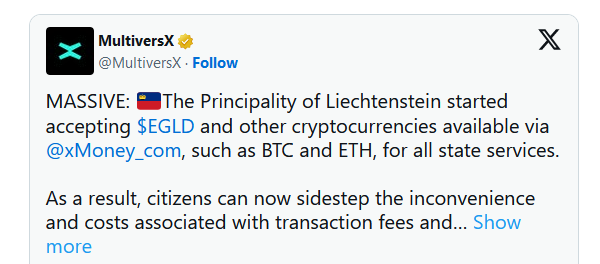
What’s new? Liechtenstein has started accepting cryptocurrencies as a means of payment for public services. The initiative is in partnership with Web 3.0 platform xMoney, built on the MultiversX Layer 1 (L1) blockchain. The Principality accepts MultiversX (EGLD) native tokens and other cryptocurrencies available on the platform, including BTC and ETH. The introduction of digital currencies is aimed at reducing costs associated with conventional transaction fees and exchange rates.
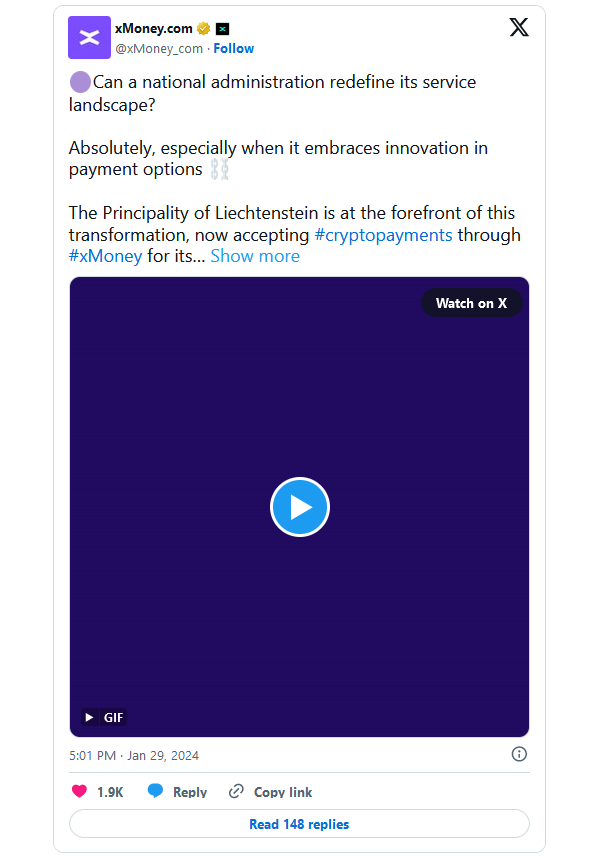
What else is known? Liechtenstein residents can use cryptocurrencies to pay for a number of services, including trademark registrations, commercial licenses, and extracts from commercial and family registers.
“A win for the entire industry, and great progress from the xMoney team, who continue to accelerate the adoption of blockchain through cheaper, faster and cross-border payments for more than 15,000 merchants and even entire cities - Lugano, also dubbed as the “Crypto Capital of Europe,” the representatives of MultiversX said.
In May 2023, Liechtenstein Prime Minister Daniel Risch said that in the future, citizens of Liechtenstein would be able to pay for some government services using bitcoin. The Swiss municipalities of Zug and Lugano use a similar approach to bitcoin payments.
What is known about MultiverseX? The company was called Elrond until November 2022 but then rebranded with a focus on development in Web 3.0 technologies and the development of products and services for metaverses.
This scalable blockchain network offers infrastructure services for enterprise and decentralized applications, as well as the new Internet economy. It is one of Europe’s first carbon-negative blockchains.

Useful material?
 Telegram
  Twitter
 Incidents
Developers warned of potential risks to bridges across the ecosystem and asked exchanges for assistance.
Jun 22, 2026
Incidents
The defendant helped move funds stolen through investment scams and earned at least $4 million for his role in the operation.
Jun 10, 2026
Incidents
The company is linking the incident to a compromised private key on a service wallet, rather than a smart contract exploit
May 22, 2026
Incidents
Following the incident, the project temporarily halted trading operations and node activity.
May 15, 2026
Incidents
The user spent weeks unsuccessfully trying to guess the password until Claude helped find an old wallet backup file
May 14, 2026
Crypto regulations
Authorities are introducing mandatory registration for companies handling cross-border crypto transactions
May 8, 2026
Cryptocurrency rates
-

Bitcoin
$82 185
BTC
+0.73%
-

Ethereum
$2 441.39
ETH
+0.66%
-

BNB Smart Chain
$732.52
BSC
+0.57%
-

Ripple
$1.42
XRP
+1.04%
-

TRON
$0.331644
TRX
-0.54%
-

Zcash
$1 234.53
ZEC
+7.12%
-

Dogecoin
$0.081101
DOGE
-1.02%
-

Cardano
$0.218269
ADA
+2.11%
-

Stellar XLM
$0.184461
XLM
+2.83%
-

Bitcoin Cash
$279.53
BCH
+4.17%