

Philippine senator proposes moving national budget to blockchain
If the initiative is implemented, the country will become the first in the world with a blockchain-based budget

28.08.2025 - 11:30
502
3 min
0
Key points:
- Senator Bam Aquino is preparing a bill to transfer the Philippine state budget to blockchain
- The project should ensure complete transparency of spending and control of every peso
- The proposal is part of a series of initiatives to apply blockchain technology in the public sector
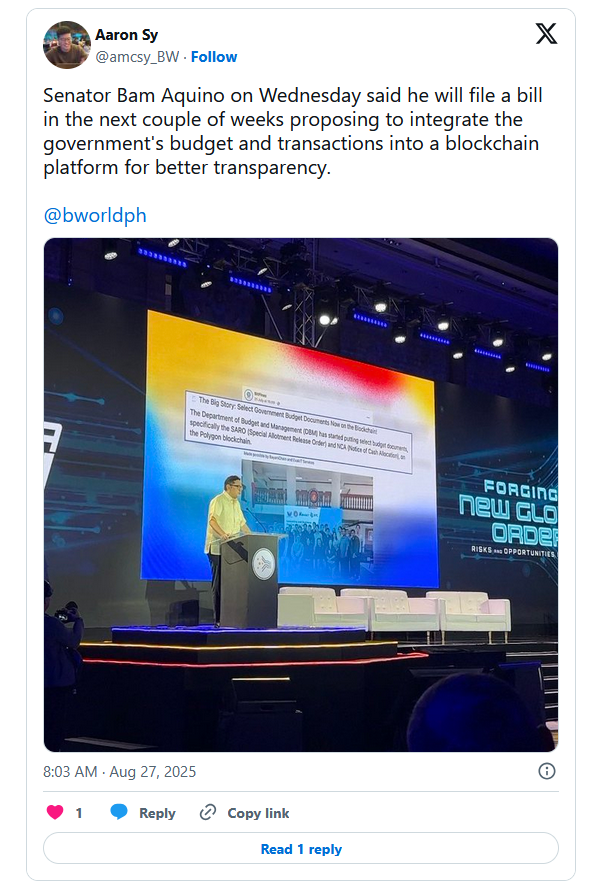
Philippine Senator Bam Aquino has announced his intention to introduce a bill to transfer the national budget and all related transactions to blockchain. According to him, this will make government spending completely transparent and accountable to the public.
Aquino spoke about his plans at the Manila Tech Summit. He noted that the initiative will be submitted to parliament in the coming weeks.
“No one is crazy enough to put their transactions on blockchain, where every single step of the way will be logged and transparent to every single citizen. But we want to start,” the senator said at the conference.
What will the initiative be based on?
The bill has not yet been submitted, but it is expected to be based on the existing blockchain platform of the Ministry of Budget and Management, built on Polygon. The system is already being used to verify financial documents: orders for the allocation of funds and notifications about the distribution of budget money are published online.
Paul Soliman, the CEO of BayaniChain, emphasized that the senator’s vision is consistent with the company’s commitment to developing transparent digital solutions. According to him, blockchain does not completely solve the problem of corruption, but it creates immutable records that increase the accountability of officials.
BayaniChain currently provides a technological link between the department’s internal system and the public blockchain.
Blockchain in politics in the Philippines and other countries
Aquino’s statement came shortly after the launch of the country’s first blockchain platform to protect government documents from forgery and deepfakes. The system was developed by Deputy Minister Maria Francesca Del Rosario and became the first initiative of its kind in Asia.
At the same time, another bill was introduced in the Philippine Congress. Congressman Miguel Luis Villafuerte proposed creating a strategic reserve of 10 000 BTC. According to the initiative, the central bank will purchase 2000 BTC annually for five years and then lock them up for 20 years. The reserve can only be used to pay off the national debt.

Philippines proposes creating a strategic reserve of 10 000 BTC
The bill states that the reserve should not be sold or exchanged for any purpose other than to pay off public debt
By the end of 2024, the Philippines’ national debt had grown to 16,09 trillion pesos ($285 billion), of which nearly 68% was domestic borrowing.
Global trend
The Philippines is not the only country implementing blockchain in public administration. This week, US Secretary of Commerce Howard Lutnick announced that the department will begin publishing economic statistics, including GDP data, on the blockchain.

Useful material?
 Telegram
  Twitter
 Incidents
In 104 minutes, the attacker emptied 1,404 addresses before validators halted the network and froze almost all of the loot.
Oct 19, 2026
Incidents
Developers warned of potential risks to bridges across the ecosystem and asked exchanges for assistance.
Jun 22, 2026
Incidents
The defendant helped move funds stolen through investment scams and earned at least $4 million for his role in the operation.
Jun 10, 2026
Incidents
The company is linking the incident to a compromised private key on a service wallet, rather than a smart contract exploit
May 22, 2026
Incidents
Following the incident, the project temporarily halted trading operations and node activity.
May 15, 2026
Incidents
The user spent weeks unsuccessfully trying to guess the password until Claude helped find an old wallet backup file
May 14, 2026
Cryptocurrency rates
-

Bitcoin
$81 285
BTC
-1.97%
-

Ethereum
$2 377.82
ETH
-2.59%
-

BNB Smart Chain
$726.39
BSC
-0.02%
-

Ripple
$1.42
XRP
+1.04%
-

TRON
$0.332031
TRX
+0.3%
-

Zcash
$1 126
ZEC
-3.49%
-

Dogecoin
$0.078743
DOGE
-1.36%
-

Cardano
$0.218269
ADA
+2.11%
-

Stellar XLM
$0.184461
XLM
+2.83%
-

Bitcoin Cash
$272.5
BCH
-2.49%