

Russia has overtaken the UK and leads Europe’s crypto economy
A Chainalysis report has shown that Russia has taken first place in terms of crypto transaction volume, and the introduction of MiCA has radically changed the European market
17.10.2025 - 14:40
401
4 min
0
Key points:
- Russia has become Europe’s largest crypto market with a volume of $376 billion, ahead of the UK with $273 billion.
- The introduction of MiCA and the 2727% growth of EURC have changed the balance of power between euro and dollar stablecoins.
Between July 2023 and June 2025, Europe showed steady growth in crypto activity. After a decline in mid-2024, transaction volume rose again, peaking at $234 billion in December. The region has strengthened its position as a mature market dominated by institutional players and the growing role of DeFi.
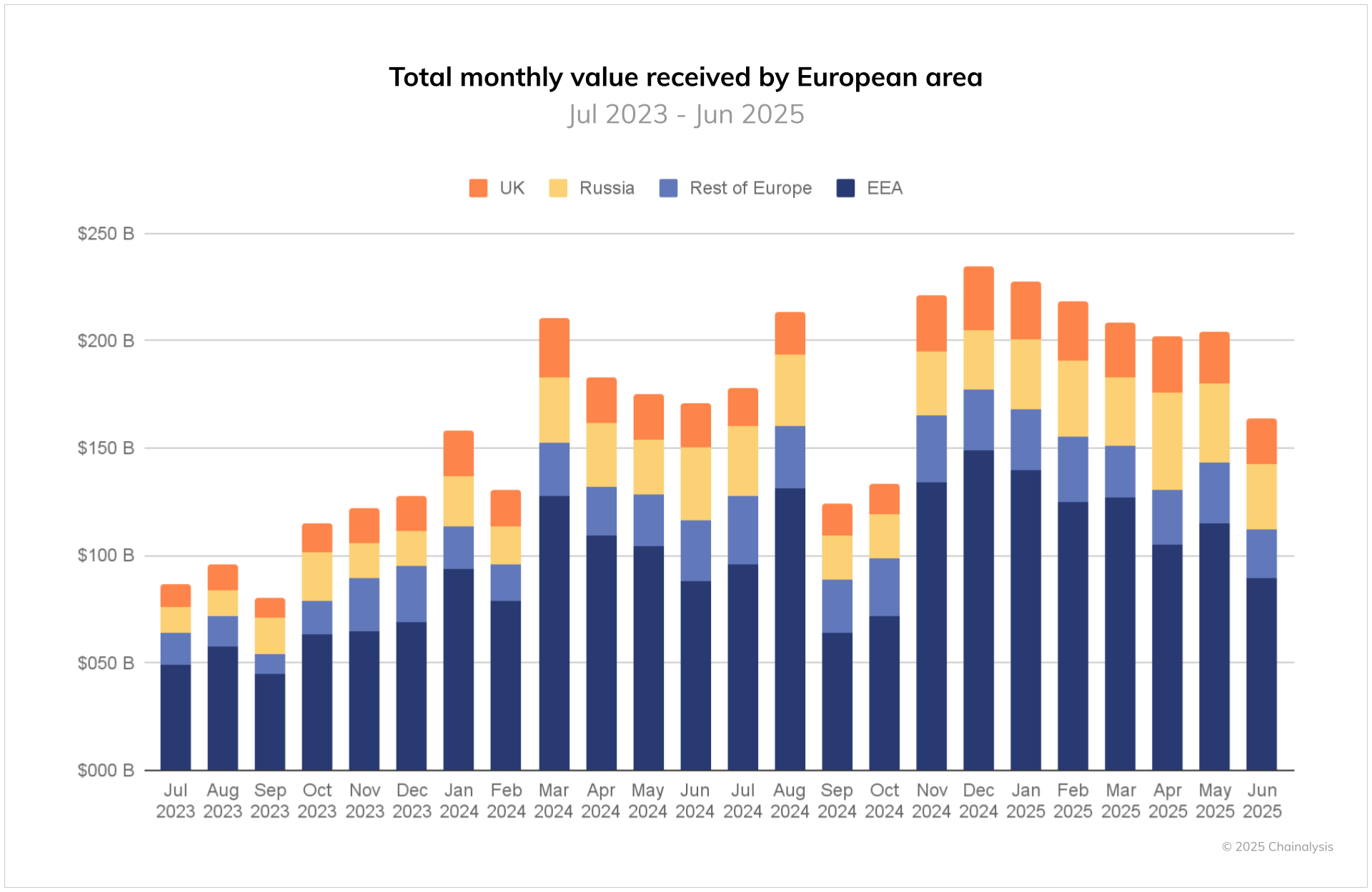
Monthly dynamics of cryptocurrency transactions in Europe
According to the Chainalysis report, the ten largest markets are spread across the continent. Russia confidently took first place with $376,3 billion in assets received, ahead of the UK ($273,2 billion) and Germany ($219,4 billion). Ukraine ($206,3 billion) and France ($180,1 billion) rounded out the top five.
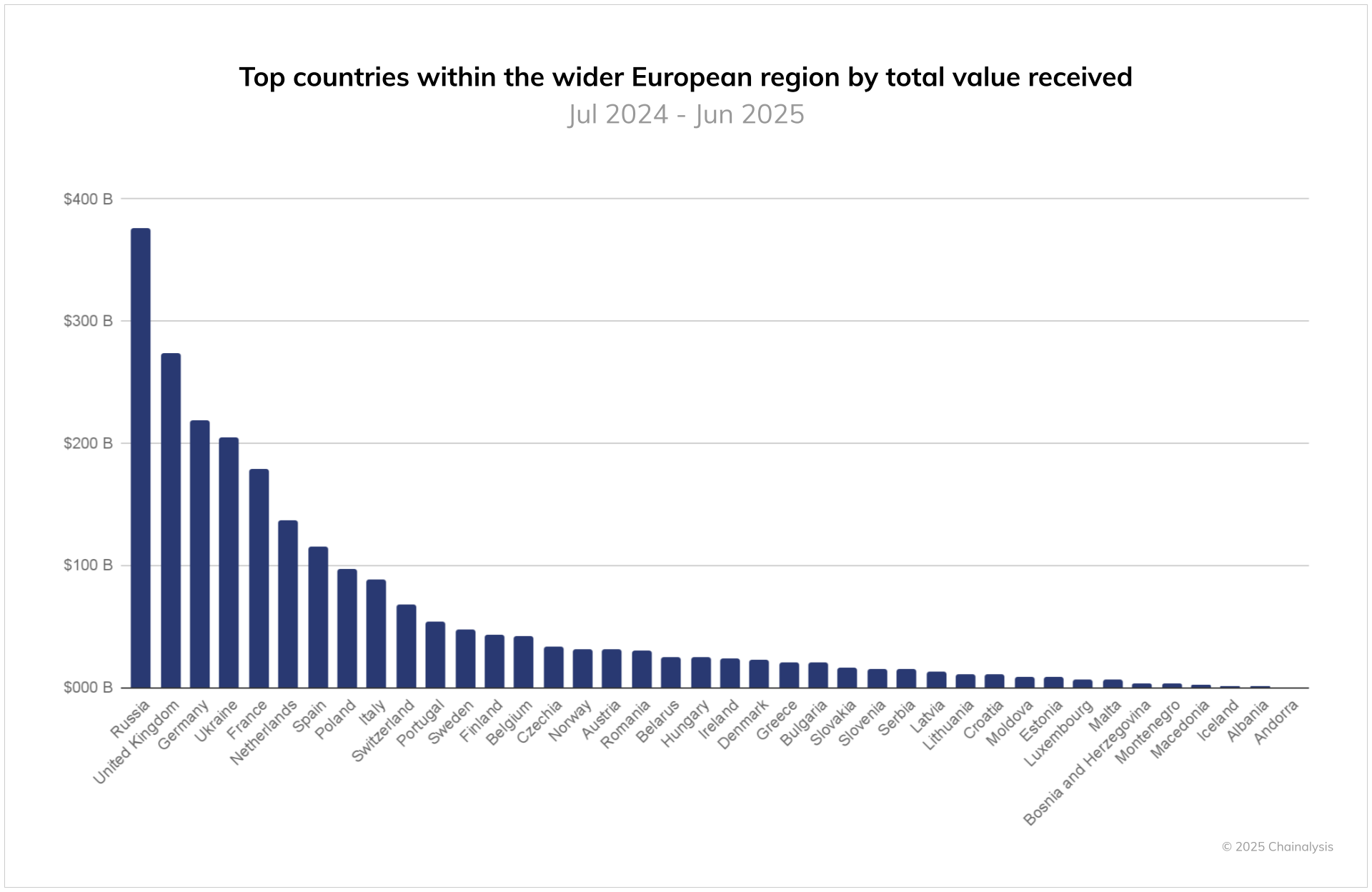
Top European countries by volume of crypto assets received in 2024–2025
European growth: from Germany to Poland
The growth of crypto activity in Europe depends not only on market size. Germany increased its volume by 54%, becoming a magnet for crypto companies thanks to transparent MiCA rules and developed infrastructure. Ukraine and Poland showed growth of 52% and 51%, respectively, due to local transfers and high user acceptance.
Contrary to expectations, the largest markets are not slowing down but growing faster. This indicates strong network effects: the more participants in the ecosystem, the faster it attracts new users. Europe is still in a phase of accelerated adoption rather than saturation.
MiCA and the new order of stablecoins
The MiCA regulation, which came into force in the summer of 2024, became a key driver of market restructuring. It unified the rules for 30 EEA countries and, for the first time, established clear requirements for token issuers.
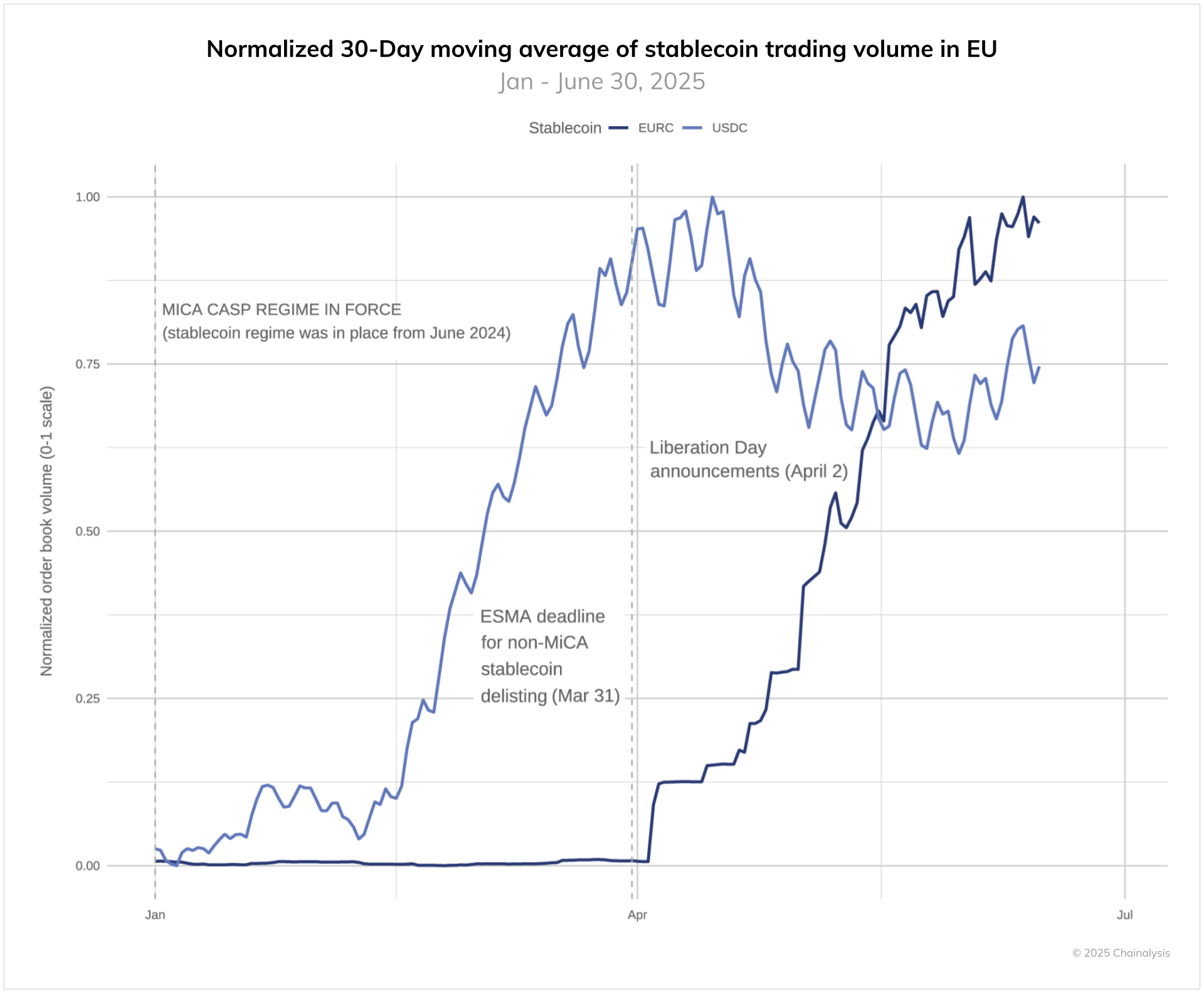
Change in stablecoin trading volumes in the EU after the introduction of MiCA
As a result, there was a noticeable shift: stablecoins that did not comply with MiCA, in particular USDT, effectively left the market. Regulated analogs grew in their place. Circle’s EURC stablecoin increased its trading volume by 2727%, while USDC increased by only 86%.
Key milestones of the reform:
- December 2024 — growth of USDC after CASP’s transition to MiCA;
- March 2025 — ESMA deadline for delisting old tokens;
- April 2025 — surge in EURC and decline in the share of dollar-pegged stablecoins.
Russia strengthens its position in DeFi
Russia not only leads in terms of total transaction volume, but also shows explosive growth in DeFi. Activity in the sector increased eightfold compared to 2023 and stabilized at a level 3,5 times higher than the baseline.
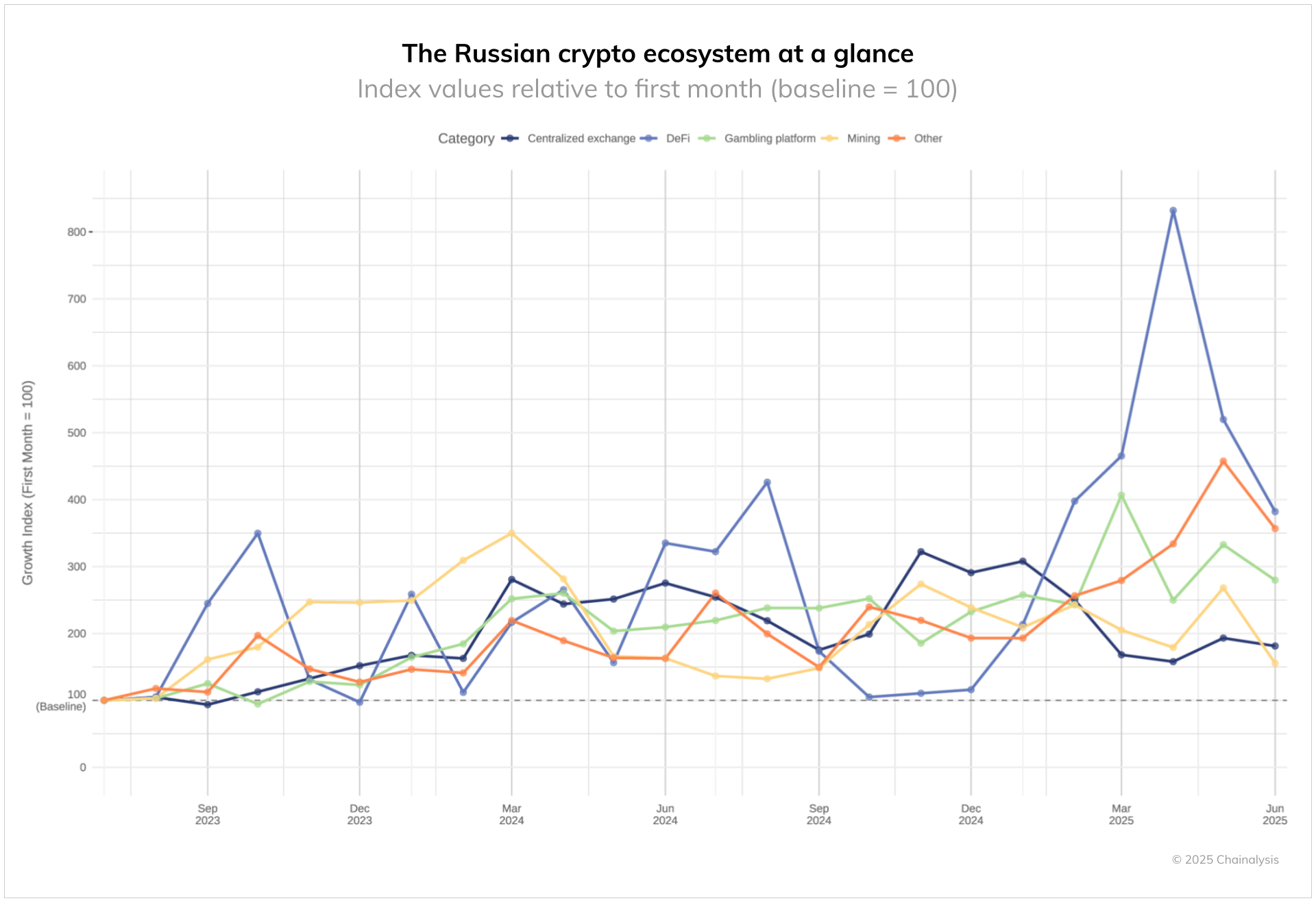
Overview of the dynamics of Russia’s crypto economy
The growth in institutional transfers is particularly noticeable: transactions over $10 million grew by 86% over the year — almost twice as fast as the regional average.
The Chainalysis report emphasizes that the European crypto market has entered a phase of maturity, where regulation no longer hinders innovation but guides it.

Useful material?
 Telegram
  Twitter
 Incidents
Developers warned of potential risks to bridges across the ecosystem and asked exchanges for assistance.
Jun 22, 2026
Incidents
The defendant helped move funds stolen through investment scams and earned at least $4 million for his role in the operation.
Jun 10, 2026
Incidents
The company is linking the incident to a compromised private key on a service wallet, rather than a smart contract exploit
May 22, 2026
Incidents
Following the incident, the project temporarily halted trading operations and node activity.
May 15, 2026
Incidents
The user spent weeks unsuccessfully trying to guess the password until Claude helped find an old wallet backup file
May 14, 2026
Crypto regulations
Authorities are introducing mandatory registration for companies handling cross-border crypto transactions
May 8, 2026
Cryptocurrency rates
-

Bitcoin
$85 570
BTC
-0.32%
-

Ethereum
$2 698.42
ETH
-0.59%
-

BNB Smart Chain
$778.95
BSC
-0.99%
-

Ripple
$1.42
XRP
+1.04%
-

TRON
$0.335357
TRX
-0.31%
-

Zcash
$1 365.32
ZEC
+2.18%
-

Dogecoin
$0.093762
DOGE
-1.73%
-

Cardano
$0.218269
ADA
+2.11%
-

Stellar XLM
$0.184461
XLM
+2.83%
-

Bitcoin Cash
$311.43
BCH
-1.55%