

US court recognizes NFTs as goods under trademark law
The ruling allows creators of NFT collections to file lawsuits for plagiarism
24.07.2025 - 11:25
553
3 min
0
What’s new? A panel of three US Court of Appeals judges ruled that non-fungible tokens (NFTs) from Yuga Labs’ Bored Ape Yacht Club (BAYC) collection are goods under trademark law. The judges concluded that Yuga “had trademark priority because it was the first to use the Bored Ape Yacht Club marks in commerce.”
What else is known? The decision sets a legal precedent that could allow creators of NFT collections to file lawsuits alleging plagiarism. It was handed down as part of a multi-year dispute between Yuga Labs and artist Ryder Ripps and his business partner Jeremy Cahen.
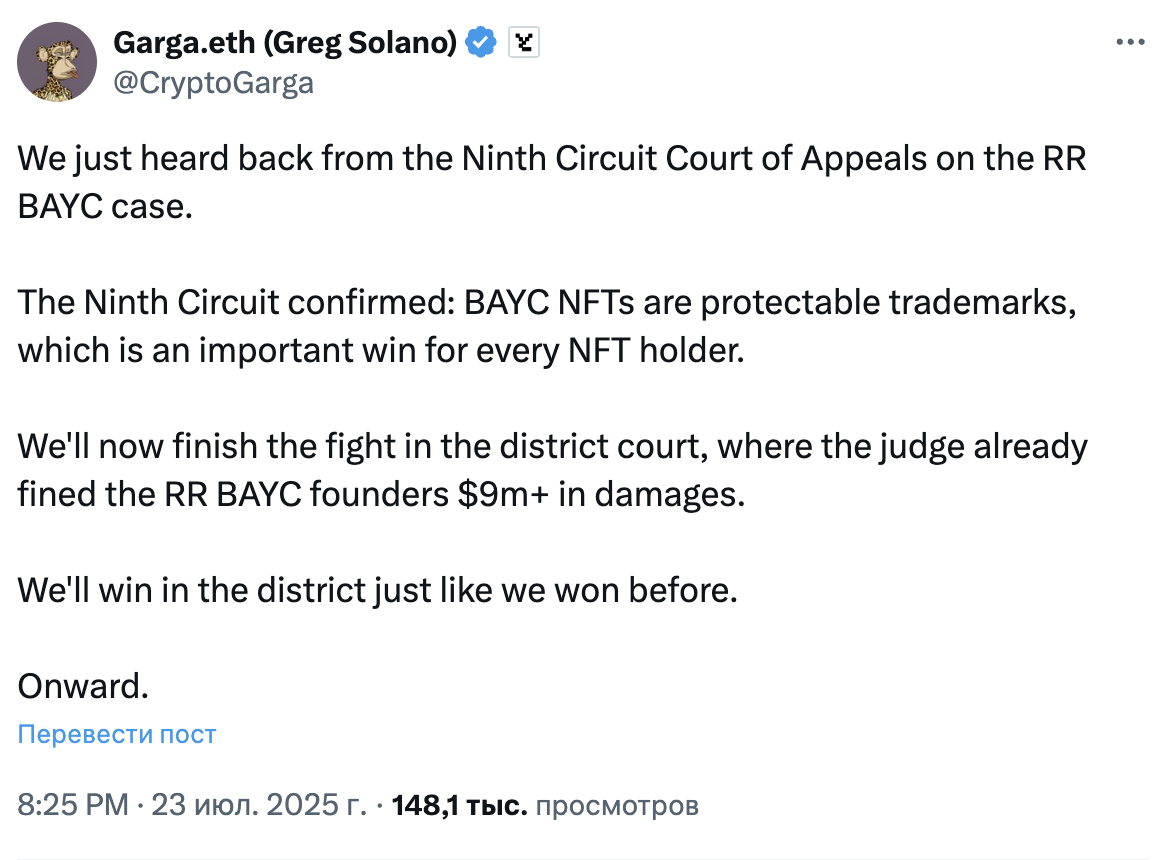
Yuga co-founder Greg Solano commented on the ruling on social media: “BAYC NFTs are protectable trademarks, which is an important win for every NFT holder.”
At the same time, the court overturned the decision requiring the defendants to pay Yuga Labs $9 million. According to the court, Yuga Labs has not yet proven its claim that Ripps and Cahen’s collection is a direct plagiarism of BAYC and misleads consumers. As a result, the panel remanded the case back to the California federal court for reconsideration.
In 2022, Yuga Labs sued Ripps and Cahen, claiming that their NFT collection, called Ryder Ripps Bored Ape Yacht Club, was a direct copy of BAYC. Ripps responded by saying that his collection was a satire of the racist images that the company allegedly used in its collection.
In a comment to Cointelegraph, Ripps called the court’s decision a “huge victory for artists who seek to make expressive meaningful work.” Greg Solano, in turn, wrote on social media: “we’ll now finish the fight in the district court.”
The federal court ruled in favor of Yuga in 2023, ruling that Ripps and Cahen’s NFT collection could have created confusion in the market, and initially awarded Yuga $1,6 million in compensation, which increased to $9 million after Ripps and Cahen lost their counterclaim.
Now, the appeals court has overturned the compensation ruling, ruling that Yuga’s trademark infringement claim “did not prove as a matter of law that defendants’ actions were likely to cause consumer confusion.”
According to the panel, a federal court hearing is necessary to determine whether Ripps’ NFT collection infringes on Yuga’s trademark rights.
At the same time, the judges agreed with the federal court that Ripps and Cahen’s “use of Yuga’s marks did not constitute nominative fair use and was not ‘expressive work’ protected by the First Amendment.”

Useful material?
 Telegram
  Twitter
 Incidents
In 104 minutes, the attacker emptied 1,404 addresses before validators halted the network and froze almost all of the loot.
Oct 19, 2026
Incidents
Developers warned of potential risks to bridges across the ecosystem and asked exchanges for assistance.
Jun 22, 2026
Incidents
The defendant helped move funds stolen through investment scams and earned at least $4 million for his role in the operation.
Jun 10, 2026
Incidents
The company is linking the incident to a compromised private key on a service wallet, rather than a smart contract exploit
May 22, 2026
Incidents
Following the incident, the project temporarily halted trading operations and node activity.
May 15, 2026
Incidents
The user spent weeks unsuccessfully trying to guess the password until Claude helped find an old wallet backup file
May 14, 2026
Cryptocurrency rates
-

Bitcoin
$84 694
BTC
+2.16%
-

Ethereum
$2 493.92
ETH
+1.51%
-

BNB Smart Chain
$749.67
BSC
+1.25%
-

Ripple
$1.42
XRP
+1.04%
-

TRON
$0.33097
TRX
-0.01%
-

Zcash
$1 348.12
ZEC
+6.63%
-

Dogecoin
$0.082696
DOGE
+1.22%
-

Cardano
$0.218269
ADA
+2.11%
-

Stellar XLM
$0.184461
XLM
+2.83%
-

Bitcoin Cash
$288.62
BCH
+2.39%