

12 days of war: how the Iranian Nobitex exchange recovered after the hack
The trading platform resumed trading on July 9, but Iranian users are in no hurry to return to the exchange
18.07.2025
949
3 min
0
In June, Israel, together with the United States, struck Iranian nuclear facilities. The active stage of the armed conflict lasted 12 days, after which the parties agreed to a truce. GetBlock AML Research explains how the military action affected the regional cryptocurrency market.
Nobitex hack
On June 18, one of the most high-profile events of the Iran-Israel standoff took place: the Iranian crypto exchange Nobitex lost more than $80 million as a result of a hacker attack. The hack of the trading platform was realized by the pro-Israeli hacker group Predatory Sparrow.
How Iran’s Nobitex exchange lost more than $80 million. Chronology of the hack
The trading platform was hacked by the pro-Israeli hacker group Predatory Sparrow
Mass withdrawals
A week before the Israeli attack on Iran, there were mass withdrawals of cryptocurrency from Nobitex and other Iranian cryptocurrency platforms. It is likely that Iranian crypto investors anticipated the onset of the conflict and the economic instability that followed, so they rushed to move digital assets to more reliable platforms.
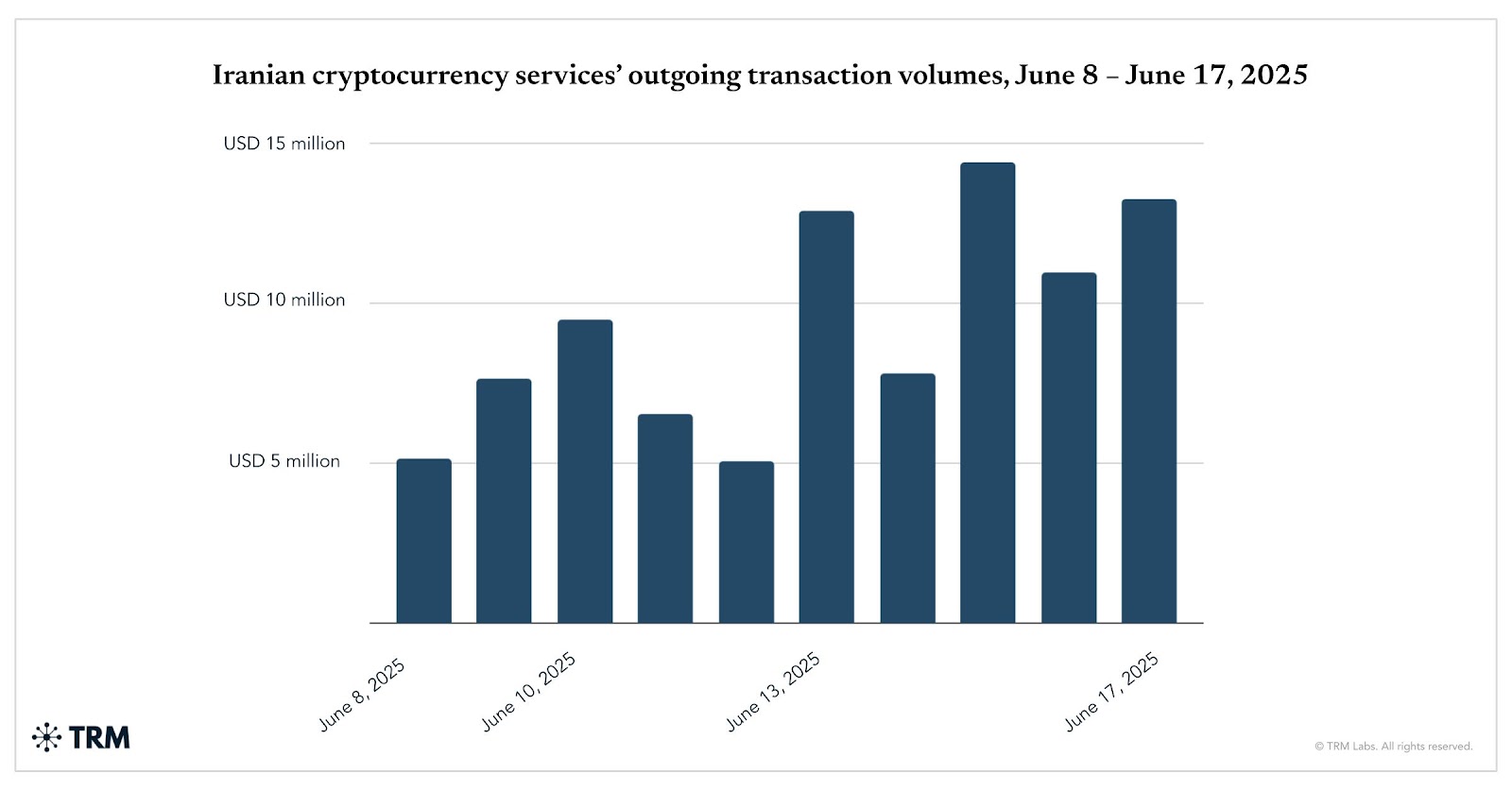
Cryptocurrency withdrawals from Iranian crypto exchanges and services
Source code
As a result of the attack on Nobitex, hackers gained access to the source code of the exchange and published it in free access. Analysis of the source code shows that Nobitex, as Iran’s main crypto platform, skillfully combined modern methods of concealing transactions and financial flows with full oversight and control by Iranian government agencies.
Technically, Nobitex was built in such a way that global regulatory bodies (such as FATF or FinCEN), as well as analytical services, could not monitor the exchange’s financial flows. Nobitex used modules to generate hidden addresses and proprietary asset-mixing technologies.
In parallel with the functions of hiding the flow of funds, Nobitex created an API to connect government services that could monitor the exchange’s transactions in real time. They could use the Nobitex infrastructure for their own purposes without the restrictions and limits imposed on ordinary users of the platform.
New chapter
In July, Nobitex announced a full recovery of operations. The exchange has completely revamped its technical infrastructure. This is indicated by the fact that Nobitex warned users about the inactivity of old deposit addresses. The exchange resumed trading on July 9. According to TRM Labs, the trading platform managed to recover quickly thanks to BTC reserves.
Despite the resumption of activity, users are in no hurry to return to Nobitex. On-chain data shows that incoming transaction volumes on Nobitex in early July 2025 (after the hack) dropped by more than 70% compared to the same period in 2024.
Iranian authorities reaction
Following the Nobitex hack, Iranian authorities imposed severe restrictions on cryptocurrency services. Iranian crypto exchanges were banned from trading at night (from 20:00 to 10:00). The restriction on trading provoked the fluctuation of the USDT exchange rate to the Iranian rial. The ban on trading crypto assets at night is still in effect today.

Useful material?
 Telegram
  Twitter
 Research
One and the same cryptocurrency address received two completely opposite assessments from different analytics systems: from an ordinary gambling service to an extremely severe criminal offense. This story has become the starting point for a broader conversation about what the scientific standards of blockchain analysis should look like — and why errors in systems like these can shape the fates of real people.
Jul 1, 2026
Research
The blockchain has helped uncover the ties between cryptocurrency fundraising campaigns, exchangers in Syria, and intermediaries in several countries around the world. A telltale pattern has emerged in which the same addresses were used across multiple donation drives at once
Jun 24, 2026
Research
Four Iranian cryptocurrency exchanges accounted for roughly 78% of all digital asset volume tied to the country in 2025. They have now become the focal point of the largest U.S. sanctions campaign against Iran's cryptocurrency infrastructure.
Jun 5, 2026
Research
A financial system is already up and running on public blockchains, with loans, analogues of U.S. Treasuries, and automated capital markets. More than $551 billion has flowed through DeFi protocols — but most of that activity has nothing to do with the real economy and everything to do with the speculative build-up of risk.
May 29, 2026
Research
Around 97% of Chinese suppliers of chemicals used to make fentanyl accept payment in cryptocurrency. The volume of such transactions continues to grow alongside the global market for synthetic drugs
May 22, 2026
Research
For the first time, the new law makes blockchain analytics an officially mandatory tool of financial oversight in the United States. Authorities will also gain the power to restrict transactions with foreign crypto services tied to money-laundering risks.
May 20, 2026
Cryptocurrency rates
-

Bitcoin
$84 694
BTC
+2.16%
-

Ethereum
$2 493.92
ETH
+1.51%
-

BNB Smart Chain
$749.67
BSC
+1.25%
-

Ripple
$1.42
XRP
+1.04%
-

TRON
$0.33097
TRX
-0.01%
-

Zcash
$1 348.12
ZEC
+6.63%
-

Dogecoin
$0.082696
DOGE
+1.22%
-

Cardano
$0.218269
ADA
+2.11%
-

Stellar XLM
$0.184461
XLM
+2.83%
-

Bitcoin Cash
$288.62
BCH
+2.39%