

A hit from within: why THORChain lost $11 million in crypto
Following the latest breach, total losses tied to THORChain since 2021 are now approaching $25 million. The protocol continues to appear in investigations connected to major crypto thefts and money laundering operations.

18.05.2026
263
4 min
0
THORChain — a crypto-swapping protocol widely used by cybercriminals to move and launder stolen funds — has now become a victim itself, losing more than $11 million in digital assets. GetBlock AML Research breaks down what is currently known about the attack.
Key Takeaways
- On May 15, 2026, an unknown attacker stole more than $11 million in cryptocurrency through THORChain. The exploit affected multiple blockchain networks, including Bitcoin, Ethereum, Binance Smart Chain (BSC), Base, Avalanche, DOGE, Litecoin, Bitcoin Cash, and XRP.
- Including previous exploits and attacks tied to the project — among them an incident involving THORChain founder JP Thorbjornsen — total losses connected to the ecosystem since 2021 are now close to $25 million.
THORChain Remains a Prime Target for Hackers
THORChain is a decentralized cross-chain liquidity protocol that allows users to swap assets between blockchains without wrapped tokens or centralized intermediaries. That same feature has made the platform both popular among users and attractive to cybercriminals.
On May 15, the attacker reportedly compromised THORChain-related functions across at least nine supported networks and drained funds from several blockchains almost simultaneously.
| Network | Initial addresses receiving stolen assets |
| BTC | bc1ql4u94klk265lnfur2ujk9p6uh52f2a8jhf6f37 |
| EVM | 0x82fc0d5150f3548027e971ec04c065f3c93154eb |
| EVM | 0xd477b69551f49c0519f9b18c55030676138890bd |
| BCH | qpp775v2je9texcv54rhd6kl9pfudy2nyyz4df2uvc |
| DOGE | DBLJWFemMHbduKofBRg6TJ9XFAgWdvFCjS |
| LTC | ltc1qg0h4rz5kf27fkr99gamw4heg20rfz5epd7m7wh |
| XRP | rwoGBrYEJ28jhBjchrTyCGXd1Pt4pobFBz |
Cross-chain attacks like this are especially difficult to investigate. Funds can move across multiple networks faster than blockchain analytics systems can trace their origin and connect related transactions. That speed is one reason THORChain has remained a key tool in large-scale laundering operations for years.
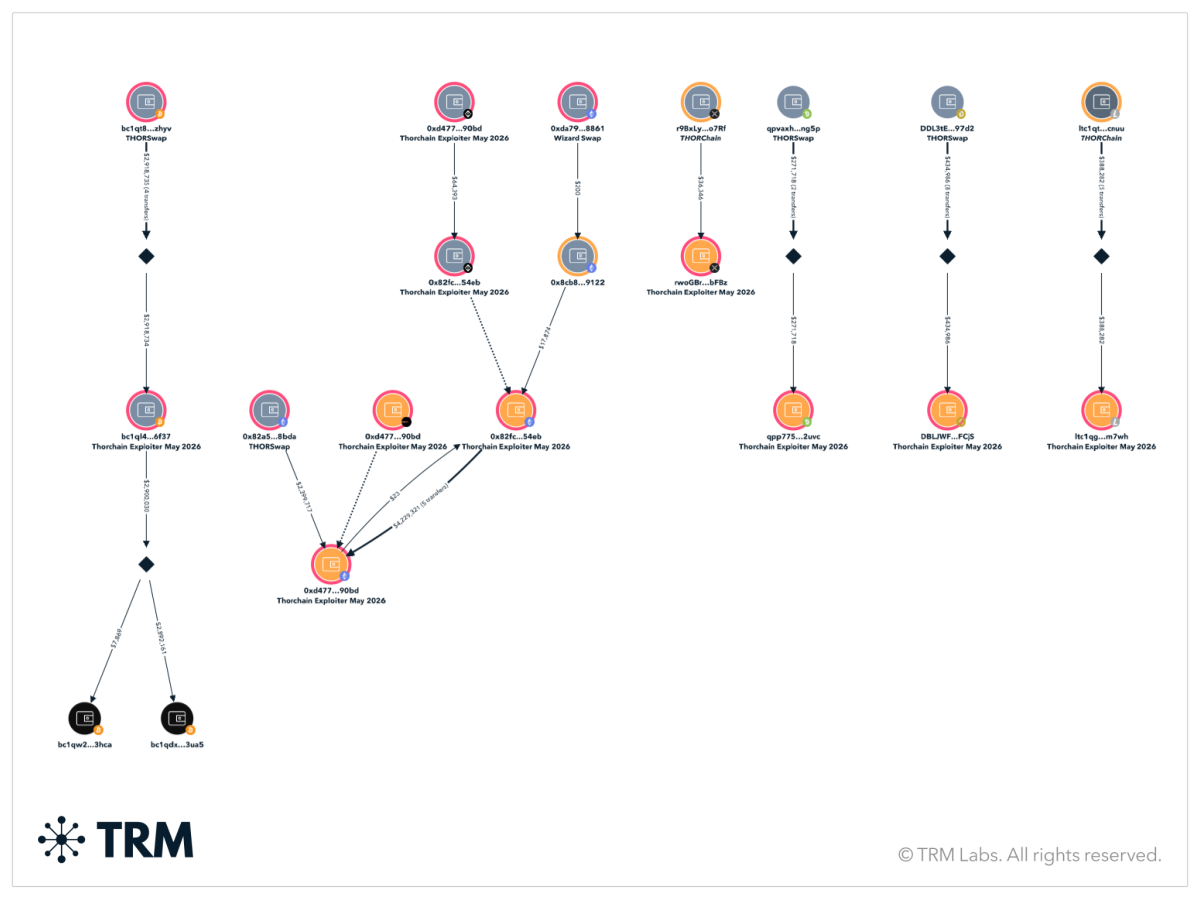
Movement of stolen assets across networks. Source: TRM Labs
After draining the funds, the attacker redistributed the stolen crypto across Bitcoin, Ethereum, BSC, and Base before consolidating the assets into two primary wallets.
Why THORChain Continues to Spark Controversy
THORChain has faced multiple security incidents over the years. In July 2021 alone, the protocol suffered two major hacks. In 2025, founder JP Thorbjornsen was also reportedly targeted by suspected North Korean hackers. With the latest exploit, cumulative losses tied to THORChain-related attacks are now nearing $25 million.
The Problem Goes Beyond the Hacks
Over the past several years, THORChain has increasingly been linked to laundering operations involving stolen cryptocurrency from major cyberattacks.
The protocol was heavily associated with fund movements following the record-breaking $1.5 billion Bybit hack in 2025, as well as the recent KelpDAO exploit that resulted in nearly $300 million in losses.
Critics argue that THORChain’s leadership has consistently refused to block illicit transactions, citing support for transaction freedom and resistance to censorship within blockchain networks.
The same cross-chain infrastructure that makes THORChain attractive to legitimate users also makes it highly effective for rapidly moving stolen assets between blockchains.
Today, THORChain is increasingly viewed both as a potential attack surface and as infrastructure capable of facilitating illicit crypto flows.
For crypto exchanges and financial platforms, that means any transactions connected to THORChain are now widely considered higher risk — especially given the possibility that such transfers may involve funds from recent hacks or broader criminal activity.

Useful material?
 Telegram
  Twitter
 Research
One and the same cryptocurrency address received two completely opposite assessments from different analytics systems: from an ordinary gambling service to an extremely severe criminal offense. This story has become the starting point for a broader conversation about what the scientific standards of blockchain analysis should look like — and why errors in systems like these can shape the fates of real people.
Jul 1, 2026
Research
The blockchain has helped uncover the ties between cryptocurrency fundraising campaigns, exchangers in Syria, and intermediaries in several countries around the world. A telltale pattern has emerged in which the same addresses were used across multiple donation drives at once
Jun 24, 2026
Research
Four Iranian cryptocurrency exchanges accounted for roughly 78% of all digital asset volume tied to the country in 2025. They have now become the focal point of the largest U.S. sanctions campaign against Iran's cryptocurrency infrastructure.
Jun 5, 2026
Research
A financial system is already up and running on public blockchains, with loans, analogues of U.S. Treasuries, and automated capital markets. More than $551 billion has flowed through DeFi protocols — but most of that activity has nothing to do with the real economy and everything to do with the speculative build-up of risk.
May 29, 2026
Research
Around 97% of Chinese suppliers of chemicals used to make fentanyl accept payment in cryptocurrency. The volume of such transactions continues to grow alongside the global market for synthetic drugs
May 22, 2026
Research
For the first time, the new law makes blockchain analytics an officially mandatory tool of financial oversight in the United States. Authorities will also gain the power to restrict transactions with foreign crypto services tied to money-laundering risks.
May 20, 2026
Cryptocurrency rates
-

Bitcoin
$84 096
BTC
+1.36%
-

Ethereum
$2 469.86
ETH
+0.85%
-

BNB Smart Chain
$745.9
BSC
+0.69%
-

Ripple
$1.42
XRP
+1.04%
-

TRON
$0.330708
TRX
-0.12%
-

Zcash
$1 309.52
ZEC
+4.13%
-

Dogecoin
$0.081799
DOGE
-0.05%
-

Cardano
$0.218269
ADA
+2.11%
-

Stellar XLM
$0.184461
XLM
+2.83%
-

Bitcoin Cash
$285.71
BCH
+0.89%