


Dangerous burn: how Movie Token handed $242K to an attacker
The incident was driven by a “double counting” flaw that distorted token balances. This allowed the attacker to profit without breaking the platform’s normal operating logic.

25.03.2026
429
3 min
0
On March 10, 2026, Movie Token (MT) was exploited, allowing an attacker to drain roughly $242,000 due to a critical flaw in the token sale logic. GetBlock AML Research analyzed the exploit step by step, revealing how a coding error led to the loss of funds.
The issue stemmed from a “double counting” bug. When users sold MT, the system both sent the tokens to a liquidity pool and simultaneously marked the same tokens for future burning. Later, when the daily rewards function (distributeDailyRewards) was triggered, those tokens were burned, artificially reducing supply. This drove the price of MT sharply higher — a condition the attacker exploited to extract funds from the pool.
Addresses Involved
| Attacker wallet: |
| 0xDB0901A3254f47c0CE57fFFCE2C730Bc33A1c0e1 |
| Victim address: |
| 0xb32979f3A5b426a4A6Ae920f2B391D885Abf4C18 |
Step-by-Step Breakdown of the Attack
The attacker began by taking out a flash loan of 358,681.54 WBNB, effectively using all available liquidity from a single source.
Next, they executed a series of swaps: buying a small amount of MT, adding liquidity to the pool, and receiving LP tokens representing their share. They then swapped 496 WBNB for 10 million MT, sending the tokens into the exchange system.
After that, they removed the previously added liquidity and reclaimed the same 10 million MT. This workaround helped bypass fees and restrictions that would apply to direct purchases.
The attacker then initiated another flash loan operation. Within it, about 90% of the tokens (after fees) were sent to the pool — while simultaneously being recorded as tokens to be burned later.
They then swapped 717 WBNB for roughly 10 million MT, significantly reducing the token supply in the pool. Afterward, they manually triggered the reward distribution function, which burned about 6.74 million MT directly from the pool.
As a result, the pool was left with very few MT tokens (around 21,000) but still held a large amount of WBNB (~1,201). This imbalance caused a sharp price spike. The attacker then swapped their ~10 million MT for 1,198.628 WBNB, capitalizing on the distorted price. After repaying the loan, they walked away with a profit of 381.7468 WBNB.
Root Cause of the Vulnerability
The core issue was a flaw in the token sale logic. When tokens were sold, the system:
- Sent them to the liquidity pool
- Simultaneously marked them as “to be burned”
Later, those same tokens were burned again, effectively double-counted and removed from circulation. Based on the code structure, this appears to have been an unintended implementation error.
What Happened to the Funds
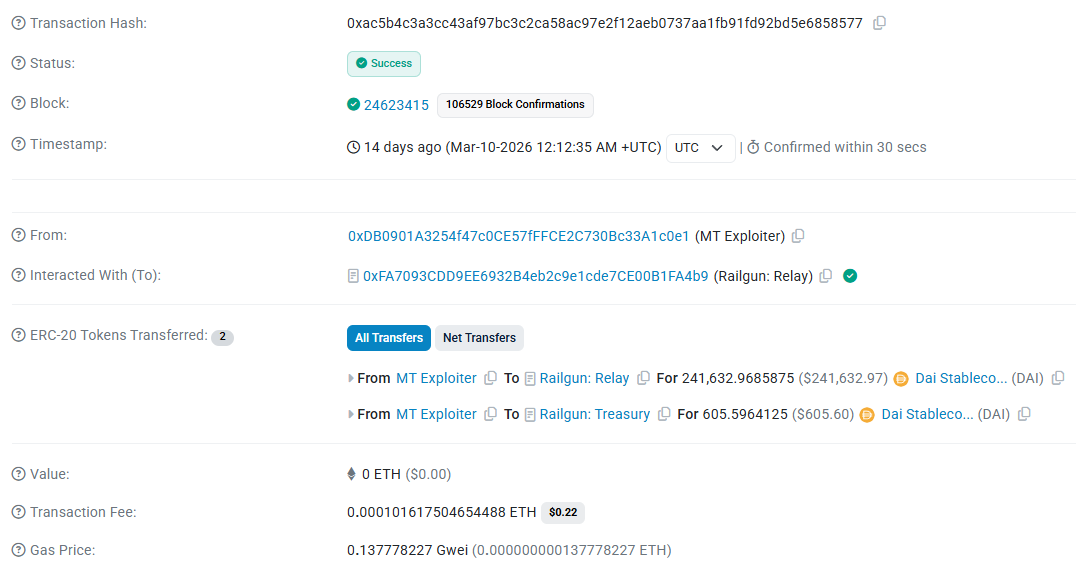
Transaction showing the swap of stolen assets via Railgun
After the exploit, the attacker swapped 381.7468 WBNB for $242,000 in USDC. The funds were then bridged to another network and converted into DAI. Finally, the attacker used Railgun, a privacy tool, to further obfuscate the transaction trail.

Useful material?
 Telegram
  Twitter
 Research
One and the same cryptocurrency address received two completely opposite assessments from different analytics systems: from an ordinary gambling service to an extremely severe criminal offense. This story has become the starting point for a broader conversation about what the scientific standards of blockchain analysis should look like — and why errors in systems like these can shape the fates of real people.
Jul 1, 2026
Research
The blockchain has helped uncover the ties between cryptocurrency fundraising campaigns, exchangers in Syria, and intermediaries in several countries around the world. A telltale pattern has emerged in which the same addresses were used across multiple donation drives at once
Jun 24, 2026
Research
Four Iranian cryptocurrency exchanges accounted for roughly 78% of all digital asset volume tied to the country in 2025. They have now become the focal point of the largest U.S. sanctions campaign against Iran's cryptocurrency infrastructure.
Jun 5, 2026
Research
A financial system is already up and running on public blockchains, with loans, analogues of U.S. Treasuries, and automated capital markets. More than $551 billion has flowed through DeFi protocols — but most of that activity has nothing to do with the real economy and everything to do with the speculative build-up of risk.
May 29, 2026
Research
Around 97% of Chinese suppliers of chemicals used to make fentanyl accept payment in cryptocurrency. The volume of such transactions continues to grow alongside the global market for synthetic drugs
May 22, 2026
Research
For the first time, the new law makes blockchain analytics an officially mandatory tool of financial oversight in the United States. Authorities will also gain the power to restrict transactions with foreign crypto services tied to money-laundering risks.
May 20, 2026
Cryptocurrency rates
-

Bitcoin
$84 611
BTC
+1.07%
-

Ethereum
$2 696.69
ETH
+0.49%
-

BNB Smart Chain
$769.99
BSC
+0.32%
-

Ripple
$1.42
XRP
+1.04%
-

TRON
$0.335396
TRX
-0.78%
-

Zcash
$1 332.13
ZEC
-6.18%
-

Dogecoin
$0.094531
DOGE
+0.06%
-

Cardano
$0.218269
ADA
+2.11%
-

Stellar XLM
$0.184461
XLM
+2.83%
-

Bitcoin Cash
$309.99
BCH
+1.39%