

From “Bitcoin Prophet” to Controversial Figure: Who Is Davinci Jeremie?
In 2013, Davinci Jeremie became known for a video where he advised viewers to buy just one dollar worth of bitcoin. Years later, his name has appeared in investigations linked to the promotion of controversial crypto projects.

16.03.2026
437
7 min
0
The cryptocurrency market is full of influencers who monetize their audiences through questionable schemes. Yet Davinci Jeremie stands out even among them. According to GetBlock AML Research, the man once called a “Bitcoin prophet” is now facing accusations related to promoting suspicious crypto projects.
From “Bitcoin Prophet” to a Controversial Reputation
In May 2013, Davinci Jeremie uploaded a low-quality YouTube video that later became the foundation of his fame. In it, he gave a simple piece of advice: buy at least $1 worth of bitcoin. At the time, BTC was trading at around $113.
For the small number of viewers who followed his advice, the investment turned out to be extremely profitable. Jeremie quickly went from a regular crypto enthusiast to someone many began calling the “Bitcoin prophet.”
Thirteen years later, that video is no longer just a piece of internet history. It has become a powerful tool of influence.

Today Jeremie operates from Dubai and speaks to an audience of more than 800,000 followers. Over time, he managed to turn his reputation as an early bitcoin supporter into a steady source of influence in the crypto market.
The pattern is fairly simple: he reminds his audience about his successful 2013 prediction, promotes lesser-known tokens or new crypto projects, and his followers’ trust helps push those assets sharply higher. Early investors can then sell their tokens for profit.
However, blockchain data and investigations by independent analysts — including well-known crypto researcher ZachXBT — suggest a different story. According to them, Jeremie didn’t just survive the turbulent decade of crypto markets. They claim he built a lifestyle around the trust of his audience, effectively using it as liquidity for various projects.
ZachXBT Investigations: From Prophet to “The Most Unlucky Token Holder”
ZachXBT is a well-known blockchain investigator who has exposed numerous questionable crypto projects and influencers in recent years. In his reports, he didn’t just criticize Jeremie — he presented specific evidence and on-chain data.
According to his findings, the image of the “Bitcoin prophet” hides another reality: Jeremie allegedly evolved from an early crypto enthusiast into an active promoter of dubious projects.
The YoloCoinsIO Scam (April 2022)
In April 2022, Jeremie actively promoted a project called YoloCoinsIO. The result was swift: in less than a day, the project effectively disappeared and the token’s price collapsed to zero.
ZachXBT tracked the situation in real time and labeled the project a direct scam on the BSC network. According to him, liquidity vanished almost immediately after Jeremie’s followers began buying the token.
When criticism started to grow, Jeremie said he had personally lost around $10,000. Many in the crypto community viewed that explanation skeptically, noting that influencers often claim losses themselves after promoting failed projects.
Reputation and the Title of “Worst Token Holder”
By July 2024, ZachXBT publicly called Jeremie “the worst token holder of all time” — a phrase that quickly became part of his reputation in the crypto community.
The logic behind the criticism was simple. Jeremie gained enormous credibility thanks to his early bitcoin prediction in 2013. Instead of preserving that reputation, critics say he spent years promoting questionable projects for relatively small payouts.
The investigator also suggested that the trust built more than a decade ago may have been used as a tool to influence his audience — especially when it came to little-known tokens or early crypto presales.
How the Token Promotion Model Works
According to analysts, the structure of Jeremie's promotions often follows the same pattern.
First, he highlights a little-known asset with a small market capitalization. Then he uses social media to drive interest and push the price higher.
To build credibility, he frequently claims to personally hold a large amount of the token or predicts strong price growth.
When retail interest peaks and the price surges, early holders often sell their tokens. After the price drops, Jeremie typically deletes promotional posts, blames the project’s developers, or says he also ended up among the victims.
The Expert Image — and Its Contradictions
At the same time, Jeremie works to maintain the image of an experienced crypto market participant. On LinkedIn, for example, he regularly posts warnings about scam crypto wallets and dangerous projects, presenting himself as someone fighting fraud.
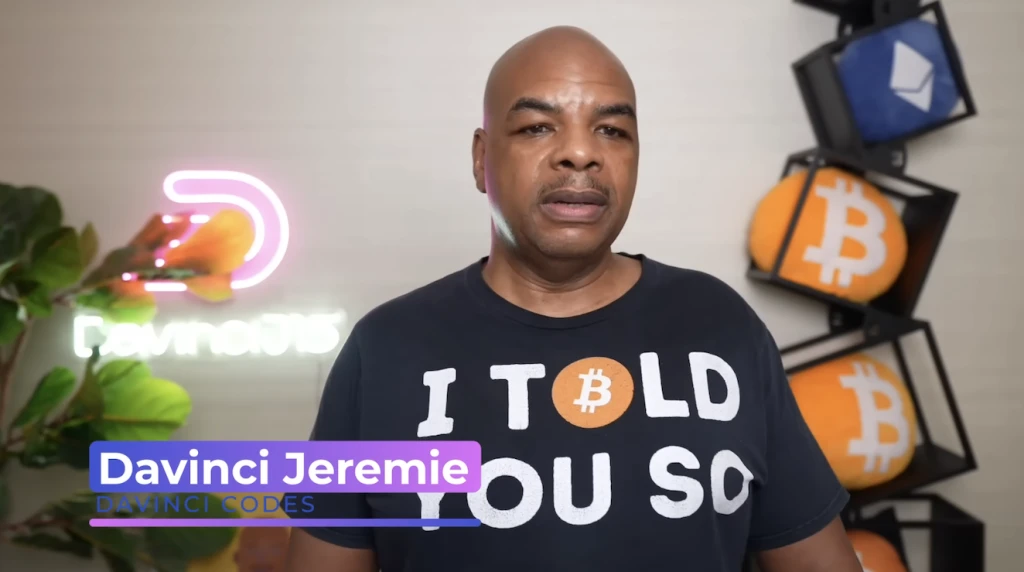
Davinci Jeremie today
He also frequently criticizes other cryptocurrencies. For instance, he has publicly called XRP “a scam you can only play like a casino.”
This kind of rhetoric helps shift attention away from his own promotional campaigns and reinforces his image as a supporter of “pure bitcoin.”
The NFT Era and Disappearing Evidence
Promotion was not limited to tokens. During the NFT boom, Jeremie actively promoted collections including the project Little Doodles.
That project also ended in controversy. The launch failed, the development team disappeared, and some users reported that the NFTs they purchased had even vanished from their crypto wallets.
One affected user wrote directly to Jeremie, saying their NFTs disappeared after the launch. The message reportedly went unanswered.
Over time, many of Jeremie's promotional posts about controversial projects began disappearing from his social media accounts. However, replies from users and complaints from victims often remained, leaving a digital trail.
A List of Failed Projects
Even when larger crypto projects were involved, their price patterns often looked similar: a sharp rise after promotion followed by a major decline.
Examples frequently mentioned include:
- Star Atlas (ATLAS) — surged to $0.267 before falling nearly 99%
- LooksRare (LOOKS) — climbed to $7.10 before losing about 99% of its value
- Arkham (ARKM) — rose to $3.98 and later dropped roughly 87%
- Core DAO (CORE) — jumped to $6.14 before falling more than 95%
- TrueFi (TRU) — increased to $1.02 before declining about 90%
Personal Tokens and Accusations From Followers
Additional criticism surrounded tokens linked to Jeremie himself — DVINCI and Peon.
Some users claimed they bought these assets because they trusted his reputation and later lost money after the prices collapsed. Social media posts describing these losses appeared online, many of which reportedly received no response from Jeremie.
New Projects, Same Pattern
A similar pattern allegedly appeared in other projects, including:
- WAFFLES
- ORC
- WAOWO
- PeiPei
In many cases, the tokens saw rapid price increases followed by steep declines.
The Story of the $1 Token
In March 2026, the crypto community created a token called $1, inspired by Jeremie's famous 2013 video about buying one dollar worth of bitcoin.
Instead of supporting the original project, Jeremie began interacting with a copycat token created by a third-party developer.
According to blockchain researchers, trading activity around that token may have generated fees directed to the developer and associated parties. After the token’s market cap surged, its price quickly collapsed.
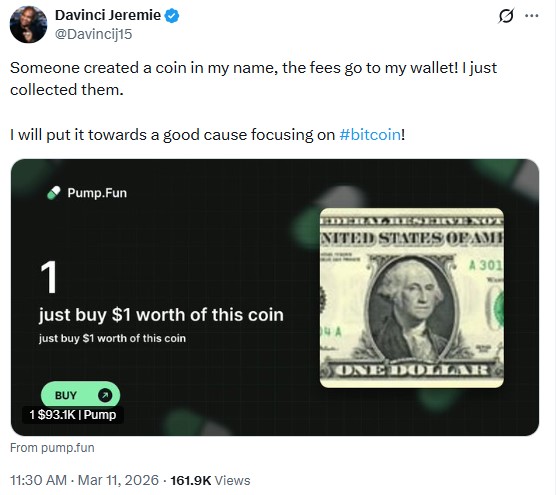
When users began asking questions, Jeremie said he had never directly told people to buy the token — only that he had mentioned its existence.
Response to Criticism
Jeremie often responds to accusations with sarcasm. In one message, he wrote:
“I’m grateful for the hate. It means I matter.”
He has also joked that he lost all his bitcoins in a “boating accident” — a common meme in the crypto community.
Such responses allow him to avoid directly addressing the allegations.
Conclusion: A Reputation Under Pressure
Today, Davinci Jeremie's name is still closely tied to that famous 2013 video. For many followers, it remains a symbol of early belief in bitcoin.
But the controversies of recent years — including the story surrounding the $1 token — have intensified the debate about his reputation.
For some, he remains the man who recognized bitcoin’s potential early. For others, he has become an example of how early success can be turned into a powerful tool of influence in the crypto market.

Useful material?
 Telegram
  Twitter
 Research
One and the same cryptocurrency address received two completely opposite assessments from different analytics systems: from an ordinary gambling service to an extremely severe criminal offense. This story has become the starting point for a broader conversation about what the scientific standards of blockchain analysis should look like — and why errors in systems like these can shape the fates of real people.
Jul 1, 2026
Research
The blockchain has helped uncover the ties between cryptocurrency fundraising campaigns, exchangers in Syria, and intermediaries in several countries around the world. A telltale pattern has emerged in which the same addresses were used across multiple donation drives at once
Jun 24, 2026
Research
Four Iranian cryptocurrency exchanges accounted for roughly 78% of all digital asset volume tied to the country in 2025. They have now become the focal point of the largest U.S. sanctions campaign against Iran's cryptocurrency infrastructure.
Jun 5, 2026
Research
A financial system is already up and running on public blockchains, with loans, analogues of U.S. Treasuries, and automated capital markets. More than $551 billion has flowed through DeFi protocols — but most of that activity has nothing to do with the real economy and everything to do with the speculative build-up of risk.
May 29, 2026
Research
Around 97% of Chinese suppliers of chemicals used to make fentanyl accept payment in cryptocurrency. The volume of such transactions continues to grow alongside the global market for synthetic drugs
May 22, 2026
Research
For the first time, the new law makes blockchain analytics an officially mandatory tool of financial oversight in the United States. Authorities will also gain the power to restrict transactions with foreign crypto services tied to money-laundering risks.
May 20, 2026
Cryptocurrency rates
-

Bitcoin
$82 700
BTC
+0.38%
-

Ethereum
$2 493.24
ETH
-0.07%
-

BNB Smart Chain
$748.65
BSC
+0.8%
-

Ripple
$1.42
XRP
+1.04%
-

TRON
$0.3307
TRX
-0.4%
-

Zcash
$1 226.03
ZEC
+0.49%
-

Dogecoin
$0.086203
DOGE
+1.02%
-

Cardano
$0.218269
ADA
+2.11%
-

Stellar XLM
$0.184461
XLM
+2.83%
-

Bitcoin Cash
$278.34
BCH
-0.98%