

GOTBIT, Vortex, and Antier: How Major Market Makers Ended Up Behind Bars
Undercover agents ordered token “promotion” services themselves—and received a detailed breakdown of the scheme. Every transaction was recorded on the blockchain, allowing investigators to fully reconstruct the fraud.

06.04.2026
352
5 min
0
On March 30, 2026, authorities in the Northern District of California filed charges against ten foreign nationals connected to four crypto firms. They were accused of wire fraud and conspiracy to commit fraud as part of an operation dubbed Operation Token Mirrors. GetBlock AML Research reveals the details of this large-scale international crackdown on crypto fraudsters.
The investigation was led by the FBI and the IRS. In addition to analyzing blockchain data—the digital record of all transactions—agents conducted undercover operations, even launching their own crypto projects to identify bad actors.
Several company executives were arrested or extradited to the United States, including detentions in Singapore. The defendants are citizens of Taiwan, Russia, Serbia, and India. Notably, the charges focus on fraud, avoiding the need to navigate complex securities law.
Three Cases, Ten Defendants, One Major Operation
On March 30, 2026, U.S. prosecutors announced three criminal cases against ten individuals linked to GOTBIT, Vortex, Antier, and Contrarian. The cases are part of a broader investigation into crypto market manipulation.
Although charges were filed separately between March and September 2025, they were later consolidated into a single case—one of the largest investigations targeting services that artificially inflate crypto market activity.
The GOTBIT Case
Charges in the GOTBIT case were brought against:
- Antoine Cao (Taiwan)
- Ivan Sofronov (Russia)
- Nemanja Popov (Serbia)
They were charged with conspiracy and wire fraud.
Cao was arrested on March 30, 2025, at JFK Airport in New York. On June 2, he pleaded guilty and was sentenced in a California court. Popov was arrested in San Francisco and also pleaded guilty in February 2026.
The Vortex Case
The Vortex case involves Russian nationals:
- Gleb Gora
- Sergey Ryzhkov
- Michael Vogel
Gora was arrested in Singapore in October 2025 and later extradited to the United States.
The Contrarian / Antier Case
Charges were also brought against Indian nationals:
- Manu Singh
- Kushagra Srivastava
- Vasu Sharma
- Sabby Singh
They are accused of running schemes to artificially pump cryptocurrency prices. Some were also detained in Singapore.
A Company Manipulating the Market in Plain Sight
GOTBIT was registered in Belize and openly offered “market-making” services—claiming to support liquidity and provide market analysis.
By 2021, it reportedly employed over 100 people. On the surface, it appeared to be a legitimate business. However, according to the charges, GOTBIT was actually engaged in so-called wash trading.
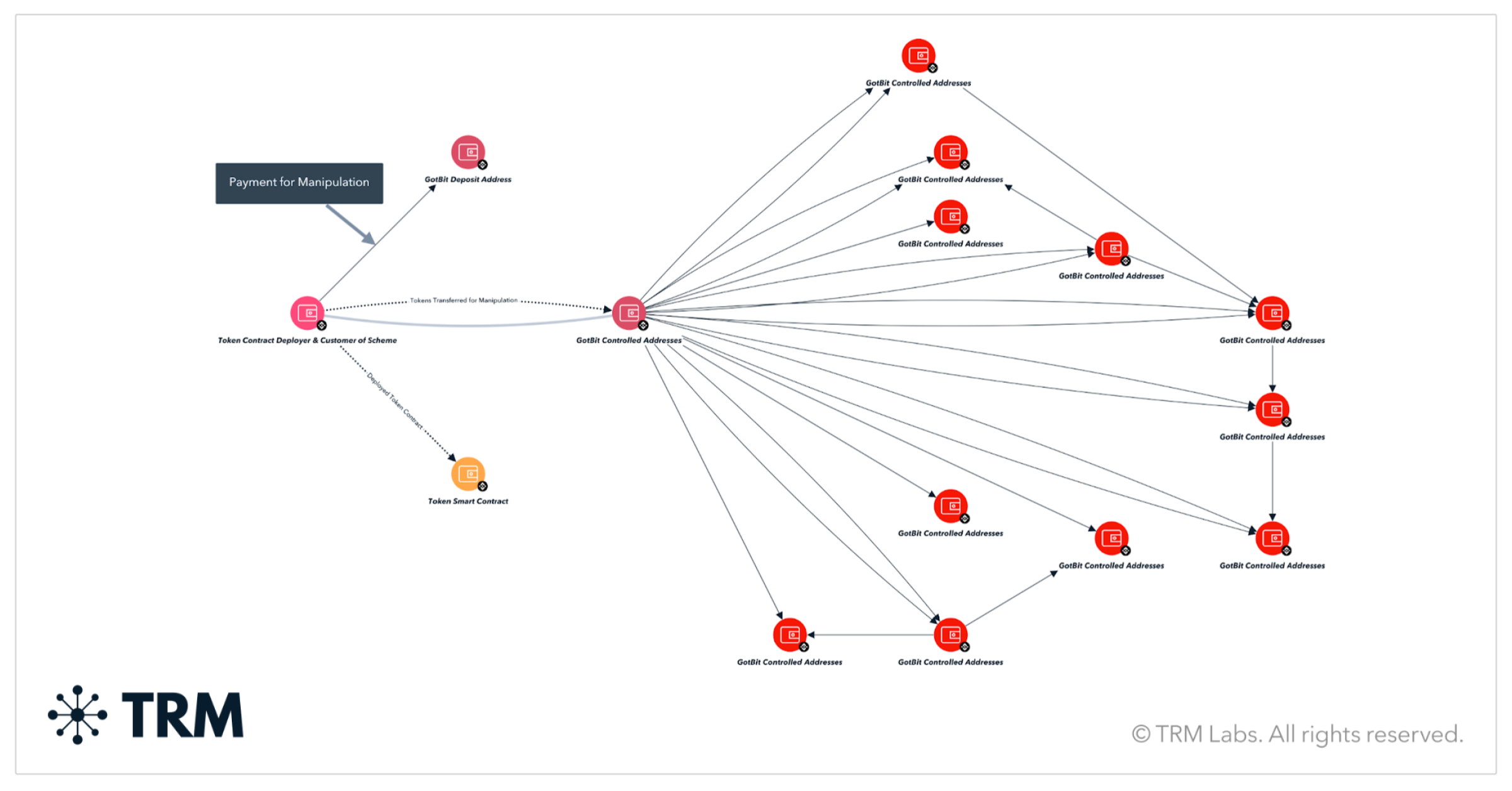
GOTBIT Wallet On-Chain Activity. Visualization: TRM Labs
Clients paid around $5,000 per month to create the illusion of active trading in their tokens. This misled retail investors into believing there was real demand, prompting them to buy in. The operators then sold tokens at inflated prices for profit.
How It Was Proven
Investigators analyzed blockchain transactions and found that most trades occurred between affiliated wallets. Of 1,221 transactions, 1,209 (99%) were linked to GOTBIT wallets—clear evidence of artificial trading.
Authorities also conducted an undercover operation. Agents posing as clients approached GOTBIT and asked them to promote a token called Lexobit.
Company representatives explicitly explained how they could artificially raise—and, if needed, crash—the token’s price. They also stated they charged 2% per transaction and “didn’t ask unnecessary questions.”
How Wash Trading Works
The scheme is simple: the same party acts as both buyer and seller. No real ownership changes hands, but it creates the illusion of active trading.
Such transactions have no economic substance—they exist solely to mislead the market and fabricate demand.
In traditional finance, this is illegal. In crypto, enforcement is more complex since not all tokens are legally classified as securities. However, in this case, participants openly admitted their goal was to create a fake market—enabling fraud charges.
Asset Seizure
On June 3, 2025, a court ordered the seizure of 1.2 million USDT from Antoine Cao. His wallet was also used during the undercover operation: agents transferred $15,000 for services and later sent 5 ETH to activate trading bots.
Evidence That Can’t Be Erased
Key evidence included not only communications between the defendants but also blockchain data.
All transactions executed by GOTBIT’s bots are permanently recorded on the Ethereum network. The company even provided a client with 36 wallet addresses—allowing investigators to fully reconstruct the scheme.
Even when bad actors attempt to cover their tracks, blockchain records cannot be altered or deleted, making such investigations particularly effective.
Why It Matters
This operation signals that authorities are no longer targeting just theft, but also market manipulation.
GOTBIT’s founder reportedly acknowledged that clients knowingly participated in the scheme—while ordinary investors ultimately bore the losses.
The problem is deeper: schemes like this undermine the very mechanism of price discovery. When prices are artificially manipulated, investors lose both reliable signals and trust in the market.

Useful material?
 Telegram
  Twitter
 Research
One and the same cryptocurrency address received two completely opposite assessments from different analytics systems: from an ordinary gambling service to an extremely severe criminal offense. This story has become the starting point for a broader conversation about what the scientific standards of blockchain analysis should look like — and why errors in systems like these can shape the fates of real people.
Jul 1, 2026
Research
The blockchain has helped uncover the ties between cryptocurrency fundraising campaigns, exchangers in Syria, and intermediaries in several countries around the world. A telltale pattern has emerged in which the same addresses were used across multiple donation drives at once
Jun 24, 2026
Research
Four Iranian cryptocurrency exchanges accounted for roughly 78% of all digital asset volume tied to the country in 2025. They have now become the focal point of the largest U.S. sanctions campaign against Iran's cryptocurrency infrastructure.
Jun 5, 2026
Research
A financial system is already up and running on public blockchains, with loans, analogues of U.S. Treasuries, and automated capital markets. More than $551 billion has flowed through DeFi protocols — but most of that activity has nothing to do with the real economy and everything to do with the speculative build-up of risk.
May 29, 2026
Research
Around 97% of Chinese suppliers of chemicals used to make fentanyl accept payment in cryptocurrency. The volume of such transactions continues to grow alongside the global market for synthetic drugs
May 22, 2026
Research
For the first time, the new law makes blockchain analytics an officially mandatory tool of financial oversight in the United States. Authorities will also gain the power to restrict transactions with foreign crypto services tied to money-laundering risks.
May 20, 2026
Cryptocurrency rates
-

Bitcoin
$81 385
BTC
-1.68%
-

Ethereum
$2 379.56
ETH
-2.22%
-

BNB Smart Chain
$726.83
BSC
+0.13%
-

Ripple
$1.42
XRP
+1.04%
-

TRON
$0.331882
TRX
+0.29%
-

Zcash
$1 126.24
ZEC
-3.4%
-

Dogecoin
$0.078807
DOGE
-1.15%
-

Cardano
$0.218269
ADA
+2.11%
-

Stellar XLM
$0.184461
XLM
+2.83%
-

Bitcoin Cash
$273.57
BCH
-1.69%