

Reorganization and cancellation transactions: what is happening with the Monero network?
The anonymous cryptocurrency network underwent a chain reorganization of 18 blocks, which canceled 117 transactions
15.09.2025
523
3 min
0
Monero (XMR) is a cryptocurrency created in 2014 that focuses on anonymity and protecting users’ personal data.
Transactions on the Monero network are anonymous — the sender, recipient, and amount are hidden. This is achieved using cryptographic methods: ring signatures, effective stealth addresses, and RingCT, which hides the amount. The network is decentralized and based on the RandomX protocol — a Proof-of-Work algorithm that is resistant to specialized equipment (ASIC), allowing mining on regular computers.

Monero: Behind the scenes of anonymity. How does the new generation cryptocurrency work?
We talk about how the search for a balance between privacy and government control has influenced the coin
Chain interference: chronology
- 51% attack: the Qubic mining pool, associated with the IOTA blockchain, gained control of more than half of the Monero network’s computing power (i.e., more than 51% of the hashrate).
- Block reorganization: as a result of this control, a chain reorganization of 18 blocks was carried out, leading to a chain rollback and the cancellation of ~117 transactions.
- Timeframe: the reorganization began at block 3499659 on Sunday at 05:12 UTC and ended around block 3499676, ~43 minutes later.
- Consequences: users were exposed to the threat of double-spending, as previously confirmed transactions could disappear.
- Market reaction: despite this, the price of XMR rose by more than 7%, from approximately $287 to $308, just a few hours after the attack.
What is network reorganization: a simple explanation
A chain of transactions in a blockchain can be represented as a railroad on which trains (blocks) move. Normally, trains run strictly according to schedule and along the tracks in one direction. But if someone suddenly builds a new section of track (an alternative branch) and trains start running on it, the system may choose this route as the main one and continue moving along it. The previous route is then considered “incorrect,” and the trains (blocks) on it roll back and disappear.
In the Monero situation, the Qubic mining pool created its own branch, which proved to be longer than 10 blocks due to power control. The network accepted it as the main one, and the previous “branch” of blocks (with transactions) was canceled. As a result, approximately 117 transactions were lost.
New target: Dogecoin
Earlier, the Qubic mining pool held a vote to select the next network to be attacked with a 51% attack. Qubic’s next target will be the Dogecoin network.
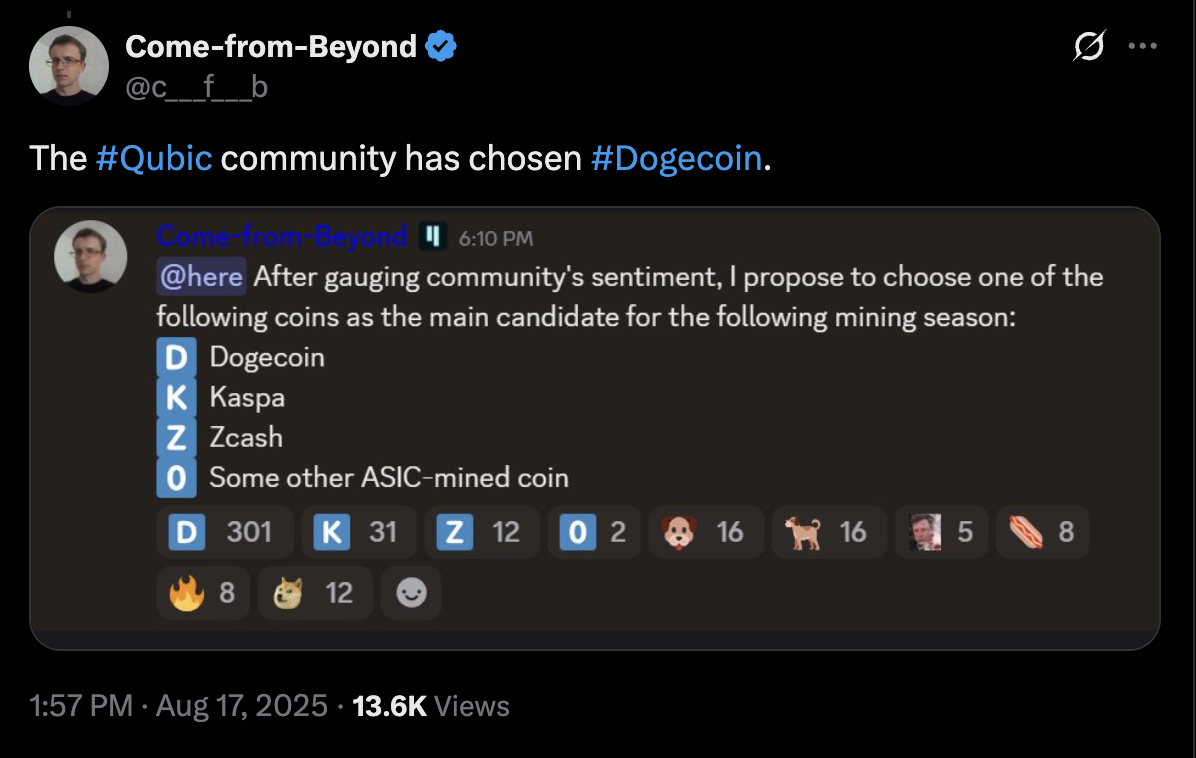 Community vote on the selection of the next target

Useful material?
 Telegram
  Twitter
 Research
One and the same cryptocurrency address received two completely opposite assessments from different analytics systems: from an ordinary gambling service to an extremely severe criminal offense. This story has become the starting point for a broader conversation about what the scientific standards of blockchain analysis should look like — and why errors in systems like these can shape the fates of real people.
Jul 1, 2026
Research
The blockchain has helped uncover the ties between cryptocurrency fundraising campaigns, exchangers in Syria, and intermediaries in several countries around the world. A telltale pattern has emerged in which the same addresses were used across multiple donation drives at once
Jun 24, 2026
Research
Four Iranian cryptocurrency exchanges accounted for roughly 78% of all digital asset volume tied to the country in 2025. They have now become the focal point of the largest U.S. sanctions campaign against Iran's cryptocurrency infrastructure.
Jun 5, 2026
Research
A financial system is already up and running on public blockchains, with loans, analogues of U.S. Treasuries, and automated capital markets. More than $551 billion has flowed through DeFi protocols — but most of that activity has nothing to do with the real economy and everything to do with the speculative build-up of risk.
May 29, 2026
Research
Around 97% of Chinese suppliers of chemicals used to make fentanyl accept payment in cryptocurrency. The volume of such transactions continues to grow alongside the global market for synthetic drugs
May 22, 2026
Research
For the first time, the new law makes blockchain analytics an officially mandatory tool of financial oversight in the United States. Authorities will also gain the power to restrict transactions with foreign crypto services tied to money-laundering risks.
May 20, 2026
Cryptocurrency rates
-

Bitcoin
$82 165
BTC
+0.25%
-

Ethereum
$2 415.41
ETH
+0.05%
-

BNB Smart Chain
$724.45
BSC
+0.32%
-

Ripple
$1.42
XRP
+1.04%
-

TRON
$0.33118
TRX
-0.58%
-

Zcash
$1 133.03
ZEC
+0.72%
-

Dogecoin
$0.078896
DOGE
-0.43%
-

Cardano
$0.218269
ADA
+2.11%
-

Stellar XLM
$0.184461
XLM
+2.83%
-

Bitcoin Cash
$276.36
BCH
+0.76%