

Why did someone transfer $8 billion worth of bitcoins? Detailed breakdown
An unknown person transferred 80 000 BTC to new storage addresses, paying a $340 fee
07.07.2025
738
4 min
0
In early July 2025, one of the largest bitcoin holders has been activated, storing 80 000 BTC in inactive wallets for over 14 years. GetBlock AML Research publishes everything you need to know about the activation of this whale.
Where did the cryptocurrency come from
Transaction chain analysis shows that the source of 80 000 BTC comes from early miners who were mining bitcoins back in early 2010. For example, this early address was used to receive 50 BTC as a reward for mining a block. The coins then went through several addresses before reaching a single whale address that processed over 80 000 BTC. The coins were then split into equal parts (10 000 each) and transferred to addresses for storage.
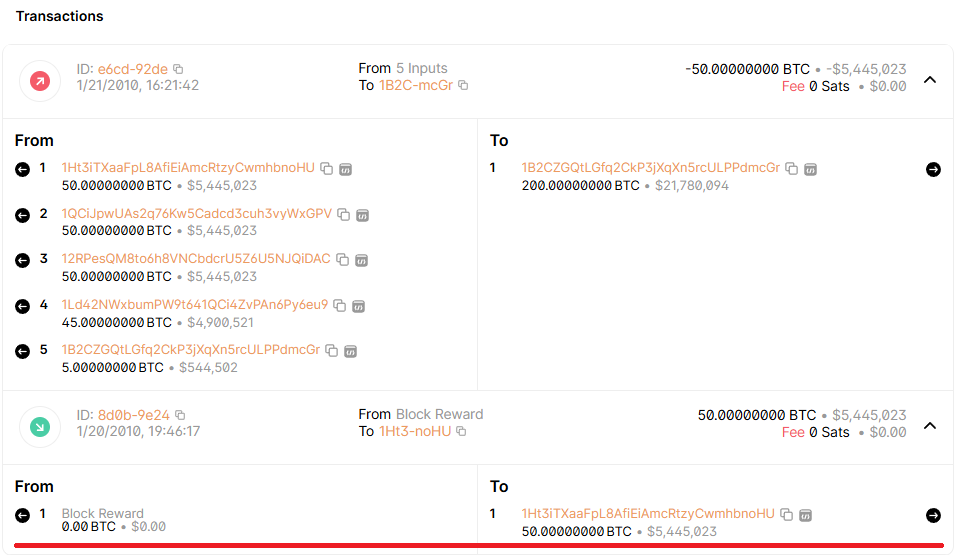
Receiving a block mining award in 2010
Roadmap
Storage address | Withdrawal transaction | New address |
At the time of the transfer, the value of 80 000 BTC was estimated at just over $8,6 billion. The total fee for all eight transactions amounted to $340 (0,00314394 BTC).
Where the funds were withdrawn
Many media outlets believe that the transfer of 80 000 BTC to new addresses is a normal asset rotation. However, this is only one of the possible theories. We have collected the most likely scenarios why the cryptocurrency changed storage addresses:
- Restoring access. The cryptocurrency owner was able to regain access to the old wallets and moved the coins to more modern addresses with multi-signature or SegWit support. This is roughly the same theory held by Arkham;
- OTC sale. 80000 BTC could have been sold via an OTC transaction because the amount of assets is too large to use an intermediary between buyer and seller;
- Hacking or confiscation. Old wallets could have been accessed by third parties such as hackers or law enforcement.

Useful material?
 Telegram
  Twitter
 Research
One and the same cryptocurrency address received two completely opposite assessments from different analytics systems: from an ordinary gambling service to an extremely severe criminal offense. This story has become the starting point for a broader conversation about what the scientific standards of blockchain analysis should look like — and why errors in systems like these can shape the fates of real people.
Jul 1, 2026
Research
The blockchain has helped uncover the ties between cryptocurrency fundraising campaigns, exchangers in Syria, and intermediaries in several countries around the world. A telltale pattern has emerged in which the same addresses were used across multiple donation drives at once
Jun 24, 2026
Research
Four Iranian cryptocurrency exchanges accounted for roughly 78% of all digital asset volume tied to the country in 2025. They have now become the focal point of the largest U.S. sanctions campaign against Iran's cryptocurrency infrastructure.
Jun 5, 2026
Research
A financial system is already up and running on public blockchains, with loans, analogues of U.S. Treasuries, and automated capital markets. More than $551 billion has flowed through DeFi protocols — but most of that activity has nothing to do with the real economy and everything to do with the speculative build-up of risk.
May 29, 2026
Research
Around 97% of Chinese suppliers of chemicals used to make fentanyl accept payment in cryptocurrency. The volume of such transactions continues to grow alongside the global market for synthetic drugs
May 22, 2026
Research
For the first time, the new law makes blockchain analytics an officially mandatory tool of financial oversight in the United States. Authorities will also gain the power to restrict transactions with foreign crypto services tied to money-laundering risks.
May 20, 2026
Cryptocurrency rates
-

Bitcoin
$85 524
BTC
-0.34%
-

Ethereum
$2 695.12
ETH
-0.69%
-

BNB Smart Chain
$779.23
BSC
-0.97%
-

Ripple
$1.42
XRP
+1.04%
-

TRON
$0.335664
TRX
-0.24%
-

Zcash
$1 332.13
ZEC
-1.53%
-

Dogecoin
$0.09343
DOGE
-2.29%
-

Cardano
$0.218269
ADA
+2.11%
-

Stellar XLM
$0.184461
XLM
+2.83%
-

Bitcoin Cash
$314.3
BCH
-0.52%