

“The FTX crash accelerated capitulation.” What will cause cryptocurrencies to rise in December
Analysts at Santiment note signs of a possible rebound in prices this month

02.12.2022
2661
5 min
2
Despite the market collapse that shook the crypto community over the past month, analysts see signs that cryptocurrencies have hit price lows and are capable of continuing to attempt a rebound.
“November, 2022 will go down in the history books as a month most traders will want to forget,” was the comment made by analytics firm Santiment in its monthly report on the state of the crypto market, titled “FTX Disaster Makes Capitulation Come Faster.” According to the authors’ observations, the small jump in prices in late November following news of a slowdown in the aggressive interest rate hikes in the United States is barely noticeable after the “disastrous news” that rocked the crypto world early last month.
The bankruptcy of the FTX exchange triggered probably the most tangible collapse in cryptocurrency history. Prices on the crypto market fell sharply in response to the news, while equities or gold continued to rise. Analysts at Santiment call the chart of returns for the top 100 assets a reflection of the “bloodbath” that took place because more than 5 million FTX users probably lost all of their funds. Not since the days of the Mt. Gox exchange has there been a situation in the crypto market in which the fall of one player negatively affected so many traders.
The collapse of one of the largest exchanges provoked a surge of interest in non-custodial and hardware cryptocurrency wallets. The native token of Trust Wallet (TWT) rose strongly in value (+150% in six days), largely due to Binance CEO Changpen Zhao’s Twitter posts in which he called Trust Wallet a great option for secure coin storage. Ledger and Trezor hardware wallet sales were also up significantly, with the latter reporting a 350% increase in its website traffic following the FTX collapse.
According to the report’s authors’ observation, the name of now former FTX CEO Sam Bankman-Fried “is essentially working as a volatility indicator.” “When SBF is mentioned notably as prices are falling, markets suddenly turn positive.” Conversely, when markets are rising, an onslaught of news about Bankman-Fried and FTX stops the rally.
High-profile topics, such as fears of inflation and recession in 2022, often act as markers of price volatility in the crypto market. “But with long-term fear, traders capitulate. And capitulation, as we’ve seen several times in crypto, leads to price bottoms,” the analysts write.
Every day more and more people keep dropping out of crypto, and bitcoin shows no signs of returning to its November 2021 all-time high, when the price of BTC reached $68 000. That said, fear and uncertainty can also be used as an indicator, as “weak hands” tend to signal that prices have reached their lowest levels, Santiment noted.
While October showed “signs of organic capitulation” from traders who were tired of watching prices fall all year, November essentially “hit the reset button.” Analysts note that the FTX crash and market collapse triggered mass and non-core media interest similar in scale to the periods when bitcoin hit price highs in late 2017 or 2021. According to the report’s authors, to form price lows, “a best case scenario if these publications simply forget about crypto.”
Trends and prospects
Altcoins remain the focus of many traders who are trying to quickly recoup their 2022 losses. This leads to the continued low bitcoin social dominance, “which has been evident since late July.” Only 6,48% of bitcoin’s available supply is on exchanges, Santiment noted. That is the lowest ratio in 4 years and should generally be considered bullish, the analysts write. Fewer coins that can be sold off tend to limit the amount of an asset’s future decline.
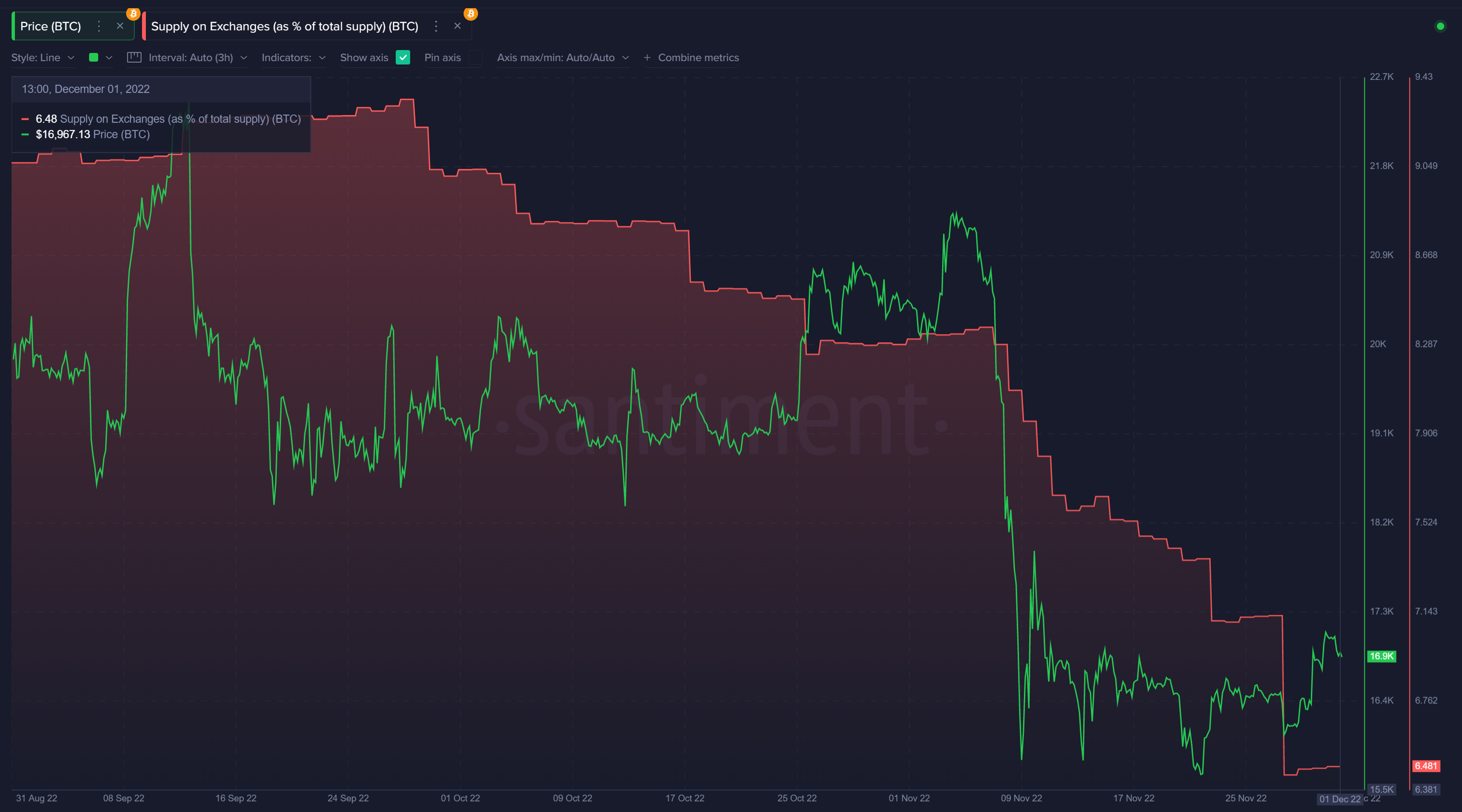
On the chart, the BTC supply on the exchanges is marked in red, and the BTC price is marked in green
Bitcoin’s key addresses, which usually dictate the state of the market (holding between 100 and 10 000 BTC), have “ begun to show some signs of life” at the recent local bottom. These whales have accumulated 53 572 bitcoins in the last 10 days. Ethereum’s key addresses (holding 100 to 1 000 000 ETH) are also “showing encouraging signs.” Just as the news about FTX came out on November 7 and 8, Santiment saw an increase in “whale” accumulation. Since then, these addresses have accumulated 1,1 million ETH, which now hold nearly two-thirds of the available supply.
“Wait out the storm.” Traders switch to decentralized exchanges after FTX’s collapse
The trend of less confidence in exchanges because of the FTX fiasco can be interpreted in two ways, analysts write. On the one hand, the self-custody of assets is a good thing in and of itself, but at the same time, it could lead to restrictions on the circulation of tokens for a long period of time until exchanges regain their reputation.
In the short term, there are some good signs that cryptocurrency prices could continue to attempt a rebound in December. According to the authors, the key things to watch for next month are whether whales continue to show signs of accumulation, whether there will be a flow of positive news, and whether cryptocurrency circulation, in general, will increase as “the dust from FTX’s implosion begins to settle.”

Useful material?
 Telegram
  Twitter
 Research
One and the same cryptocurrency address received two completely opposite assessments from different analytics systems: from an ordinary gambling service to an extremely severe criminal offense. This story has become the starting point for a broader conversation about what the scientific standards of blockchain analysis should look like — and why errors in systems like these can shape the fates of real people.
Jul 1, 2026
Research
The blockchain has helped uncover the ties between cryptocurrency fundraising campaigns, exchangers in Syria, and intermediaries in several countries around the world. A telltale pattern has emerged in which the same addresses were used across multiple donation drives at once
Jun 24, 2026
Research
Four Iranian cryptocurrency exchanges accounted for roughly 78% of all digital asset volume tied to the country in 2025. They have now become the focal point of the largest U.S. sanctions campaign against Iran's cryptocurrency infrastructure.
Jun 5, 2026
Research
A financial system is already up and running on public blockchains, with loans, analogues of U.S. Treasuries, and automated capital markets. More than $551 billion has flowed through DeFi protocols — but most of that activity has nothing to do with the real economy and everything to do with the speculative build-up of risk.
May 29, 2026
Research
Around 97% of Chinese suppliers of chemicals used to make fentanyl accept payment in cryptocurrency. The volume of such transactions continues to grow alongside the global market for synthetic drugs
May 22, 2026
Research
For the first time, the new law makes blockchain analytics an officially mandatory tool of financial oversight in the United States. Authorities will also gain the power to restrict transactions with foreign crypto services tied to money-laundering risks.
May 20, 2026
Cryptocurrency rates
-

Bitcoin
$81 289
BTC
-0.47%
-

Ethereum
$2 389.6
ETH
-0.7%
-

BNB Smart Chain
$744.15
BSC
+1.51%
-

Ripple
$1.42
XRP
+1.04%
-

TRON
$0.3295
TRX
-0.27%
-

Zcash
$1 223.49
ZEC
-2.12%
-

Dogecoin
$0.079357
DOGE
-0.19%
-

Cardano
$0.218269
ADA
+2.11%
-

Stellar XLM
$0.184461
XLM
+2.83%
-

Bitcoin Cash
$282.53
BCH
+2.59%