

Not just DOGE. What cryptocurrencies can be integrated into Twitter
Elon Musk has released an updated roadmap of the social network, confirming plans to implement a payment function
28.11.2022
3352
4 min
2
Tesla and SpaceX CEO Elon Musk, as the new owner of Twitter, has released a roadmap of the social network, according to which the application will be radically restructured. The crypto community is speculating on how the payment function, information about which was intended to be hidden, will be implemented.
On Sunday, November 27, Musk shared slides from an internal Twitter presentation. Over the past week, the platform had 2 million new daily registrations and 8 billion active users. According to the published presentation, in addition to payments, reforms to the social network also include a change in advertising policy, increased text size for tweets, and a relaunch of Blue Verified and encrypted messages. The last point has suddenly become a cause for activity in the crypto market.
Slides from my Twitter company talk pic.twitter.com/8LLXrwylta
— Elon Musk (@elonmusk) November 27, 202
On the slide of the “Payments” section, an empty space is intentionally left, and no details are disclosed, which suggests the future use of cryptocurrency on Twitter. The first obvious candidate is Dogecoin (DOGE), whose integration options Musk himself hinted at more than once.
Elon Musk bought Twitter. How this will affect the crypto market
Over the past week, the DOGE rate rose by more than 22,5%, jumping from $0,075 to $0,094. Immediately after Musk’s publication, the coin’s price gained 8%. The most popular meme coin entrenched itself in eighth place in the ranking of cryptocurrencies in terms of market capitalization, ahead of Polygon (MATIC), Cardano (ADA), and Litecoin (LTC).
DOGE’s price reaction to Musk’s statements is probably already familiar to market participants, but other cryptocurrencies are also reacting to the possible implementation on Twitter. If previously MASK token increased by 300% on expectations of integration into the social network as a means of payment, this time a similar jump in the price of another coin is associated with another direction of future innovations of the social network.
Not just Dogecoin
Encryption elements used by messenger Signal were found in the source code of Twitter’s iOS app, leading to a rise in the price of the cryptocurrency Mobilecoin (MOB), which has been used in the app since 2021.
Twitter is likely to use the Signal protocol to encrypt private messages, engineering expert Jane Manchun Wong wrote on Twitter, citing snippets of the social network’s app code for Apple devices. Wong’s tweet quickly went viral, and many crypto enthusiasts supported the idea that Mobilecoin could also be integrated into Twitter as a payment medium, leading to a surge in MOB.
Musk previously spoke well of Signal, advising his subscribers to use the messenger as an alternative to WhatsApp or iMessage. The Signal app is open source and is developed by the Signal Technology Foundation, which is funded by user donations. MobileCoin’s MOB token is integrated into the beta version of Signal and the Chinese messenger Mixin.
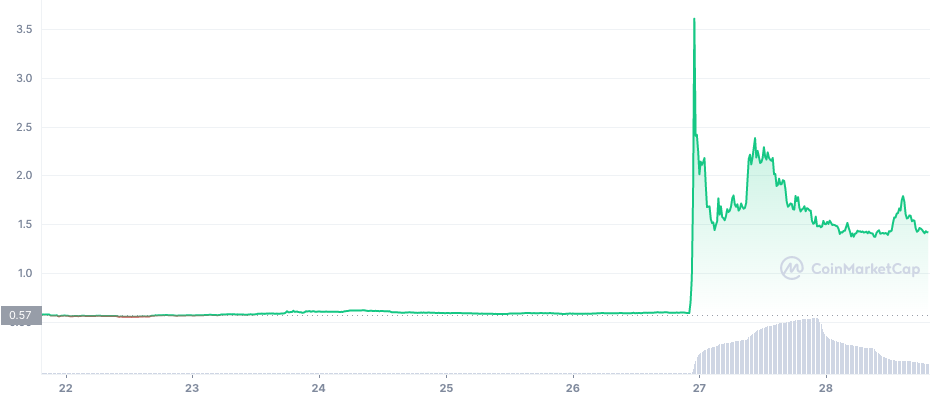
Mobilecoin’s weekly price chart
When reports began appearing en masse that Twitter might use Signal’s technology, the price of Mobilecoin rose by 300% in 24 hours. According to CoinMarketCap, MOB has a market capitalization of $105 million and ranks 169th on the website. Despite the huge surge in interest in the coin, its price is still 96% below its all-time high (ATH) of $71,96.
The Signal protocol added MobileCoin as a payment feature in August 2021. Signal founder Moxie Marlinspike has been an advisor to MobileCoin since 2018. The project raised $66 million in venture capital investment to develop its own mobile privacy payment technology. Notable investors include Coinbase Ventures, BlockTower Capital, and Alameda Research, which went bankrupt with the FTX exchange.

Useful material?
 Telegram
  Twitter
 Research
One and the same cryptocurrency address received two completely opposite assessments from different analytics systems: from an ordinary gambling service to an extremely severe criminal offense. This story has become the starting point for a broader conversation about what the scientific standards of blockchain analysis should look like — and why errors in systems like these can shape the fates of real people.
Jul 1, 2026
Research
The blockchain has helped uncover the ties between cryptocurrency fundraising campaigns, exchangers in Syria, and intermediaries in several countries around the world. A telltale pattern has emerged in which the same addresses were used across multiple donation drives at once
Jun 24, 2026
Research
Four Iranian cryptocurrency exchanges accounted for roughly 78% of all digital asset volume tied to the country in 2025. They have now become the focal point of the largest U.S. sanctions campaign against Iran's cryptocurrency infrastructure.
Jun 5, 2026
Research
A financial system is already up and running on public blockchains, with loans, analogues of U.S. Treasuries, and automated capital markets. More than $551 billion has flowed through DeFi protocols — but most of that activity has nothing to do with the real economy and everything to do with the speculative build-up of risk.
May 29, 2026
Research
Around 97% of Chinese suppliers of chemicals used to make fentanyl accept payment in cryptocurrency. The volume of such transactions continues to grow alongside the global market for synthetic drugs
May 22, 2026
Research
For the first time, the new law makes blockchain analytics an officially mandatory tool of financial oversight in the United States. Authorities will also gain the power to restrict transactions with foreign crypto services tied to money-laundering risks.
May 20, 2026
Cryptocurrency rates
-

Bitcoin
$81 173
BTC
-3.27%
-

Ethereum
$2 365.23
ETH
-6.24%
-

BNB Smart Chain
$719.09
BSC
-3.53%
-

Ripple
$1.42
XRP
+1.04%
-

TRON
$0.332237
TRX
+0.03%
-

Zcash
$1 099.44
ZEC
-12.89%
-

Dogecoin
$0.079988
DOGE
-6.27%
-

Cardano
$0.218269
ADA
+2.11%
-

Stellar XLM
$0.184461
XLM
+2.83%
-

Bitcoin Cash
$262.33
BCH
-6.84%