

AI-driven scams went “industrial” in 2025
A new report shows a sharp rise in AI-powered scams and their transformation into a systemic tool of crypto crime

29.01.2026 - 11:10
382
5 min
0
Key points:
- AI-driven crypto scams grew by roughly 500% year over year.
- Generative models have made scam campaigns easier to scale and automate.
According to TRM Labs, fraud involving AI technologies became one of the fastest-growing forms of crypto crime in 2025. The use of generative AI allowed attackers to dramatically expand their reach and automate user deception at scale.

Chainalysis: сrypto Money laundering grows to $82 billion
Experts attribute the surge to the professionalization of underground services and criminals moving away from centralized exchanges.
How “industrial” AI scams work
Criminal networks are increasingly using AI to create fake identities, texts, images and videos. Content generation no longer requires large teams — a single script can now be replicated across thousands of victims.
AI is commonly used for:
- large-scale investment and romance scams;
- deepfake videos and voice cloning;
- fake websites, brands and “platforms”;
- automated conversations with victims across multiple languages.
This sharply reduces costs while significantly increasing the efficiency of attacks.

“Pig butchering”: another $47 million belonging to scammers has been frozen
A scheme for laundering criminal proceeds obtained by fraudsters through a sophisticated scam has been uncovered
Why losses keep rising
Analysts note that modern scam groups now operate like full-fledged companies, with clear role separation, internal playbooks, reusable templates and rapidly replaceable infrastructure. AI enables these networks to run thousands of conversations simultaneously and quickly adapt to new markets.
Another contributing factor is underreporting. Many victims never contact law enforcement, meaning the true scale of losses is likely higher than official figures suggest.

How your cryptocurrency will be stolen: top 5 popular schemes
Scammers use a set of ready-made schemes to deceive unsuspecting cryptocurrency owners and obtain their assets
Key trends from 2025
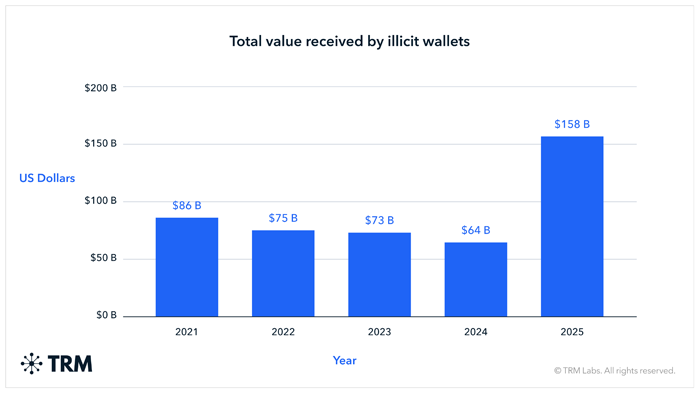
Despite record absolute losses, the share of illicit activity in overall crypto transaction volume continued to decline. In 2025, it stood at 1.2%, down from 1.3% a year earlier. Under TRM’s updated methodology, criminal groups captured around 2.7% of total crypto liquidity originating from VASP platforms.
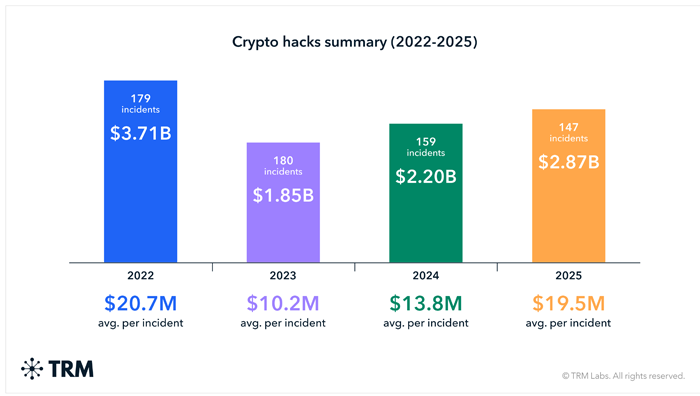
At the same time, thefts and hacks remained elevated. Attackers stole about $2.87 billion across nearly 150 incidents in 2025. More than half of that total — roughly $1.46 billion — came from a single breach involving the Bybit exchange.

Why you shouldn’t trust cryptocurrency ads on social media: Top 5 scam cases
On social media platform X, the accounts of stars and celebrities are often hacked to promote scam tokens
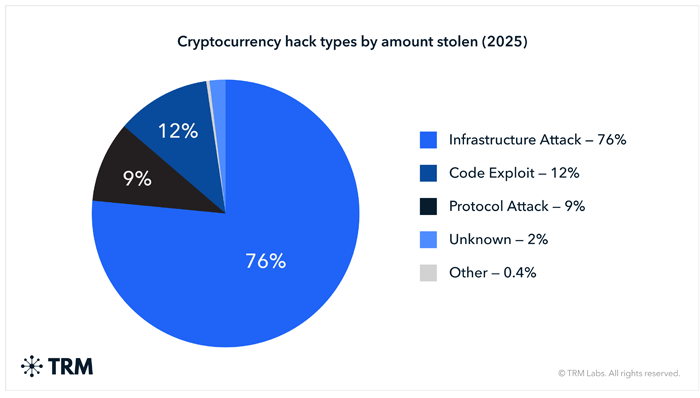
The primary attack vector has shifted away from smart contract vulnerabilities toward compromises of operational infrastructure and access keys, underscoring a broader move toward more sophisticated, AI-assisted crime models.

Useful material?
 Telegram
  Twitter
 Incidents
In 104 minutes, the attacker emptied 1,404 addresses before validators halted the network and froze almost all of the loot.
Oct 19, 2026
Incidents
Developers warned of potential risks to bridges across the ecosystem and asked exchanges for assistance.
Jun 22, 2026
Incidents
The defendant helped move funds stolen through investment scams and earned at least $4 million for his role in the operation.
Jun 10, 2026
Incidents
The company is linking the incident to a compromised private key on a service wallet, rather than a smart contract exploit
May 22, 2026
Incidents
Following the incident, the project temporarily halted trading operations and node activity.
May 15, 2026
Incidents
The user spent weeks unsuccessfully trying to guess the password until Claude helped find an old wallet backup file
May 14, 2026
Cryptocurrency rates
-

Bitcoin
$84 212
BTC
+1.5%
-

Ethereum
$2 478.73
ETH
+1.29%
-

BNB Smart Chain
$747.99
BSC
+0.83%
-

Ripple
$1.42
XRP
+1.04%
-

TRON
$0.330575
TRX
-0.15%
-

Zcash
$1 324.18
ZEC
+5.18%
-

Dogecoin
$0.0821
DOGE
+0.43%
-

Cardano
$0.218269
ADA
+2.11%
-

Stellar XLM
$0.184461
XLM
+2.83%
-

Bitcoin Cash
$287.32
BCH
+0.65%