

Brazil’s central bank approves new rules for cryptocurrency companies
The central bank’s resolutions will come into force in February 2026 and will establish control over operations and risks.
11.11.2025 - 09:25
472
3 min
0
Key points:
- Brazil’s central bank has officially included cryptocurrency platforms in the country’s financial system, establishing strict AML and CTF rules.
- From February 2, 2026, all crypto exchanges and stablecoin issuers will be required to verify customers, report cross-border transfers, and have minimum capital.
- The crypto community is concerned that the new measures will lead to excessive control and centralization of user data.
Brazil’s central bank has approved new rules for the cryptocurrency industry, officially incorporating digital platforms into the country’s financial system. The document establishes measures to prevent money laundering (AML) and terrorist financing (CTF). They will be mandatory for cryptocurrency exchanges, stablecoin issuers, and other companies working with digital assets.
The new requirements, enshrined in Resolutions No. 519, 520, and 521, will come into force on February 2, 2026. This is the country’s first major attempt to bring the cryptocurrency market up to the same standards that apply to banks and brokers.
According to Gilneu Vivan, the director of regulation at the central bank, the changes are aimed at reducing the risks of fraud and illegal transactions with virtual assets. Last year, the volume of crypto transactions in Brazil exceeded 1,7 trillion reais (about $330 billion).
New cryptocurrency control system
Now, every transaction involving digital assets pegged to fiat currency, such as USDT or USDC, will be classified as a currency transaction. This means that any international transfers or settlements in stablecoins must comply with the country’s currency legislation.
According to the rules, crypto exchanges and other service providers are required to:
- Verify the identity of users transferring funds to personal wallets;
- Report cross-border crypto transactions;
- Maintain internal control, risk management, and cybersecurity systems;
- Have a minimum capital of between 10,8 and 37,2 million reais, depending on the size of the company and the level of risk.
Foreign companies will only be able to operate in Brazil if they have a local license. Local startups may face additional costs to comply with the requirements, making it difficult to compete with large players.
Crypto community reaction
After the rules were published, cryptocurrency supporters expressed concern. Analyst Felipe Demartini noted that the new measures could lead to complete control over user transactions. In his opinion, exchanges will be required to track and report any transfers to private wallets.
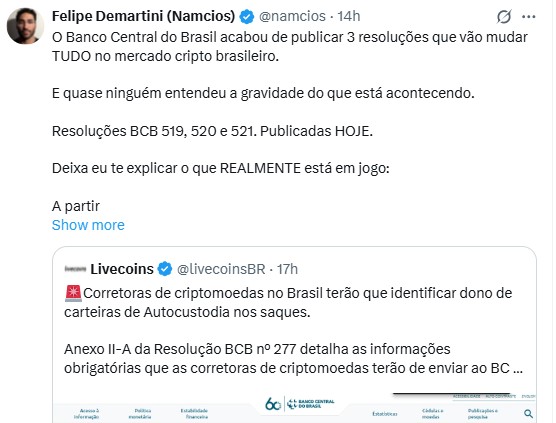
“The central bank will know your name, CPF, how much Bitcoin you hold, and when you move it. This creates a centralized database of all crypto holders in Brazil, an irresistible target for hackers and a dangerous political tool.”
He also pointed to new limits on the amount of international cryptocurrency transfers: $100 000 for exchanges and $500 000 for banks, saying that these rules “force users back into traditional banking channels.”

Useful material?
 Telegram
  Twitter
 Incidents
In 104 minutes, the attacker emptied 1,404 addresses before validators halted the network and froze almost all of the loot.
Oct 19, 2026
Incidents
Developers warned of potential risks to bridges across the ecosystem and asked exchanges for assistance.
Jun 22, 2026
Incidents
The defendant helped move funds stolen through investment scams and earned at least $4 million for his role in the operation.
Jun 10, 2026
Incidents
The company is linking the incident to a compromised private key on a service wallet, rather than a smart contract exploit
May 22, 2026
Incidents
Following the incident, the project temporarily halted trading operations and node activity.
May 15, 2026
Incidents
The user spent weeks unsuccessfully trying to guess the password until Claude helped find an old wallet backup file
May 14, 2026
Cryptocurrency rates
-

Bitcoin
$81 025
BTC
-4.32%
-

Ethereum
$2 373.8
ETH
-5.72%
-

BNB Smart Chain
$727.57
BSC
-2.99%
-

Ripple
$1.42
XRP
+1.04%
-

TRON
$0.32796
TRX
-1.44%
-

Zcash
$1 193.44
ZEC
-12.13%
-

Dogecoin
$0.078089
DOGE
-6.57%
-

Cardano
$0.218269
ADA
+2.11%
-

Stellar XLM
$0.184461
XLM
+2.83%
-

Bitcoin Cash
$272.69
BCH
-5.15%