

Ethereum to shut down Holesky testnet after Fusaka fork
The Holesky network has completed its task of testing staking and is giving way to a new ecosystem of Ethereum testnets

02.09.2025 - 13:10
469
3 min
0
Key points:
- Holesky will shut down two weeks after the Fusaka fork is activated.
- Massive validator shutdowns led to the launch of the new Hoodi network.
- Developers are advised to switch to Sepolia, validators to Hoodi.
Ethereum’s largest testnet, Holesky, is shutting down according to the network’s development plan. The Ethereum Foundation has confirmed that the network will be shut down two weeks after the Fusaka upgrade, which will take place in the fall of 2025. After that, Holesky will no longer be supported by the client and infrastructure teams.
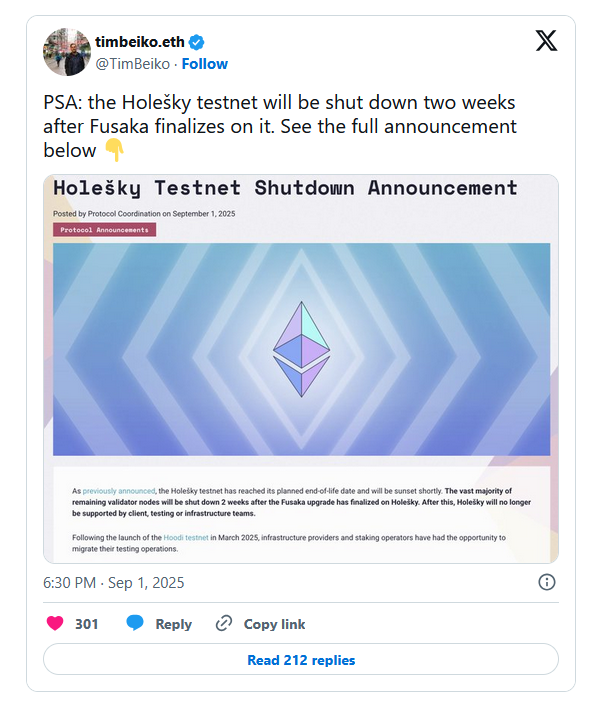
Holesky was launched in September 2023 and, within two years, became the largest test bed for verifying the operation of Proof-of-Stake and validator infrastructure. It was used to test key Ethereum upgrades, including Dencun and Pectra, which reduced costs and increased staking efficiency.
However, after Pectra was activated in early 2025, the network experienced massive validator outages. This caused long exit queues and made it impossible to test validator performance at all stages. In response, developers launched a new testnet, Hoodi, which does not have these limitations.
Ethereum developers have scheduled the Fusaka hard fork for November
On July 23, the upgrade will be rolled out to devnet to test the improvements
Fusaka and new Ethereum capabilities
The Fusaka fork will be the next important step in Ethereum’s development. It will redistribute the data storage load among validators, allowing layer 2 solutions (rollups) to process transactions faster and cheaper. The upgrade will include 11 proposals to improve Ethereum.
New map of Ethereum testnets
After Holesky’s departure, the Ethereum test ecosystem will consist of three mainnets, each with its own role:
|
Testnet |
Purpose |
|
Sepolia |
testing dApps and smart contracts |
|
Hoodi |
testing validators and staking |
|
Ephemery |
short validation cycles with a restart every 28 days |
The Ethereum Foundation emphasized that Holesky had accomplished its mission: the community gained experience in large-scale validator testing and worked out key upgrades, and the results formed the basis for the development of Hoodi and new protocol testing methods.

Useful material?
 Telegram
  Twitter
 Incidents
Developers warned of potential risks to bridges across the ecosystem and asked exchanges for assistance.
Jun 22, 2026
Incidents
The defendant helped move funds stolen through investment scams and earned at least $4 million for his role in the operation.
Jun 10, 2026
Incidents
The company is linking the incident to a compromised private key on a service wallet, rather than a smart contract exploit
May 22, 2026
Incidents
Following the incident, the project temporarily halted trading operations and node activity.
May 15, 2026
Incidents
The user spent weeks unsuccessfully trying to guess the password until Claude helped find an old wallet backup file
May 14, 2026
Crypto regulations
Authorities are introducing mandatory registration for companies handling cross-border crypto transactions
May 8, 2026
Cryptocurrency rates
-

Bitcoin
$81 479
BTC
+0.71%
-

Ethereum
$2 416.11
ETH
+0.76%
-

BNB Smart Chain
$715.66
BSC
-0.43%
-

Ripple
$1.42
XRP
+1.04%
-

TRON
$0.334234
TRX
-0%
-

Zcash
$1 146.69
ZEC
+0.5%
-

Dogecoin
$0.079797
DOGE
+0.4%
-

Cardano
$0.218269
ADA
+2.11%
-

Stellar XLM
$0.184461
XLM
+2.83%
-

Bitcoin Cash
$275.42
BCH
+1.15%