

North Korean hackers stole $2 billion in cryptocurrency
Elliptic analysts called this figure a record
08.10.2025 - 10:00
325
4 min
0
Key points:
- Analytics company Elliptic reported that hackers linked to the North Korean government stole over $2 billion in cryptocurrency in 2025.
- Most of the amount came from the hack of the Bybit exchange, where the attackers withdrew $1,46 billion.
- Experts note that hackers are increasingly using social engineering and complex laundering schemes to cover up their crimes.
According to analytics company Elliptic, hackers working for the North Korean government have stolen more than $2 billion in cryptocurrency since the beginning of the year. Elliptic published a report on its blog with a new estimate, which is the “largest annual total on record.” The estimate is based on an analysis of more than 30 hacks this year.
Experts say the amount has nearly tripled compared to 2024 and significantly exceeded the previous record of $1,35 billion set in 2022. At that time, the main damage was caused by attacks on the Ronin Network and Harmony Bridge. Elliptic clarified:
“We are aware of many other thefts that share some of the hallmarks of North Korea-linked activity but lack sufficient evidence to be definitively attributed. Other thefts are likely unreported and remain unknown.”
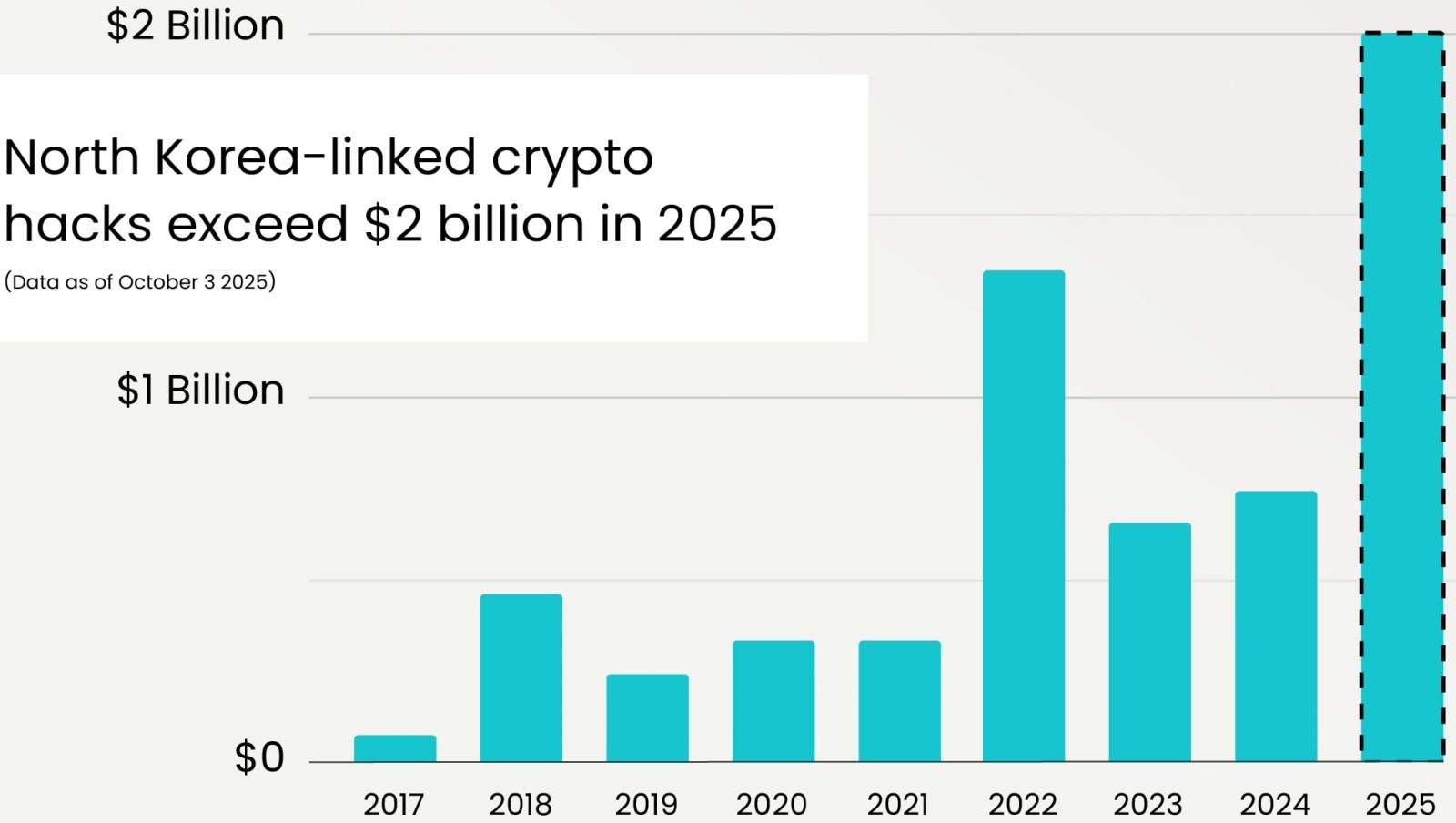
Most of the record amount stolen attributed to North Korean hackers in 2025 was linked to the Bybit hack in February, when hackers stole $1,46 billion.
Six months after the $1,5 billion Bybit hack. How the incident changed the industry
North Korean hackers behind the Bybit hack had to invent new ways to launder cryptocurrency because they found themselves in a situation unique to the industry
Other confirmed incidents include attacks on LND.fi, WOO X, Seedify, and the Taiwanese exchange BitoPro, from which Lazarus withdrew $11 million.
Lazarus Group suspected of the largest hack worth $22,8 million
The first theories appeared in the OFSI report, but the regulator did not disclose the sources of the information
Features of the hacks
Elliptic notes that in 2025, hackers changed their approach: instead of attacking DeFi infrastructure, they increasingly targeted the accounts of wealthy users and exchange employees. Their main weapon is social engineering, which is gradually replacing the exploitation of technical vulnerabilities.
Money laundering strategies have also evolved under pressure from regulators, blockchain analysis companies, and law enforcement agencies.
Attackers are using increasingly sophisticated tax evasion tactics, including multiple mixing and cross-chain transfers, the use of little-known blockchains, the purchase of utility tokens, the use of refund addresses, or the use of custom tokens issued by money laundering networks.
Despite this, Elliptic emphasizes that blockchain transparency still helps law enforcement agencies track stolen funds and identify participants in schemes.

Useful material?
 Telegram
  Twitter
 Incidents
Developers warned of potential risks to bridges across the ecosystem and asked exchanges for assistance.
Jun 22, 2026
Incidents
The defendant helped move funds stolen through investment scams and earned at least $4 million for his role in the operation.
Jun 10, 2026
Incidents
The company is linking the incident to a compromised private key on a service wallet, rather than a smart contract exploit
May 22, 2026
Incidents
Following the incident, the project temporarily halted trading operations and node activity.
May 15, 2026
Incidents
The user spent weeks unsuccessfully trying to guess the password until Claude helped find an old wallet backup file
May 14, 2026
Crypto regulations
Authorities are introducing mandatory registration for companies handling cross-border crypto transactions
May 8, 2026
Cryptocurrency rates
-

Bitcoin
$82 195
BTC
-0.78%
-

Ethereum
$2 488.73
ETH
-3.1%
-

BNB Smart Chain
$739.48
BSC
-3.98%
-

Ripple
$1.42
XRP
+1.04%
-

TRON
$0.332024
TRX
-1.09%
-

Zcash
$1 220.45
ZEC
-6.68%
-

Dogecoin
$0.084899
DOGE
-4.23%
-

Cardano
$0.218269
ADA
+2.11%
-

Stellar XLM
$0.184461
XLM
+2.83%
-

Bitcoin Cash
$278.86
BCH
-6.66%