

Six months after the $1,5 billion Bybit hack. How the incident changed the industry
North Korean hackers behind the Bybit hack had to invent new ways to launder cryptocurrency because they found themselves in a situation unique to the industry
22.08.2025
573
4 min
0
It has been exactly six months since the historic hack of the Bybit exchange. At that time, attackers stole approximately $1б46 billion in Ethereum (ETH) and ERC-20 tokens. GetBlock AML Research summarizes the efforts to counter North Korean hackers and explains their methods of laundering stolen cryptocurrency.
According to a recent report by zeroShadow, more than $1 billion of the stolen funds have already been laundered. It is unlikely that all this money remained under the complete control of North Korean hackers at every stage. It is believed that from the very beginning, they connected professional turnkey laundering services: they paid North Korea an agreed amount minus their fee. This version is confirmed by user complaints: sometimes the services blocked funds stolen from Bybit, and the launderers tried to “save” the money not for the client’s sake, but for their own profit.
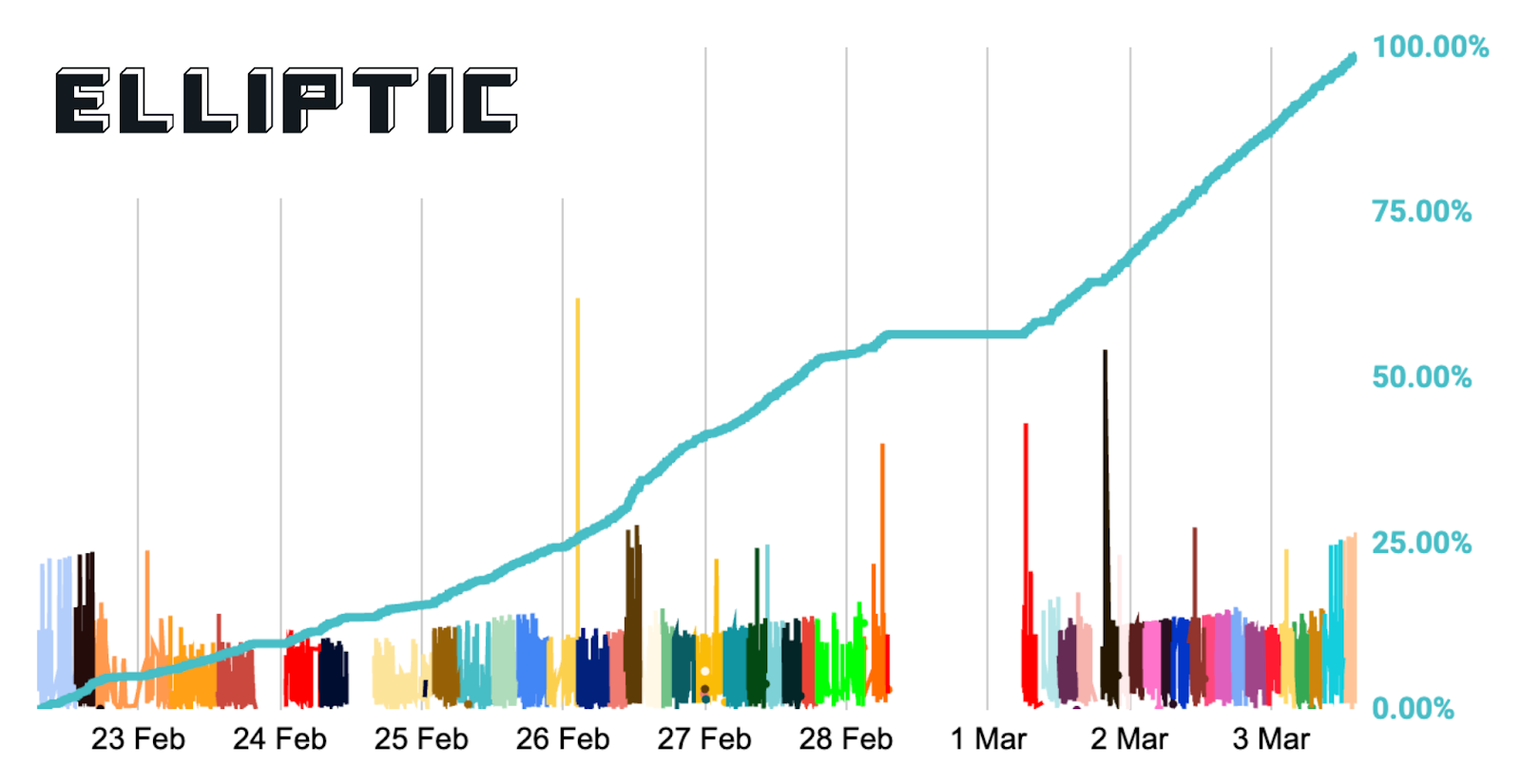
The rate of laundering of stolen assets in the first days after the hack
Large volumes
Usually, funds stolen by North Korea remained in wallets for weeks or even months before any movement began. In the case of Bybit, the money began to be actively transferred immediately. This is because the attack attracted a lot of attention: the crypto community, analysts, and even law enforcement agencies joined the investigation.
In addition to speed, the complexity of the laundering schemes is also noteworthy. Standard techniques are usually used: transfers through different blockchains and anonymizing services. But in the case of Bybit, the attackers repeatedly “mixed” the coins, running them through different blockchains and services, creating additional layers of obfuscation. Sometimes they even used little-known blockchains to make the investigation more difficult.
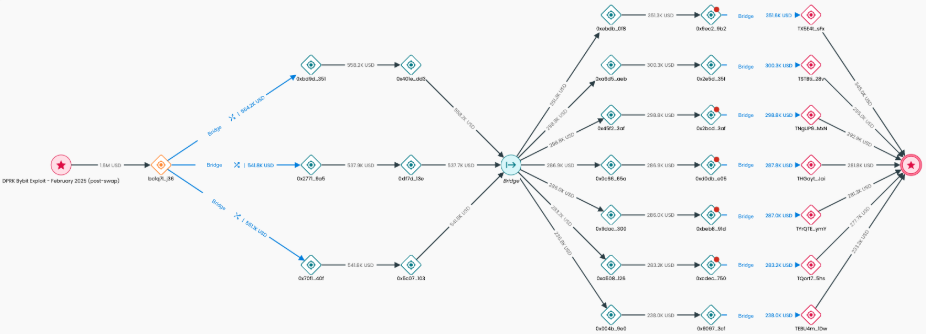
Connection of money laundering wallets with different blockchains
New methods
Different schemes were used for different parts of the stolen funds, suggesting that several independent money laundering teams were at work.
Sometimes they tried to save on fees:
- they bought special tokens that reduced the cost of transactions,
- used energy rental services on the Tron network instead of standard payments in TRX,
- and used “return addresses.”
The latter method worked as follows: some services allow you to specify a separate address for refunds if the transaction fails. Usually, the money is returned to the sender. But the hackers specified a new “clean” wallet to which the refunded funds were transferred. As a result, the trail disappeared. At the same time, the services still charged a processing fee, which shows that this trick was not invented specifically for anonymity, but helped to hide the transfers.

Use of addresses for refunds
Mixers and anonymous wallets
Some of the stolen funds were converted into bitcoins and run through Wasabi Wallet (CoinJoin wallet) and various mixers. The use of Wasabi was particularly high, much higher than in previous North Korean thefts. Tornado Cash, on the other hand, was used less frequently. Little-known mixers were also used: Cryptomixer, Jambler, Coinomize, and others. This is because many services familiar to North Korea have been shut down, such as Chip Mixer and Sinbad.io. Therefore, it was necessary to look for new tools.
Useless tokens
The hackers created a new token that no one needed, made a liquidity pool for it with USDT, and began exchanging stolen stablecoins for this token. This created the “appearance of value.” Then, these tokens were exchanged back to USDT from other addresses, and the laundering process continued. This allowed them to “hide” about $24 million.
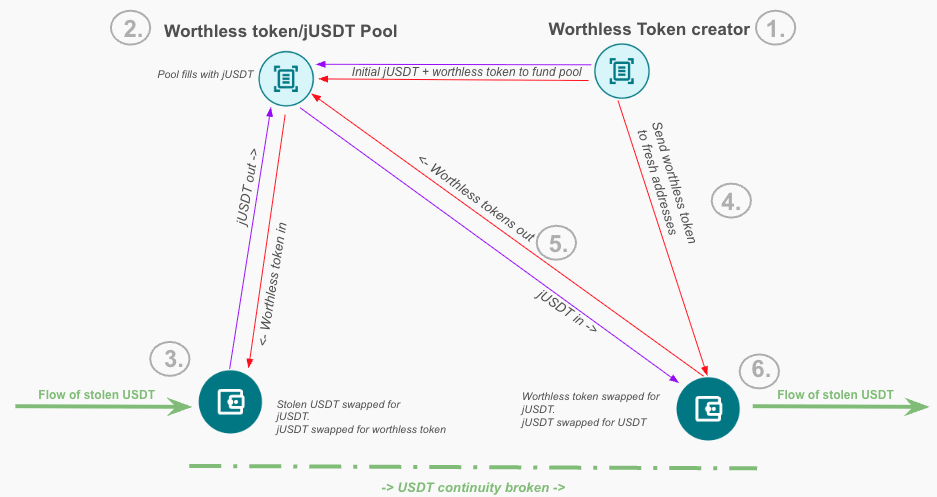
Scheme for creating useless tokens for asset laundering
Cash withdrawal
Ultimately, most of the funds ended up in the Tron blockchain and were converted to USDT. They were then “cashed out” through Chinese OTC services (unofficial exchange services), which convert millions of dollars worth of cryptocurrency into cash every year and ask their customers almost no questions. Many of these services are linked to the Huione group.
The threat remains
Despite the huge amount stolen from Bybit, North Korea continues to steal cryptocurrency in 2025. Their methods include:
- infiltrating IT specialists into crypto projects (they work honestly at first, then hack their employer),
- fake calls on Zoom or Google Meet with malicious code installation,
- “fake” job openings for developers, where infected repositories are slipped in instead of test assignments.

Useful material?
 Telegram
  Twitter
 Research
One and the same cryptocurrency address received two completely opposite assessments from different analytics systems: from an ordinary gambling service to an extremely severe criminal offense. This story has become the starting point for a broader conversation about what the scientific standards of blockchain analysis should look like — and why errors in systems like these can shape the fates of real people.
Jul 1, 2026
Research
The blockchain has helped uncover the ties between cryptocurrency fundraising campaigns, exchangers in Syria, and intermediaries in several countries around the world. A telltale pattern has emerged in which the same addresses were used across multiple donation drives at once
Jun 24, 2026
Research
Four Iranian cryptocurrency exchanges accounted for roughly 78% of all digital asset volume tied to the country in 2025. They have now become the focal point of the largest U.S. sanctions campaign against Iran's cryptocurrency infrastructure.
Jun 5, 2026
Research
A financial system is already up and running on public blockchains, with loans, analogues of U.S. Treasuries, and automated capital markets. More than $551 billion has flowed through DeFi protocols — but most of that activity has nothing to do with the real economy and everything to do with the speculative build-up of risk.
May 29, 2026
Research
Around 97% of Chinese suppliers of chemicals used to make fentanyl accept payment in cryptocurrency. The volume of such transactions continues to grow alongside the global market for synthetic drugs
May 22, 2026
Research
For the first time, the new law makes blockchain analytics an officially mandatory tool of financial oversight in the United States. Authorities will also gain the power to restrict transactions with foreign crypto services tied to money-laundering risks.
May 20, 2026
Cryptocurrency rates
-

Bitcoin
$82 458
BTC
+0.17%
-

Ethereum
$2 492.67
ETH
-2.33%
-

BNB Smart Chain
$742.04
BSC
-2.85%
-

Ripple
$1.42
XRP
+1.04%
-

TRON
$0.331913
TRX
-0.96%
-

Zcash
$1 217.93
ZEC
-2.01%
-

Dogecoin
$0.085082
DOGE
-1.6%
-

Cardano
$0.218269
ADA
+2.11%
-

Stellar XLM
$0.184461
XLM
+2.83%
-

Bitcoin Cash
$279.22
BCH
-5.16%