


Turkey to grant Masak the right to freeze crypto accounts in the fight against money laundering
A new bill will expand Masak’s powers: it will be able to block crypto accounts and impose limits on transactions within the framework of FATF AML standards

30.09.2025 - 08:50
671
2 min
0
Key points:
- The new bill will give Masak the power to freeze crypto accounts and block suspicious wallets.
- The main goal is to combat “rented accounts” for illegal betting and fraud.
- Turkey will bring its rules into line with FATF standards.
The Turkish government is drafting a bill that will expand the powers of the Financial Crimes Investigation Board, Masak. According to Bloomberg, the supervisory authority will be able to freeze crypto accounts and close accounts in banks and payment systems if illegal operations are suspected.
The measures are designed to align the country’s legislation with the recommendations of the Financial Action Task Force (FATF).
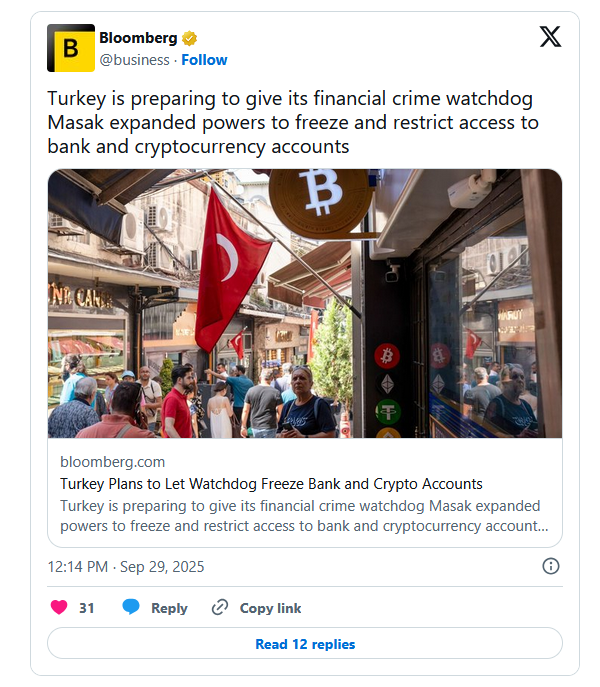
Masak’s new powers
The bill gives Masak the right to block crypto accounts, restrict transactions, and blacklist wallets linked to criminal activity. Organizations working with electronic money and crypto exchanges will also be subject to control.
The main goal is to reduce the use of so-called “rented accounts,” which criminals purchase from individuals for illegal operations, including gambling and financial fraud.
Rules for transfers and stablecoins
In June 2025, the Ministry of Finance presented a draft of new regulations for crypto platforms. Users will be required to describe each transaction that is at least 20 characters long. A delay will be introduced for withdrawals: 48 hours for most withdrawals and 72 hours for the first withdrawal from an account.
In addition, it is proposed to set limits on stablecoin transfers — $3000 per day and $50 000 per month. Platforms that fully comply with the Travel Rule and collect data on the sender and recipient will be able to double these limits.
Also in July, Turkey blocked access to several services, including PancakeSwap, for providing “unauthorized” services.

Useful material?
 Telegram
  Twitter
 Incidents
Developers warned of potential risks to bridges across the ecosystem and asked exchanges for assistance.
Jun 22, 2026
Incidents
The defendant helped move funds stolen through investment scams and earned at least $4 million for his role in the operation.
Jun 10, 2026
Incidents
The company is linking the incident to a compromised private key on a service wallet, rather than a smart contract exploit
May 22, 2026
Incidents
Following the incident, the project temporarily halted trading operations and node activity.
May 15, 2026
Incidents
The user spent weeks unsuccessfully trying to guess the password until Claude helped find an old wallet backup file
May 14, 2026
Crypto regulations
Authorities are introducing mandatory registration for companies handling cross-border crypto transactions
May 8, 2026
Cryptocurrency rates
-

Bitcoin
$84 624
BTC
-0.36%
-

Ethereum
$2 679.26
ETH
-1.32%
-

BNB Smart Chain
$768.92
BSC
-0.41%
-

Ripple
$1.42
XRP
+1.04%
-

TRON
$0.334678
TRX
+0.07%
-

Zcash
$1 320.89
ZEC
-1.26%
-

Dogecoin
$0.093195
DOGE
-0.79%
-

Cardano
$0.218269
ADA
+2.11%
-

Stellar XLM
$0.184461
XLM
+2.83%
-

Bitcoin Cash
$313.44
BCH
+1.89%