

US House of Representatives passed three crypto regulation bills at once
The document regulating the issuance of stablecoins has already been sent for Trump’s signature

18.07.2025 - 13:55
828
4 min
0
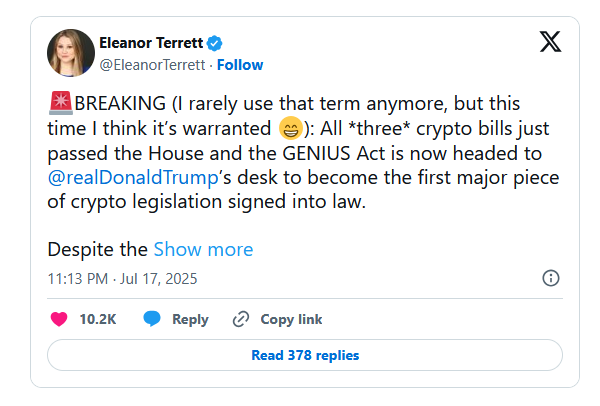
What’s new? On July 17, the US House of Representatives passed three cryptocurrency bills addressing issues such as the issuance of stablecoins, industry oversight, and central bank digital currency (CBDC) restrictions. As a result, the first of them, known by the acronym GENIUS and defining the regulation of stablecoin issuers, has already been sent to the President for his signature, as it was drafted by the Senate and previously received his approval.
What else is known? GENIUS will go into effect 18 months after Trump signs it, or 120 days after “the primary federal payment stablecoin regulators,” including the Treasury Department and the Fed, publish final regulations implementing it.
GENIUS states that stablecoin issuers authorized to operate in the US must back their tokens at a 1:1 ratio with reserves in dollars or other cash equivalents such as Treasury bills.

Circle has applied to launch a trust to hold crypto assets in the US
Last month, the company went public through an IPO under the ticker CRCL
Issuers will be required to regularly publish the composition of these reserves and make them available for review by third-party auditors, and send the results of the reports to federal or state regulators.
Three years after the bill is signed into law, it will be prohibited to offer in the United States any stablecoins issued by an unapproved issuer, including foreign companies.
At the same time, the document provides a number of exceptions for foreign issuers. Thus, in case the Treasury Department determines that the country where such an issuer is headquartered has a comparable regulatory regime to the US, it will be allowed to continue operating.
Such foreign issuers will be able to serve the US market if they register with the Office of the Comptroller of the Currency (OCC) and have sufficient reserves in a US bank to guarantee payments to US customers.

Corporate bitcoin accumulations reached 847 000 BTC in the second quarter
Companies added a record 159 107 coins to their balance sheets during the reporting period
The bill authorizes the issuance of stablecoins to different types of regulated entities, such as banks, credit unions, and non-banks, and creates a dual legal framework for their federal and state supervision.
These organizations, depending on their type, may be regulated by the National Credit Union Administration, the Federal Deposit Insurance Corporation (FDIC), the OCC, the Treasury Department, or the Federal Reserve.
If the capitalization of a stablecoin does not exceed $10 billion, the company issuing it can choose state regulation instead of federal regulation, and the state is not required to establish a special regulatory agency.
GENIUS passed by a vote of 307 to 122, with more than 100 Democrats joining a majority of Republicans in advancing it.

US launches investigation into Brazilian digital payment system
US authorities suspect Brazil of deliberately obstructing US fintech companies
In a separate action, the House of Representatives approved the CLARITY bill by a vote of 294 to 134 and sent it to the Senate, the upper chamber of Congress, for consideration.
It defines jurisdictional boundaries for crypto exchanges that offer trading in tokens that do not fall under the definition of a security.
CLARITY directs the Securities and Exchange Commission (SEC) and the Commodity Futures Trading Commission (CFTC) to form a common guideline that would allow crypto exchanges to list eligible tokens and derivatives.
Also passed by a vote of 219 to 210 was the Anti-CBDC bill, which prohibits the Fed from developing and issuing a digital dollar because of the threat to citizens’ privacy. It was supported by two members of the Democratic Party, among others.

Useful material?
 Telegram
  Twitter
 Incidents
In 104 minutes, the attacker emptied 1,404 addresses before validators halted the network and froze almost all of the loot.
Oct 19, 2026
Incidents
Developers warned of potential risks to bridges across the ecosystem and asked exchanges for assistance.
Jun 22, 2026
Incidents
The defendant helped move funds stolen through investment scams and earned at least $4 million for his role in the operation.
Jun 10, 2026
Incidents
The company is linking the incident to a compromised private key on a service wallet, rather than a smart contract exploit
May 22, 2026
Incidents
Following the incident, the project temporarily halted trading operations and node activity.
May 15, 2026
Incidents
The user spent weeks unsuccessfully trying to guess the password until Claude helped find an old wallet backup file
May 14, 2026
Cryptocurrency rates
-

Bitcoin
$84 171
BTC
+1.54%
-

Ethereum
$2 473.28
ETH
+0.94%
-

BNB Smart Chain
$748.04
BSC
+0.91%
-

Ripple
$1.42
XRP
+1.04%
-

TRON
$0.330357
TRX
-0.22%
-

Zcash
$1 322.65
ZEC
+4.22%
-

Dogecoin
$0.081876
DOGE
+0.02%
-

Cardano
$0.218269
ADA
+2.11%
-

Stellar XLM
$0.184461
XLM
+2.83%
-

Bitcoin Cash
$286.35
BCH
+0.25%