

Wisconsin bill will exempt crypto businesses from money transfer licenses
The document excludes mining, staking, and blockchain development from money transfer regulations, simplifying the work of the state’s crypto industry

30.09.2025 - 11:55
395
2 min
0
Key points:
- Wisconsin Assembly Bill 471 excludes mining, staking, and cryptocurrency exchange from money transfer licensing requirements.
- It allows digital assets to be used as a means of payment and establishes the right to store them in personal wallets.
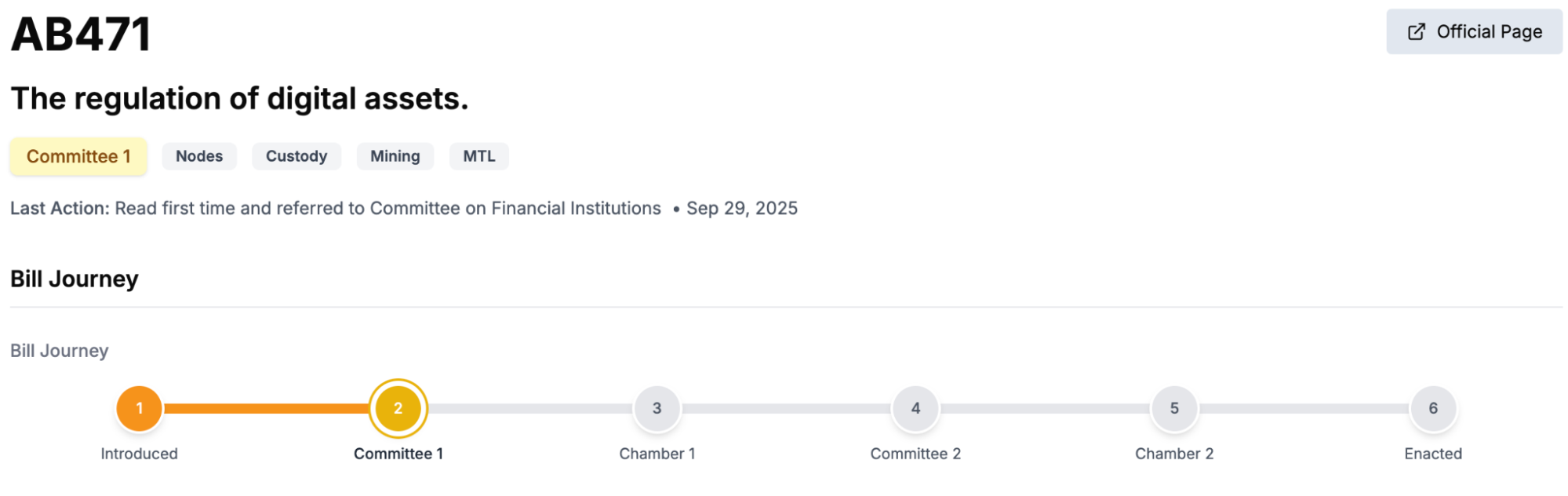
- The bill has been supported by nine Republicans, but it still needs to be reviewed by the House and committees (25% progress).
Wisconsin lawmakers have introduced a new bill that could significantly ease regulations for the crypto industry. If passed, state residents and companies will no longer need a money transmitter license to participate in mining, staking, and exchanging digital assets.
According to the Legislative Reference Bureau, Bill 471 clarifies exemptions from the Department of Financial Institutions’ rules. It will exempt crypto services from licensing if their activities are related to blockchain protocols and do not involve conversion to fiat or bank deposits.
What the bill provides for
The document allows individuals and legal entities to:
- manage nodes and connect to blockchain protocols;
- participate in network operations and staking;
- develop blockchain software;
- transfer digital assets to another person directly through the protocol.
The bill establishes the right to use digital assets to pay for legal goods and services and to store them in hardware wallets or on one’s own servers.
“Under the bill, neither a state agency nor a political subdivision may prohibit or restrict a person in accepting digital assets as a method of payment,” the text states.
Political support and prospects
The bill was supported by seven Republicans in the House of Representatives and two Republican senators. It has now been sent to the Financial Institutions Committee for further consideration.
According to Legiscan, the bill has a 25% chance of passing — it still needs to be reviewed by the committee and voted on in one of the chambers.

Useful material?
 Telegram
  Twitter
 Incidents
Developers warned of potential risks to bridges across the ecosystem and asked exchanges for assistance.
Jun 22, 2026
Incidents
The defendant helped move funds stolen through investment scams and earned at least $4 million for his role in the operation.
Jun 10, 2026
Incidents
The company is linking the incident to a compromised private key on a service wallet, rather than a smart contract exploit
May 22, 2026
Incidents
Following the incident, the project temporarily halted trading operations and node activity.
May 15, 2026
Incidents
The user spent weeks unsuccessfully trying to guess the password until Claude helped find an old wallet backup file
May 14, 2026
Crypto regulations
Authorities are introducing mandatory registration for companies handling cross-border crypto transactions
May 8, 2026
Cryptocurrency rates
-

Bitcoin
$85 570
BTC
-0.32%
-

Ethereum
$2 698.42
ETH
-0.59%
-

BNB Smart Chain
$778.95
BSC
-0.99%
-

Ripple
$1.42
XRP
+1.04%
-

TRON
$0.335357
TRX
-0.31%
-

Zcash
$1 365.32
ZEC
+2.18%
-

Dogecoin
$0.093762
DOGE
-1.73%
-

Cardano
$0.218269
ADA
+2.11%
-

Stellar XLM
$0.184461
XLM
+2.83%
-

Bitcoin Cash
$311.43
BCH
-1.55%