

A classic Ponzi scheme: how DSJ Exchange raised $150 Million
The scammers attempted to conceal over $90 million through complex cryptocurrency transactions. However, part of the funds was successfully traced and frozen.

06.05.2026
739
4 min
0
In early May 2026, a large financial scheme disguised as a cryptocurrency investment platform shut down. Operating under the names DSJ Exchange (DSJEX) and BG Wealth Sharing, the project promised high returns but ultimately turned out to be a Ponzi scheme. GetBlock AML Research has uncovered details behind the collapse of yet another crypto-based financial fraud.
Estimates suggest the total amount raised exceeded $150 million. In just the final week before the shutdown, participants attempted to conceal more than $90 million by transferring funds across multiple blockchain networks to obscure the trail.
How the Scheme Worked
The project began actively attracting users in 2025. Investors were promised daily returns ranging from 1.3% to 2.6%—figures far beyond any legitimate investment opportunities.
The DSJ platform presented itself as a crypto trading venue where users could supposedly earn profits. BG Wealth Sharing was positioned as an investment group. In reality, both were part of the same fraudulent operation.
To build credibility, the organizers used a fictitious executive named Steven Bird. They also frequently changed websites and crypto wallets to make tracking more difficult.
New participants were recruited through the BonChat messaging app, where “trading signals” and promises of high profits were regularly posted.

Messages between participants of the scheme in BonChat
Regulators around the world issued warnings about the scheme—more than ten official alerts were recorded across multiple continents. On April 23, 2026, U.S. law enforcement blocked one of the websites linked to the project. However, the scheme continued to operate even after that.
Final Stage Before Collapse
On May 2, a person claiming to be the project’s leader released a video stating that the company was preparing to go public. At the same time, users were required to pay a “tax” equal to 12% of their account balance.
By that point, withdrawals had already been disabled, leaving users unable to recover their funds.
How the Funds Were Concealed
Following this, the organizers began actively moving funds through various cryptocurrency tools. In simple terms, the money was routed through numerous transactions and addresses to make tracking more difficult.
Between April 27 and May 3, more than $90 million was transferred. Some of the funds ultimately ended up on major cryptocurrency platforms.
What Was Recovered
Well-known blockchain investigator ZachXBT, working alongside crypto companies and law enforcement agencies, managed to trace the movement of funds.
As a result:
- Over $38 million was frozen by Tether
- Approximately $3 million more was blocked on other platforms
- Total frozen funds exceeded $41 million
This means a significant portion of the funds was intercepted before it could be fully laundered.
| Wallets Used for Laundering Funds |
| 0xf3bd39870d26cfdcdc582ed02b97f74e19e0ee97 |
| 0x35c752ddbd5a5f23482141fab42f943c52ba9adb |
| 0x7a22c5d74f90515ed5834b237b6f8f865c543a66 |
| 0x78255cFa63A3b49b742Cbc9aDb36aF926d3cdA90 |
| TGTWYCJxhvrDkZc4pyugBAnc4qWeXdXJdF |
| TBsjjfnBi5mW3soFmSVFK1pAD5Jbwrbjcg |
| TWF1bcuNLXtwQCRxb6Qn6uKqWCuXRatiei |
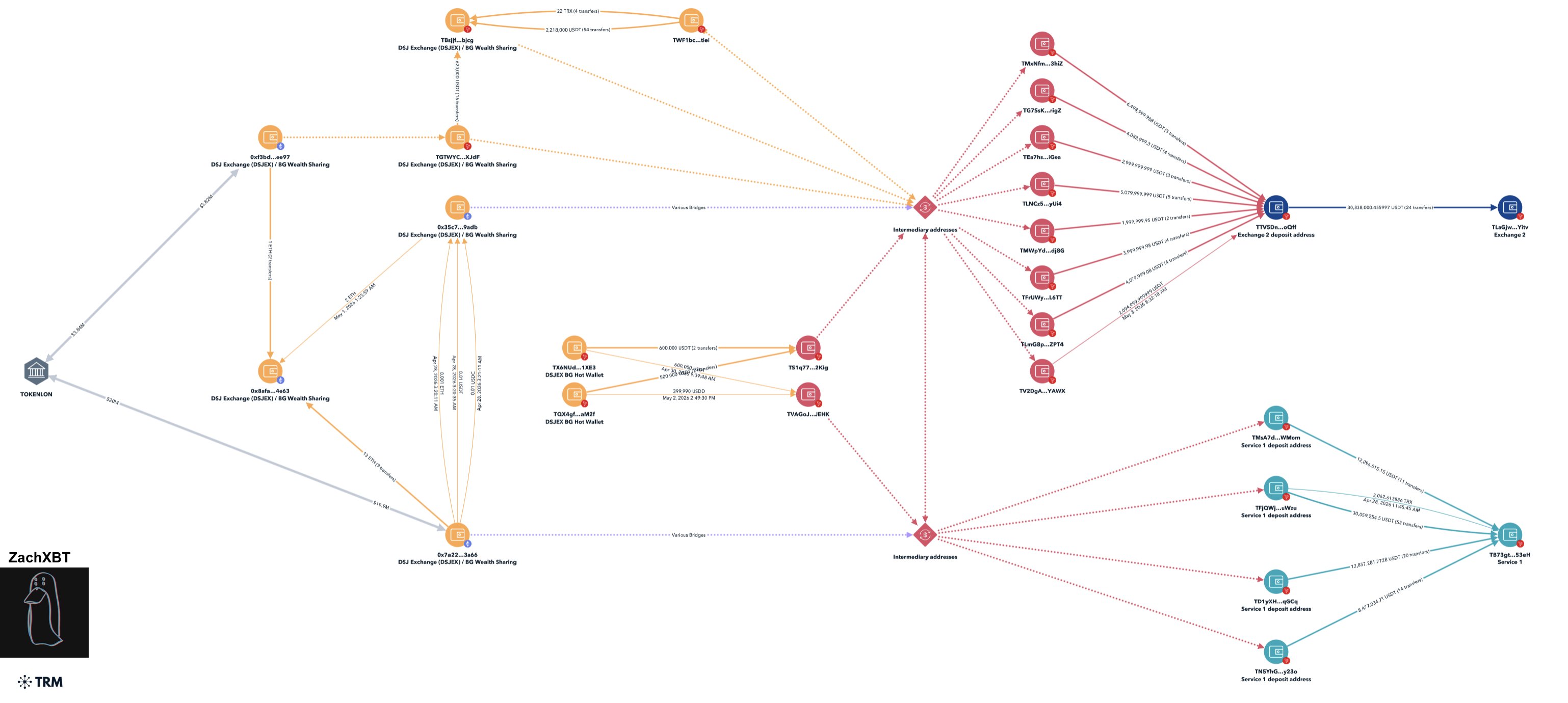
Flow of stolen funds. Visualization: ZachXBT & TRM Labs
Why People Keep Falling for It
Despite clear warning signs, such schemes continue to attract thousands of participants. The primary reason is their focus on inexperienced users who lack knowledge of investing and cryptocurrencies.
Promises of high returns combined with aggressive social media promotion make these projects especially dangerous. Even after the collapse, many participants initially refused to believe they had been scammed.
The true scale of the scheme may be significantly greater than $150 million, as it operated for over a year. This case demonstrates that even within complex digital ecosystems, it is possible to trace and partially recover stolen funds. However, the most effective protection remains caution and critical thinking.

Useful material?
 Telegram
  Twitter
 Research
One and the same cryptocurrency address received two completely opposite assessments from different analytics systems: from an ordinary gambling service to an extremely severe criminal offense. This story has become the starting point for a broader conversation about what the scientific standards of blockchain analysis should look like — and why errors in systems like these can shape the fates of real people.
Jul 1, 2026
Research
The blockchain has helped uncover the ties between cryptocurrency fundraising campaigns, exchangers in Syria, and intermediaries in several countries around the world. A telltale pattern has emerged in which the same addresses were used across multiple donation drives at once
Jun 24, 2026
Research
Four Iranian cryptocurrency exchanges accounted for roughly 78% of all digital asset volume tied to the country in 2025. They have now become the focal point of the largest U.S. sanctions campaign against Iran's cryptocurrency infrastructure.
Jun 5, 2026
Research
A financial system is already up and running on public blockchains, with loans, analogues of U.S. Treasuries, and automated capital markets. More than $551 billion has flowed through DeFi protocols — but most of that activity has nothing to do with the real economy and everything to do with the speculative build-up of risk.
May 29, 2026
Research
Around 97% of Chinese suppliers of chemicals used to make fentanyl accept payment in cryptocurrency. The volume of such transactions continues to grow alongside the global market for synthetic drugs
May 22, 2026
Research
For the first time, the new law makes blockchain analytics an officially mandatory tool of financial oversight in the United States. Authorities will also gain the power to restrict transactions with foreign crypto services tied to money-laundering risks.
May 20, 2026
Cryptocurrency rates
-

Bitcoin
$81 385
BTC
-1.68%
-

Ethereum
$2 379.56
ETH
-2.22%
-

BNB Smart Chain
$726.83
BSC
+0.13%
-

Ripple
$1.42
XRP
+1.04%
-

TRON
$0.331882
TRX
+0.29%
-

Zcash
$1 126.24
ZEC
-3.4%
-

Dogecoin
$0.078807
DOGE
-1.15%
-

Cardano
$0.218269
ADA
+2.11%
-

Stellar XLM
$0.184461
XLM
+2.83%
-

Bitcoin Cash
$273.57
BCH
-1.69%