

Binance has been caught lying again. Why the exchange is rapidly losing its reputation
One of the largest cryptocurrency exchanges wants to hide its digital asset laundering offenses by any means necessary.

15.12.2025
372
3 min
0
Last month, we published an investigation by the International Consortium of Investigative Journalists (ICIJ) that revealed Binance continues to facilitate the laundering of cryptocurrency by criminals. GetBlock AML Research reveals how the exchange is attempting to avoid a scandal and conceal the true state of affairs.
Binance is once again embroiled in a cryptocurrency laundering scandal: what’s wrong with the exchange
A new journalistic investigation shows that the trading platform does not comply with AML standards and is involved in laundering dirty cryptocurrency
Coincidence?
On the day the ICIJ investigation was published, Binance released a report announcing a record decrease in the volume of dirty cryptocurrency in its accounts. In the report, the exchange stated that the research was conducted by the analytical companies Chainalysis and TRM Labs.
However, just two days later, the exchange edited the original report and stated that it had conducted the research itself based on data from Chainalysis and TRM Labs. This happened after one of the analytical companies (Chainalysis) caught Binance manipulating the facts and refuted the exchange’s claims about conducting the research.
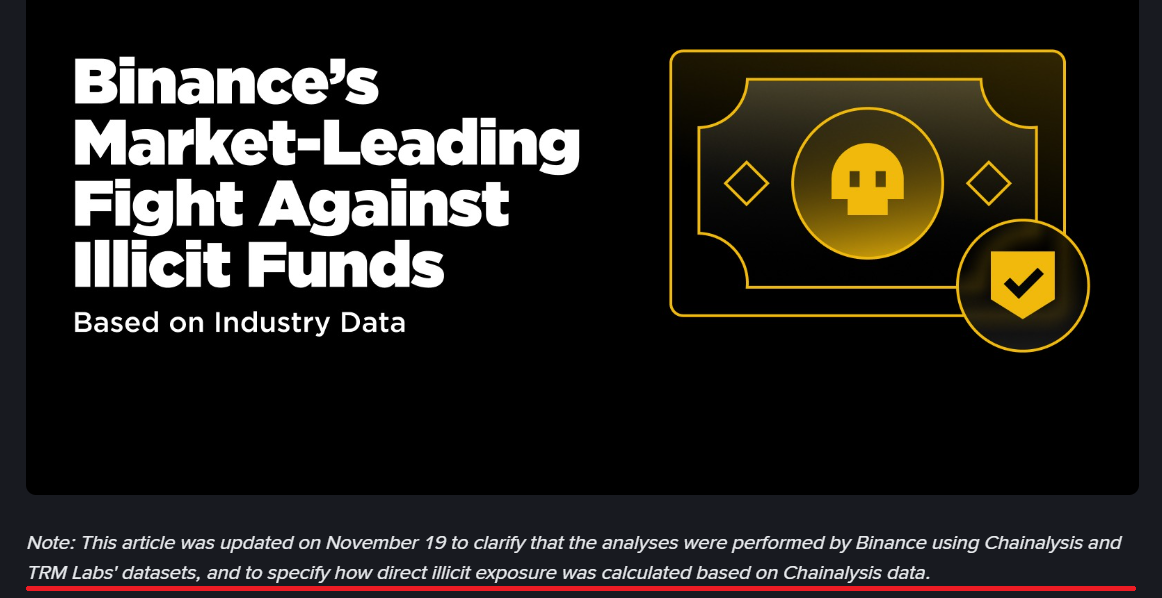
Binance’s announcement of the changes made to the report.
Chainalysis published a brief statement on its blog refuting that it had conducted research for Binance.
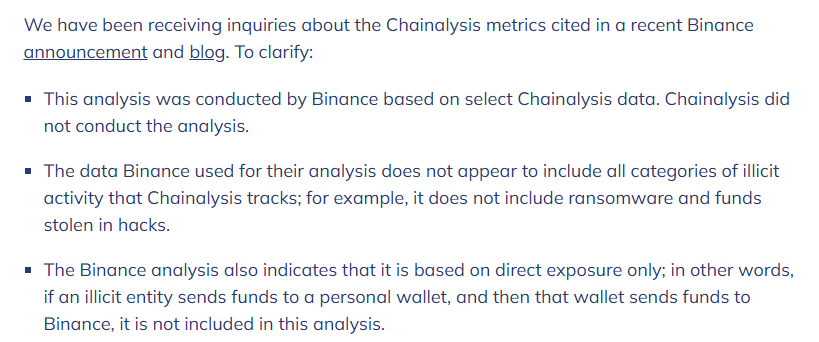
Screenshot of Chainalysis’ publication.
Not everything is so optimistic
Moreover, Chainalysis stated that Binance’s data on the reduction of dirty cryptocurrency in its own accounts is not objective, as it does not include all categories of illegal digital assets. For example, Binance did not use data on funds stolen through ransomware and hacker attacks.
Binance also skillfully manipulated the data to create an ideal picture of the fight against cryptocurrency laundering. The exchange’s data did not take into account situations where criminals transfer stolen funds to a personal wallet and then send coins from it to the exchange.

Useful material?
 Telegram
  Twitter
 Research
One and the same cryptocurrency address received two completely opposite assessments from different analytics systems: from an ordinary gambling service to an extremely severe criminal offense. This story has become the starting point for a broader conversation about what the scientific standards of blockchain analysis should look like — and why errors in systems like these can shape the fates of real people.
Jul 1, 2026
Research
The blockchain has helped uncover the ties between cryptocurrency fundraising campaigns, exchangers in Syria, and intermediaries in several countries around the world. A telltale pattern has emerged in which the same addresses were used across multiple donation drives at once
Jun 24, 2026
Research
Four Iranian cryptocurrency exchanges accounted for roughly 78% of all digital asset volume tied to the country in 2025. They have now become the focal point of the largest U.S. sanctions campaign against Iran's cryptocurrency infrastructure.
Jun 5, 2026
Research
A financial system is already up and running on public blockchains, with loans, analogues of U.S. Treasuries, and automated capital markets. More than $551 billion has flowed through DeFi protocols — but most of that activity has nothing to do with the real economy and everything to do with the speculative build-up of risk.
May 29, 2026
Research
Around 97% of Chinese suppliers of chemicals used to make fentanyl accept payment in cryptocurrency. The volume of such transactions continues to grow alongside the global market for synthetic drugs
May 22, 2026
Research
For the first time, the new law makes blockchain analytics an officially mandatory tool of financial oversight in the United States. Authorities will also gain the power to restrict transactions with foreign crypto services tied to money-laundering risks.
May 20, 2026
Cryptocurrency rates
-

Bitcoin
$83 444
BTC
+2.34%
-

Ethereum
$2 466.19
ETH
+3%
-

BNB Smart Chain
$745.45
BSC
+1.99%
-

Ripple
$1.42
XRP
+1.04%
-

TRON
$0.331147
TRX
-0.02%
-

Zcash
$1 290.4
ZEC
+11.79%
-

Dogecoin
$0.081945
DOGE
+3.25%
-

Cardano
$0.218269
ADA
+2.11%
-

Stellar XLM
$0.184461
XLM
+2.83%
-

Bitcoin Cash
$285.49
BCH
+4.31%