

BlackRock has accumulated 3% of all bitcoins. How safe is it?

20.08.2025
426
4 min
0
On January 11, 2024, an exchange-traded fund (ETF) called IBIT was launched by BlackRock, the world’s largest investment company. This fund buys bitcoins and sells shares in them through a traditional stock exchange. Since its launch, IBIT has grown incredibly fast — as of June 10, 2025, BlackRock owns more than 662 500 bitcoins, which is more than 3% of the total volume of bitcoin in the world. That’s about $72,4 billion. GetBlock AML Research is looking into whether BlackRock’s accumulation policy contradicts the basic principles of BTC.
For comparison, it took the SPDR Gold Trust more than 1600 trading days to reach $70 billion. BlackRock did it in just 341 days — it is the fastest-growing ETF in history. This suggests that large investors (institutions) are now taking bitcoin seriously.
In terms of the number of bitcoins, BlackRock has surpassed most crypto exchanges and even large companies such as MicroStrategy. Only the creator of bitcoin, Satoshi Nakamoto, currently has more bitcoins than BlackRock, but even his lead is shrinking.
If the influx of money into IBIT continues, this fund could become the largest holder of bitcoin in the world. This will significantly change the distribution of bitcoins and may lead to the concentration of cryptocurrency in the hands of a small number of large players.
Interesting fact: BlackRock does not store bitcoins itself. This is done by Coinbase Custody, which keeps private keys in “cold” (offline) storage and has insurance for these assets.
Why BlackRock is accumulating bitcoin
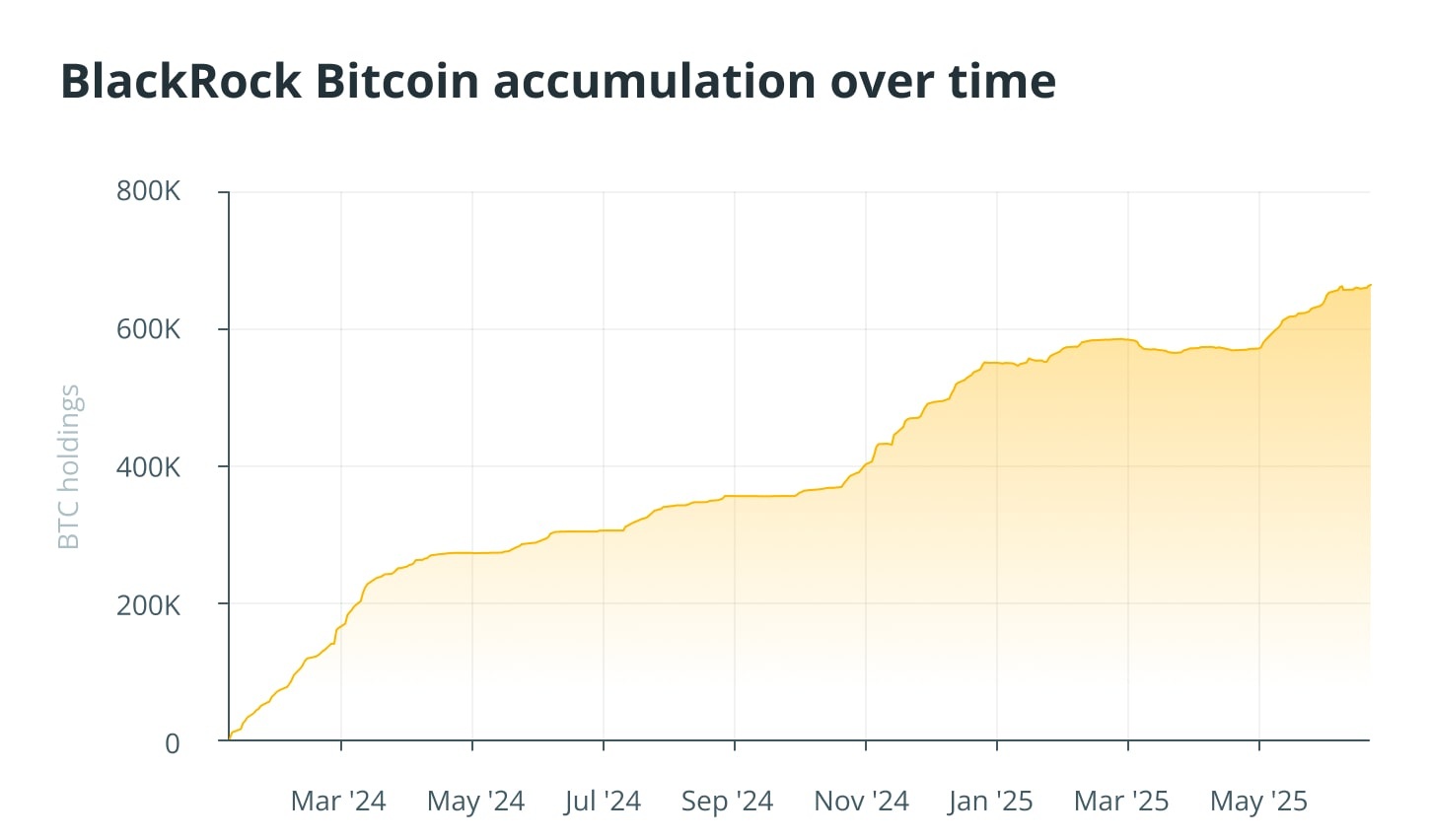
BlackRock’s bitcoin accumulation chart
BlackRock no longer considers bitcoin a risky toy. Now they see it as a full-fledged asset for long-term money storage. They understand that bitcoin can fluctuate greatly in price, but believe that it will become more stable in the future as more people and companies start using it. This will improve pricing, increase liquidity, and reduce the difference between the purchase and sale price.
BlackRock considers bitcoin to be part of the “new money” — the digital economy that is replacing the old financial systems. They are confident that bitcoin can be used as a diversification tool — that is, to avoid keeping all your money in one asset.
Why bitcoin is interesting in 2025
Here are the main reasons why BlackRock considers bitcoin a profitable investment:
- Limited quantity: no more than 21 million Bitcoins can be created. Many have already been lost, so there are even fewer available.
- An alternative to the dollar: bitcoin is not dependent on governments, so it can serve as a hedge against inflation, government debt, and political risks.
- Part of the digital revolution: The transition from traditional money and finance to online tools is a global trend that is particularly supported by younger generations.
BlackRock recommends that investors hold between 1% and 2% of their funds in bitcoin. This is not much, but for large investment funds, even 1% represents huge sums. They also compare the risks of bitcoin with those of shares in large technology companies such as Apple and Amazon.
IBIT’s impact on the market
BlackRock is buying up huge amounts of bitcoins, and this could change the cryptocurrency market itself. Bitcoin has always been volatile (i.e., its price has fluctuated greatly) because supply is limited and demand is constantly changing. When a giant like BlackRock enters the market, the question arises: will this stabilize the market or make it even more unstable?
Proponents of institutional investment believe that the participation of such companies makes the market more mature, transparent, and stable. Opponents warn that now the risks of traditional financial markets are coming to bitcoin: algorithmic failures, speculation, and price manipulation.
Bitcoin is becoming mainstream
BlackRock has done what previously seemed impossible: it has transformed bitcoin from a controversial asset into a respected financial instrument. Now, other companies are beginning to consider investing in cryptocurrency because BlackRock has removed the “stigma” from it.
This is also convenient for ordinary people: they can buy bitcoin through a fund without having to deal with wallets, private keys, and complex technologies.
Centralization of decentralization
There is also a paradox: bitcoin was created as an alternative to banks and governments, as a decentralized system. But now the world’s largest asset manager is buying it through a centralized fund. As a result, more and more bitcoins are controlled by centralized structures, exchanges, custodians, and ETF funds. This makes access to bitcoin easier, but at the same time distances it from its original idea.
The world is now moving towards a hybrid model: the basis of bitcoin remains decentralized, but most people prefer to use it through centralized services.
Conclusion
BlackRock already owns 3% of all bitcoins — and that changes the rules of the game. Bitcoin is increasingly becoming part of the global financial system, on the one hand remaining a unique digital asset, and on the other becoming increasingly centralized in the hands of major players.

Useful material?
 Telegram
  Twitter
 Research
One and the same cryptocurrency address received two completely opposite assessments from different analytics systems: from an ordinary gambling service to an extremely severe criminal offense. This story has become the starting point for a broader conversation about what the scientific standards of blockchain analysis should look like — and why errors in systems like these can shape the fates of real people.
Jul 1, 2026
Research
The blockchain has helped uncover the ties between cryptocurrency fundraising campaigns, exchangers in Syria, and intermediaries in several countries around the world. A telltale pattern has emerged in which the same addresses were used across multiple donation drives at once
Jun 24, 2026
Research
Four Iranian cryptocurrency exchanges accounted for roughly 78% of all digital asset volume tied to the country in 2025. They have now become the focal point of the largest U.S. sanctions campaign against Iran's cryptocurrency infrastructure.
Jun 5, 2026
Research
A financial system is already up and running on public blockchains, with loans, analogues of U.S. Treasuries, and automated capital markets. More than $551 billion has flowed through DeFi protocols — but most of that activity has nothing to do with the real economy and everything to do with the speculative build-up of risk.
May 29, 2026
Research
Around 97% of Chinese suppliers of chemicals used to make fentanyl accept payment in cryptocurrency. The volume of such transactions continues to grow alongside the global market for synthetic drugs
May 22, 2026
Research
For the first time, the new law makes blockchain analytics an officially mandatory tool of financial oversight in the United States. Authorities will also gain the power to restrict transactions with foreign crypto services tied to money-laundering risks.
May 20, 2026
Cryptocurrency rates
-

Bitcoin
$80 890
BTC
-0.04%
-

Ethereum
$2 364.43
ETH
-0.81%
-

BNB Smart Chain
$744.56
BSC
+0.64%
-

Ripple
$1.42
XRP
+1.04%
-

TRON
$0.328561
TRX
-0.31%
-

Zcash
$1 213.68
ZEC
+3.92%
-

Dogecoin
$0.07775
DOGE
-1.43%
-

Cardano
$0.218269
ADA
+2.11%
-

Stellar XLM
$0.184461
XLM
+2.83%
-

Bitcoin Cash
$277.11
BCH
-0.17%