

Football fans are crying too: the crypto scams around the 2026 World Cup — from fake FIFA tickets to the $WORLDCUP token
Scammers are already exploiting the 2026 World Cup to set up fake ticket-sale sites, "match-fixing" betting schemes, and football meme tokens. The losses so far are modest — but the tournament isn't over yet.

12.06.2026
332
11 min
0
In the lead-up to the 2026 FIFA World Cup, a range of scam operations have stepped up their activity. They are using cryptocurrencies on a mass scale to swindle money out of football fans. GetBlock AML Research uncovers the most common schemes being aimed at supporters.
Key points:
- Fraud remains one of the largest and most widespread categories of crime in the cryptocurrency space. By analysts' estimates, wallets tied to fraudulent schemes received around $35 billion in 2025. The volumes remain consistently high because scammers are constantly adapting their methods, cover stories, and distribution channels to find new victims.
- One of the scammers' most effective tools has always been major global events. Ahead of the 2026 FIFA World Cup, researchers are already documenting several types of cryptocurrency schemes aimed at fans. They include fake ticket-sale websites, fraudulent betting offers based on supposedly pre-known match results, off-the-shelf phishing attack kits, and the promotion of meme tokens tied to football themes.
- Preparation for such schemes begins long before the tournament itself. Scammers build out the necessary infrastructure weeks or even months ahead of the event, and start aggressively promoting their projects as the tournament approaches.
- So far, the sums collected by identified scammers are relatively small — under $1,700 across the addresses initially discovered. Some of the schemes that have been set up have not yet drawn their first victims.
- To cover their tracks, the attackers are making heavy use of cross-chain bridges and accounts on cryptocurrency exchanges. Analysts have already spotted this kind of activity in schemes tied to the World Cup. It fits a broader trend: over time, scammers have moved roughly $1.9 billion in assets through cross-chain bridges, complicating the tracing of money flows while preserving access to liquidity.
- As the opening whistle draws closer, new types of fraud are expected to emerge. Among the likely threats are fake bookmaker platforms, deepfakes of FIFA officials and well-known footballers, sham token launches, fake match streaming sites, ticket and accommodation scams, and other social engineering schemes built on the hype around the tournament.
- According to the 2026 crypto crime report, fraudulent wallets received around $35 billion over the course of 2025. That figure is part of a record $158 billion in illicit cryptocurrency activity. Roughly 62% of all fraudulent inflows came from investment scams.
- Scammers have always used major events to draw in victims and turn a profit. An analysis of user complaints shows that sporting events, while not the largest fraud category, remain a steady source of interest for criminals, who routinely build their schemes around them.
- In the run-up to the 2026 World Cup, several separate operations targeting football fans have already been identified. For now, the scale of such schemes is relatively modest and the cases look isolated, but researchers expect a rapid increase in both the number of such attacks and the number of victims as the tournament approaches.
Why the 2026 World Cup is a perfect target for crypto scammers: $35 billion in losses over the year
Most consumer-facing scams follow a similar playbook. The organizers set up a website, launch social media pages, post a cryptocurrency address for receiving payments, and try to attract as many visitors as possible before the resource is discovered and shut down.
Major sporting events significantly accelerate this process. They trigger a sharp surge in demand for tickets, accommodation, merchandise, and last-minute travel. Scammers factor that frenzy in well in advance and start building their schemes long before the tournament gets underway, in order to ride the wave of fan interest for all it's worth.
Law enforcement agencies have been warning fans for months about the risks of ticket fraud, counterfeit merchandise, and scams that involve impersonating official tournament representatives.
Even so, cryptocurrency addresses have already been identified as part of fraudulent infrastructure that uses the World Cup as a hook to lure in victims.
Three crypto schemes around the 2026 World Cup already running on the blockchain
Cryptocurrency scams leave a digital trail that cannot be erased. Every transfer is recorded on the blockchain, tied to a specific address, and stamped with a timestamp. That makes it possible to track the movement of funds and flag suspicious activity.
So far, the most compelling evidence has surfaced in schemes involving fake tickets and bets offered on supposedly pre-known match results.

How artificial intelligence turned the crypto market into a fraud factory
In 2025, crypto scammers used AI to steal $17 billion. Here’s a breakdown of real schemes — from deepfake videos to tokens built purely to deceive.
Schemes are also starting to emerge around the sale of phishing attack kits and the launch of football meme tokens, though their infrastructure is still less visible.
Fake FIFA sites: how scammers are selling 2026 World Cup tickets for crypto
Fraudulent websites mimic the look of FIFA's official services or popular ticket resale platforms. These sites offer users tickets to the most sought-after matches of the tournament, but demand that payment be made exclusively in cryptocurrency. Several such sites were uncovered during the investigation.

Fake FIFA site
In one case, an address was used on the Polygon network that had also been deployed on the Ethereum network. Roughly $1,562 came in through the Polygon address, with nearly the entire amount arriving over the course of a single day — April 1, 2026. That kind of activity may point either to a brief ad campaign or to a quick domain switch after the first payments came in. The Ethereum address, meanwhile, did not receive a single transfer.

Fake marketplace selling World Cup tickets
Another identified example involves a Bitcoin address that was used on a phishing ticket-sale site. Although the site is still up and running, at the time of analysis the scammers had not yet managed to extract any money from victims through it.
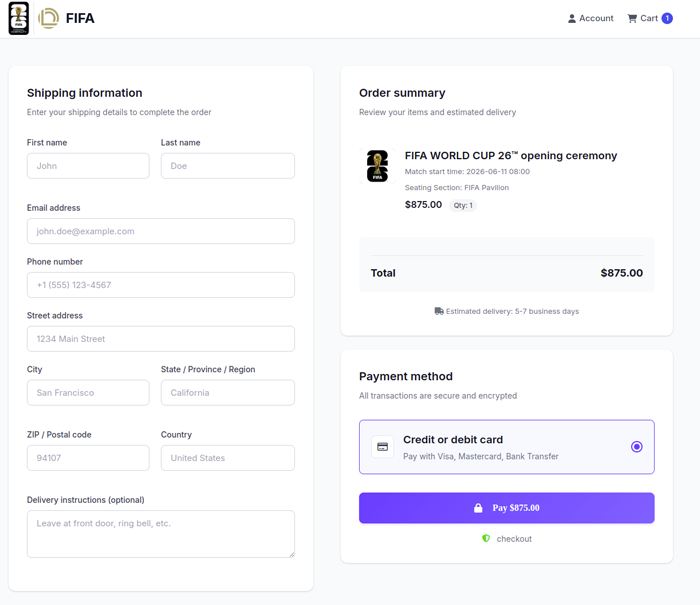
A phishing site purportedly selling World Cup tickets
Among the resources uncovered were sites mimicking the official FIFA website, fake premium ticket-sale platforms referencing the World Cup host cities, and fully counterfeit checkout pages. German-language sites offering tickets to the tournament's biggest matches were also identified.
Bets on "fixed" 2026 World Cup matches: a scheme selling insider tips for bitcoin
Another widespread scheme is built on promises to provide information about predetermined match results. Potential victims are invited to pay in cryptocurrency for access to "insider information," with the scammers claiming that certain matches are supposedly going to be played out according to a pre-agreed scenario.
The investigation uncovered one such operation tied to a Bitcoin address. Funds came in in small amounts across four different days between January and May 2026. The size of the transfers suggests that the scammers were working with individual victims one at a time.
After the money was received, it was not sent to a personal wallet belonging to the attackers, but to a deposit address at a cryptocurrency exchange, from where it then made its way to an account under their control.
Meme tokens for football fans
A third area involves meme tokens themed around the World Cup. Such projects are typically listed on lesser-known cryptocurrency exchanges and come with disclaimers stating they have no affiliation whatsoever with FIFA. One of the most prominent examples is the $WORLDCUP token, marketed as a "commemorative World Cup coin" and pitched as a fan project. The playbook is a familiar one on the market.
The creators of the project formally absolve themselves of responsibility through disclaimers about the absence of any official tie to the brand, while the popularity of the sporting event itself is used as a hook to draw in buyers.

Why the Tron blockchain became infrastructure for the shadow crypto economy
“Pig butchering” scams rely on Tron thanks to near-zero fees and transaction speeds of about 3 seconds. This allows criminals to move stolen funds through dozens of wallets before the victim even realizes the money is gone
In the meantime, investors remain exposed to the classic "pump and dump" scheme, in which the organizers and early participants sell off their holdings once interest picks up, leaving everyone else stuck with tokens whose value has collapsed. The appearance of such projects on exchanges with looser listing standards is also considered an additional sign of heightened risk.
How scammers hide the stolen money
Although the amounts involved in the identified cases are still relatively small, the methods used to move the money follow the well-worn patterns of crypto fraud.
The funds rarely stay at the original address. As a rule, the attackers either use services that allow assets to be moved between different blockchain networks, or send them to cryptocurrency exchange accounts to be cashed out.
Both approaches were spotted in the investigation tied to the World Cup. Funds from the address of a fraudulent ticket-sale site on the Polygon network were routed through a series of cross-chain swaps before ending up on the Tron network.
In some cases, the transfer went straight from Polygon to Tron. In others, the funds first passed through the Bitcoin network and only then made their way to Tron. The match-fixing betting scheme used a different approach: victims' money was sent directly to an exchange deposit address and then moved on to the attackers' account inside the trading platform.

AI in the Service of Scammers: How Crypto Fraud Became a Billion-Dollar Industry
An in-depth analysis of how artificial intelligence has reshaped the economics and scale of cryptocurrency fraud, based on data showing record levels of illicit activity in 2025.
Methods like these help criminals put distance between the funds and the original address that received them, complicating the work of analysts and law enforcement.
The use of cross-chain bridges has become especially popular among scammers. By available estimates, more than $1.9 billion in fraudulent funds has been moved through such mechanisms over time.
Despite individual spikes in activity in 2025, cross-chain bridges remain one of the main ways of obscuring the origins of stolen assets.
FIFA deepfakes and fake broadcasts: what threats will emerge closer to the 2026 World Cup
The schemes that have already been uncovered are only part of the picture. The experience of previous major global events shows that new types of fraud may emerge as the tournament draws closer.
Among the most likely scenarios, researchers point to the appearance of fake bookmaker services and investment programs promising guaranteed returns from betting.
A rise is expected in deepfakes that use artificial intelligence to mimic FIFA officials, famous footballers, sponsors, and tournament organizers. Such video and audio recordings can be used to promote fake giveaways, prize draws, and investment offers.
The launch of new tokens themed around the World Cup or FIFA is also a possibility. Such projects may be heavily promoted to capitalize on the wave of interest in the tournament, after which the organizers will try to cash in on the sudden surge in demand.
A further threat comes from fake match-streaming platforms. Users may be offered free or cheap broadcasts, while their payment details are quietly harvested or they are pushed into making cryptocurrency transfers.
The traditional schemes are not going anywhere either — fake tickets, counterfeit sports merchandise, nonexistent rental listings, and bogus travel packages.
How fans can protect themselves from crypto fraud at the 2026 World Cup
For law enforcement, cryptocurrency exchanges, and companies working in ticketing and travel services, the key takeaway is that the fraudulent infrastructure is already in place and ready to absorb a far larger flow of victims than it is handling now.
As the tournament approaches, new addresses and new schemes will emerge. Ordinary fans are advised to buy tickets only through official sales channels, to treat demands for payment exclusively in cryptocurrency with suspicion, and to steer clear of offers promising guaranteed match results or supposedly insider information.

Useful material?
 Telegram
  Twitter
 Research
One and the same cryptocurrency address received two completely opposite assessments from different analytics systems: from an ordinary gambling service to an extremely severe criminal offense. This story has become the starting point for a broader conversation about what the scientific standards of blockchain analysis should look like — and why errors in systems like these can shape the fates of real people.
Jul 1, 2026
Research
The blockchain has helped uncover the ties between cryptocurrency fundraising campaigns, exchangers in Syria, and intermediaries in several countries around the world. A telltale pattern has emerged in which the same addresses were used across multiple donation drives at once
Jun 24, 2026
Research
Four Iranian cryptocurrency exchanges accounted for roughly 78% of all digital asset volume tied to the country in 2025. They have now become the focal point of the largest U.S. sanctions campaign against Iran's cryptocurrency infrastructure.
Jun 5, 2026
Research
A financial system is already up and running on public blockchains, with loans, analogues of U.S. Treasuries, and automated capital markets. More than $551 billion has flowed through DeFi protocols — but most of that activity has nothing to do with the real economy and everything to do with the speculative build-up of risk.
May 29, 2026
Research
Around 97% of Chinese suppliers of chemicals used to make fentanyl accept payment in cryptocurrency. The volume of such transactions continues to grow alongside the global market for synthetic drugs
May 22, 2026
Research
For the first time, the new law makes blockchain analytics an officially mandatory tool of financial oversight in the United States. Authorities will also gain the power to restrict transactions with foreign crypto services tied to money-laundering risks.
May 20, 2026
Cryptocurrency rates
-

Bitcoin
$82 425
BTC
-1.3%
-

Ethereum
$2 535.07
ETH
-1.63%
-

BNB Smart Chain
$760.93
BSC
-0.68%
-

Ripple
$1.42
XRP
+1.04%
-

TRON
$0.335215
TRX
+0.42%
-

Zcash
$1 206.48
ZEC
-7.54%
-

Dogecoin
$0.087119
DOGE
-1.9%
-

Cardano
$0.218269
ADA
+2.11%
-

Stellar XLM
$0.184461
XLM
+2.83%
-

Bitcoin Cash
$294.06
BCH
-2.67%