


Harmless mistake that cost $360k. SIR.Trading case
Hacker was able to use temporary storage in an Ethereum virtual machine to bypass permission verification and withdrawal procedures

02.04.2025
604
3 min
0
On March 30, a successful attack was carried out on the decentralized crypto derivatives exchange SIR.trading. The attacker managed to withdraw assets worth $300 000. The attacker used a non-standard way to compromise the project. Representatives of the exchange reported that all their funds were stolen, so the further work of the platform remains in question.
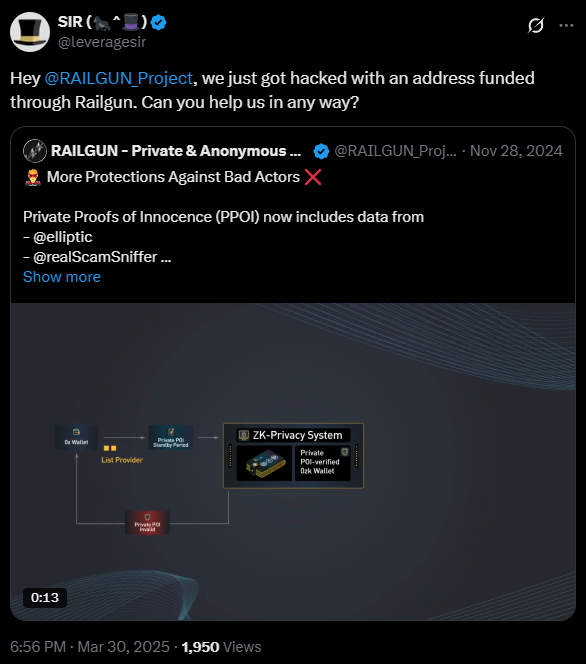
Source: Аккаунт SIR.trading (@leveragesir) в X
What you need to know
In January 2024, version 0.8.24 of Solidity was released. It is a programming language that is used to develop smart contracts in the Ethereum Virtual Machine (EVM). The upgrade added a temporary data store that is only valid when transactions are executed.
The new storage, dubbed transient storage, stores data only during transaction execution. The information in the storage is automatically cleared after the transaction is executed. The transient storage is accessed using two EVM commands:
- TSTORE(key, value): stores a 256-bit value by the specified key in temporary storage
- TLOAD(key): retrieves the 256-bit value from temporary storage using the specified key
Besides its obvious convenience, temporary storage has become a popular tool with developers due to its low gas cost. The TSTORE and TLOAD commands require only 100 units of gas to execute, while using regular storage (SSTORE) requires up to 20 000 units of gas.
It was the temporary storage mechanism that the attacker targeted. He used an exploit that prevented the temporary storage from being automatically cleared after the transaction. The hacker used the obtained data to further bypass permission checks and transfer tokens.

What happened when MIM was hacked. Detailed analysis of the attack
We reveal the scheme by which the hacker manipulated cryptocurrency loan collateral
How the hack was carried out
The attacker performed a sophisticated attack using Uniswap V3. He created two new tokens. One was used as a primary token, and the other was used as a debt token. When creating the debt token, the hacker was able to get into the temporary storage and use it to change the amount of coins being issued. He then used this to issue a large number of main tokens using leverage on SIR.trading.
The hacker’s address: 0x27defcfa6498f957918f407ed8a58eba2884768c
Compromised smart contract code: 0xb91ae2c8365fd45030aba84a4666c4db074e53e7
Attack transaction: 0xa05f047ddfdad9126624c4496b5d4a59f961ee7c091e7b4e38cee86f1335736f
Let’s go after the money
After the successful attack, 17,8k USDC, 1,4 WBTC, and 119,8 WETH were withdrawn to the hacker’s address 0x27d. The total amount of stolen assets amounted to about $360k. Next, the hacker exchanged WBTC and USDC for 63,5 WETH and 9,7 WETH, respectively. Next, 193,1 WETH was sent to the Railgun decentralized protocol for laundering.
Warning to developers
To prevent malicious users from using the Ethereum EVM temporary storage, developers are advised to forcefully clear the storage value using the TSTORE(key, 0) command.

Useful material?
 Telegram
  Twitter
 Research
One and the same cryptocurrency address received two completely opposite assessments from different analytics systems: from an ordinary gambling service to an extremely severe criminal offense. This story has become the starting point for a broader conversation about what the scientific standards of blockchain analysis should look like — and why errors in systems like these can shape the fates of real people.
Jul 1, 2026
Research
The blockchain has helped uncover the ties between cryptocurrency fundraising campaigns, exchangers in Syria, and intermediaries in several countries around the world. A telltale pattern has emerged in which the same addresses were used across multiple donation drives at once
Jun 24, 2026
Research
Four Iranian cryptocurrency exchanges accounted for roughly 78% of all digital asset volume tied to the country in 2025. They have now become the focal point of the largest U.S. sanctions campaign against Iran's cryptocurrency infrastructure.
Jun 5, 2026
Research
A financial system is already up and running on public blockchains, with loans, analogues of U.S. Treasuries, and automated capital markets. More than $551 billion has flowed through DeFi protocols — but most of that activity has nothing to do with the real economy and everything to do with the speculative build-up of risk.
May 29, 2026
Research
Around 97% of Chinese suppliers of chemicals used to make fentanyl accept payment in cryptocurrency. The volume of such transactions continues to grow alongside the global market for synthetic drugs
May 22, 2026
Research
For the first time, the new law makes blockchain analytics an officially mandatory tool of financial oversight in the United States. Authorities will also gain the power to restrict transactions with foreign crypto services tied to money-laundering risks.
May 20, 2026
Cryptocurrency rates
-

Bitcoin
$84 582
BTC
-1.95%
-

Ethereum
$2 680.32
ETH
-2.16%
-

BNB Smart Chain
$764.98
BSC
-1.57%
-

Ripple
$1.42
XRP
+1.04%
-

TRON
$0.335103
TRX
+0.21%
-

Zcash
$1 312.06
ZEC
-5.65%
-

Dogecoin
$0.092532
DOGE
-4.2%
-

Cardano
$0.218269
ADA
+2.11%
-

Stellar XLM
$0.184461
XLM
+2.83%
-

Bitcoin Cash
$310.95
BCH
-1.43%