


Holiday crypto scams: how to avoid getting caught during the festive season
Scam activity tends to surge during the holidays — especially in crypto. We break down the most common schemes and share practical tips on how to protect yourself
19.01.2026
269
8 min
0
The holiday season is usually associated with rest, family and joy. Unfortunately, for cybercriminals it is also one of the most active periods of the year. Scammers take advantage of the surge in online shopping, holiday promotions and emotionally driven spending to trick people into parting with their money.
For crypto users, these schemes are especially dangerous because cryptocurrency transfers are generally irreversible. Scammers know this well, while many users are still learning how to handle digital assets safely. GetBlock AML Research explains why fraud activity spikes during the holidays.
Ideal conditions for scams
Several factors come together during the holiday season that make fraud easier and less noticeable.
First, people spend more time online. Shopping, travel bookings and social media activity all increase, meaning users are exposed to far more ads and messages than usual. In this information overload, it becomes easier for scammers to slip in fake links or fraudulent offers.
Second, emotions run high. People tend to be more generous and optimistic, but also more tired or stressed. Scammers exploit this by offering “holiday bonuses,” “Christmas giveaways,” or “year-end investment opportunities” that sound urgent and appealing.
Third, people are distracted. Busy schedules and holiday commitments mean fewer checks of links, apps or wallet addresses. Even a small lapse in attention can lead to significant crypto losses.
How your cryptocurrency will be stolen: top 5 popular schemes
Scammers use a set of ready-made schemes to deceive unsuspecting cryptocurrency owners and obtain their assets
How victims are targeted during the holidays
From phishing emails and fake wallet apps to fraudulent token sales and “romance” scams, criminals ramp up their activity during the holidays. They lure users with bonuses, investment offers and even promises of love to steal cryptocurrency.
Phishing emails and fake wallet websites
Phishing remains one of the most common ways crypto is stolen. During the holidays, these attacks are often disguised as promotions or important alerts.
For example, an email may appear to come from a well-known exchange such as Coinbase or Binance, announcing a “holiday bonus.” The message includes a link to a fake login page. Once the user enters their credentials, the attacker gains access and drains the account.
Scammers also create fake crypto wallet apps that closely mimic legitimate ones. In previous holiday seasons, security researchers have found such apps even in Google Play and the Apple App Store. Once installed, they ask for private keys or seed phrases, which are then sent directly to attackers.
Why you shouldn’t follow the links on X: real phishing cases
Phishing links on X have become a frequent and widespread phenomenon because many users of the social network can’t identify malicious content
Fake investments and token presales
Scammers frequently launch fake investment platforms or “holiday token presales,” promising guaranteed returns or exclusive early access to a new coin or NFT collection. Victims are instructed to transfer crypto to the platform. Once enough funds are collected, the website disappears along with the money.
In late 2025, London authorities arrested five men suspected of running crypto scams that may have caused losses exceeding £1 million. The schemes involved websites promising profitable investments in new cryptocurrencies at the presale stage — a classic example of this type of fraud.
Romance scams and “pig butchering”
The holidays can be especially difficult for people who feel lonely, making them more vulnerable to emotional manipulation. In so-called “pig butchering” schemes, scammers create fake profiles on dating apps or social networks and build trust over weeks or months before proposing a “joint crypto investment.”
One of the most well-known cases involved Shreya Datta, an IT professional from Philadelphia, who lost $450,000 after meeting a man on the dating app Hinge who claimed to be a French wine trader.
Over several weeks, he gained her trust and convinced her to invest in what appeared to be a legitimate crypto trading platform. The scam was uncovered only when the app demanded a 10% “income tax” payment before allowing withdrawals. This raised red flags for her brother, who investigated and exposed the fraud.
Many of these schemes peak around Christmas and New Year, when people are more emotionally vulnerable and spend more time communicating online.
Impersonation and “fund recovery” scams during the holidays
Scammers often pose as regulators, exchange staff or even charities to pressure victims into transferring funds. Others pretend to be technical support agents or “fund recovery specialists,” targeting people who have already been scammed.
“Pig butchering”: another $47 million belonging to scammers has been frozen
A scheme for laundering criminal proceeds obtained by fraudsters through a sophisticated scam has been uncovered
Messages from “official authorities”
Attackers frequently impersonate government agencies, exchanges or law enforcement. They may claim a wallet has been compromised or that new rules require urgent action. Victims are then instructed to move funds to a “safe wallet” for verification.
Reports show that phishing activity spikes sharply during major shopping events. Attacks linked to Black Friday increased more than sixfold compared with early November, while Christmas-related scams rose by more than 300% during the peak shopping week.
With the help of AI, scammers can now replicate a person’s voice using just three seconds of audio. This makes it possible to deceive relatives or friends into believing they are speaking directly to you.
Fake holiday tokens and pump-and-dump schemes
Another growing holiday trend is fake “festive” cryptocurrencies. One example is a project called Xmas Coin (XMAS). According to reports, its creators were linked to previous scam projects that simply rebranded and relaunched to attract new victims.
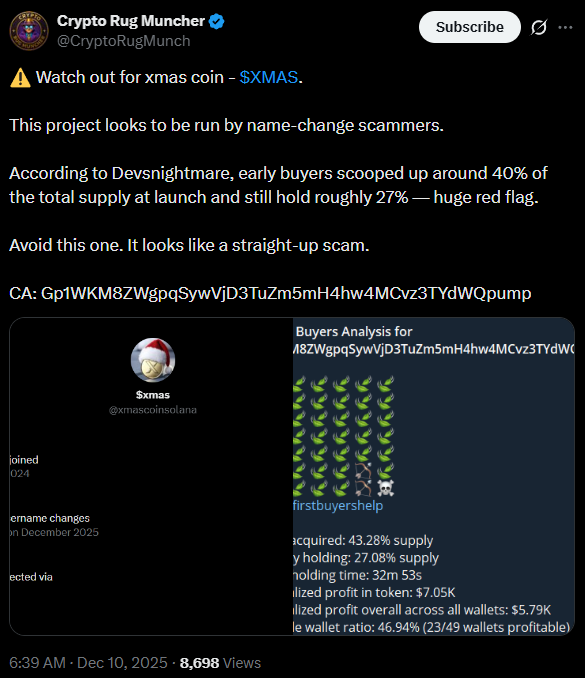
Warning about the risks of the XMAS token on X
Early buyers received nearly 40% of the total token supply at launch and continued to hold around 27%. This is a classic sign of a pump-and-dump scheme, where prices are artificially inflated before insiders sell off their holdings. Xmas Coin shows multiple indicators of a coordinated exit scam.
Investors should avoid tokens with such red flags or without transparent information about ownership and liquidity.
Fake tech support and “fund recovery” services
After someone falls victim to a scam, another group of criminals may contact them offering help to recover their funds. They pose as blockchain investigators or legal firms.
Desperate to recover losses, victims are scammed again — asked to pay additional “fees” or disclose personal information. These schemes often appear immediately after major holiday scam waves, when victims search online for assistance.
How to protect yourself from crypto scams during the holidays
Stay alert during the holiday season: verify offers, use only official apps, protect your keys, strengthen account security, avoid emotional decisions, check charity campaigns and keep up with current threats.

Why you shouldn’t trust cryptocurrency ads on social media: Top 5 scam cases
On social media platform X, the accounts of stars and celebrities are often hacked to promote scam tokens
Key recommendations include:
- Be cautious with unexpected offers: If a stranger offers investments, claims you’ve won something or demands urgent action, pause and verify the source.
- Use only official links and apps: Download wallets and exchange apps only from official websites or trusted app stores. Avoid links from emails or social media.
- Never share private keys or recovery phrases: No legitimate company or employee will ever ask for them. Store them offline and securely.
- Strengthen your security: Use two-factor authentication, unique passwords and avoid making transactions over public Wi-Fi.
- Watch out for emotional pressure: Scammers exploit trust and fear. Always take time to verify information before sending funds.
- Verify charities and giveaways: Donate only to trusted organizations and ignore promises to “double” your crypto.
- Stay informed: Follow alerts from reputable financial and cybersecurity organizations. Awareness is one of the strongest defenses.
The holidays should bring joy, not regret. By slowing down, checking sources and paying attention to warning signs, you can enjoy the festive season without falling into a scammer’s trap.

Useful material?
 Telegram
  Twitter
 Research
One and the same cryptocurrency address received two completely opposite assessments from different analytics systems: from an ordinary gambling service to an extremely severe criminal offense. This story has become the starting point for a broader conversation about what the scientific standards of blockchain analysis should look like — and why errors in systems like these can shape the fates of real people.
Jul 1, 2026
Research
The blockchain has helped uncover the ties between cryptocurrency fundraising campaigns, exchangers in Syria, and intermediaries in several countries around the world. A telltale pattern has emerged in which the same addresses were used across multiple donation drives at once
Jun 24, 2026
Research
Four Iranian cryptocurrency exchanges accounted for roughly 78% of all digital asset volume tied to the country in 2025. They have now become the focal point of the largest U.S. sanctions campaign against Iran's cryptocurrency infrastructure.
Jun 5, 2026
Research
A financial system is already up and running on public blockchains, with loans, analogues of U.S. Treasuries, and automated capital markets. More than $551 billion has flowed through DeFi protocols — but most of that activity has nothing to do with the real economy and everything to do with the speculative build-up of risk.
May 29, 2026
Research
Around 97% of Chinese suppliers of chemicals used to make fentanyl accept payment in cryptocurrency. The volume of such transactions continues to grow alongside the global market for synthetic drugs
May 22, 2026
Research
For the first time, the new law makes blockchain analytics an officially mandatory tool of financial oversight in the United States. Authorities will also gain the power to restrict transactions with foreign crypto services tied to money-laundering risks.
May 20, 2026
Cryptocurrency rates
-

Bitcoin
$84 545
BTC
-0.14%
-

Ethereum
$2 667.57
ETH
-1.23%
-

BNB Smart Chain
$766.57
BSC
-0.47%
-

Ripple
$1.42
XRP
+1.04%
-

TRON
$0.334596
TRX
-0.11%
-

Zcash
$1 291.4
ZEC
-3.12%
-

Dogecoin
$0.092439
DOGE
-1.73%
-

Cardano
$0.218269
ADA
+2.11%
-

Stellar XLM
$0.184461
XLM
+2.83%
-

Bitcoin Cash
$308.83
BCH
-0.15%