


How crypto users robbed a casino or the story of the extortionists’ failure
Extortionists got $15 million in BTC from the largest casinos in Las Vegas — Caesars Palace, Flamingo, Eldorado, and others

09.06.2025
1109
4 min
0
Fraud and extortion in the crypto sphere are so widespread that people of all generations and ages fall victim to it. But there are some unique cases. GetBlock AML Research exclusively reveals the details of a casino heist using cryptocurrencies.
Victim
This time in the crosshairs of extortionists were not pensioners, but one of the world’s largest real estate and gaming companies — Caesars Entertainment. It owns the largest and most famous casinos in the United States, such as Caesars Palace, Flamingo, Eldorado, and others.

Caesars Palace hotel and casino in Las Vegas. Source: caesars.com
How the attack happened
The incident occurred on August 18, 2023. On that day, the Scattered Spider ransomware group carried out a social engineering attack on a company that provided outsourcing services to Caesars Entertainment for organizing customer support services.
As early as August 23, the attackers gained access to the database of the loyalty system of all Caesars Entertainment customers, which stored social security numbers in addition to personal data.
Caesars Entertainment employees discovered traces of hacking only on September 7. On September 14, the company publicly admitted the fact of hacking and reported to the SEC about the transfer of $15 million to the extortionists, although initially, the attackers made demands of $30 million.
During the same period, another casino operator — MGM Resort was attacked by Scattered Spider. The company refused to pay the ransom and suffered more than $100 million in losses as a result of large-scale software failures that disrupted the organization’s operations.
How the extortionists were tracked
The funds received from Caesars Entertainment as ransom were first identified in January 2024. At that time, a suspicious transfer of 402 BTC across the Avalanche Bridge was recorded. The US Federal Bureau of Investigation sent Ava Labs a demand to freeze the assets. As a result of the cooperation, 277,56 BTC was frozen, another 125 BTC the extortionists managed to conduct through the protocol and successfully withdraw to other platforms.
Soon after, another suspicious transfer of $690 000 was detected. The cryptocurrency was sent to one of the wallets belonging to the Gate exchange. The platform complied with the US authorities’ order and blocked $519 845 in stablecoins and 1135 Monero (XMR).
On-chain trail
The cryptocurrency received from Caesars Entertainment was initially transferred to two addresses intended for asset splitting.
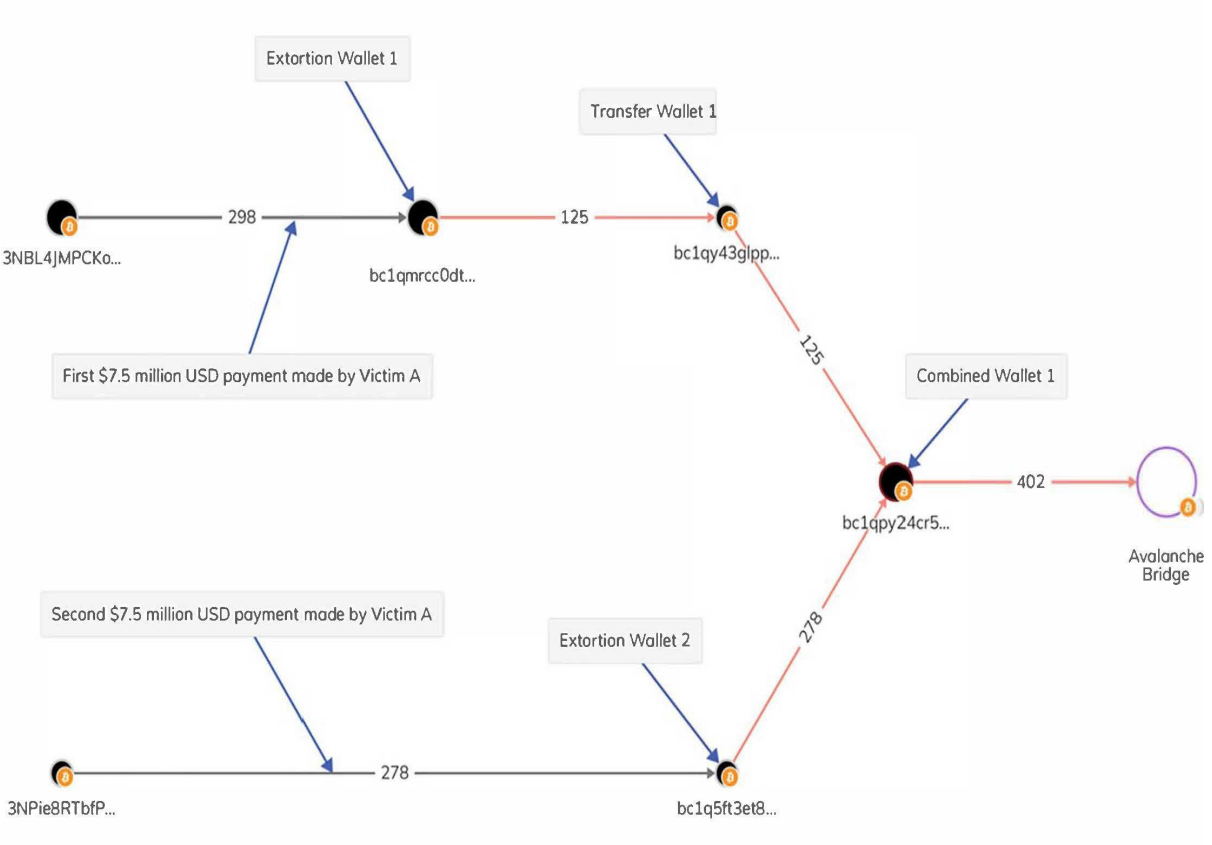
A scheme to move cryptocurrency stolen from Caesars Entertainment. Data: Chainalysis
|
Primary wallets for money laundering |
Two more new addresses were then created and used to obfuscate the transaction chain.
|
Secondary wallets for money laundering |
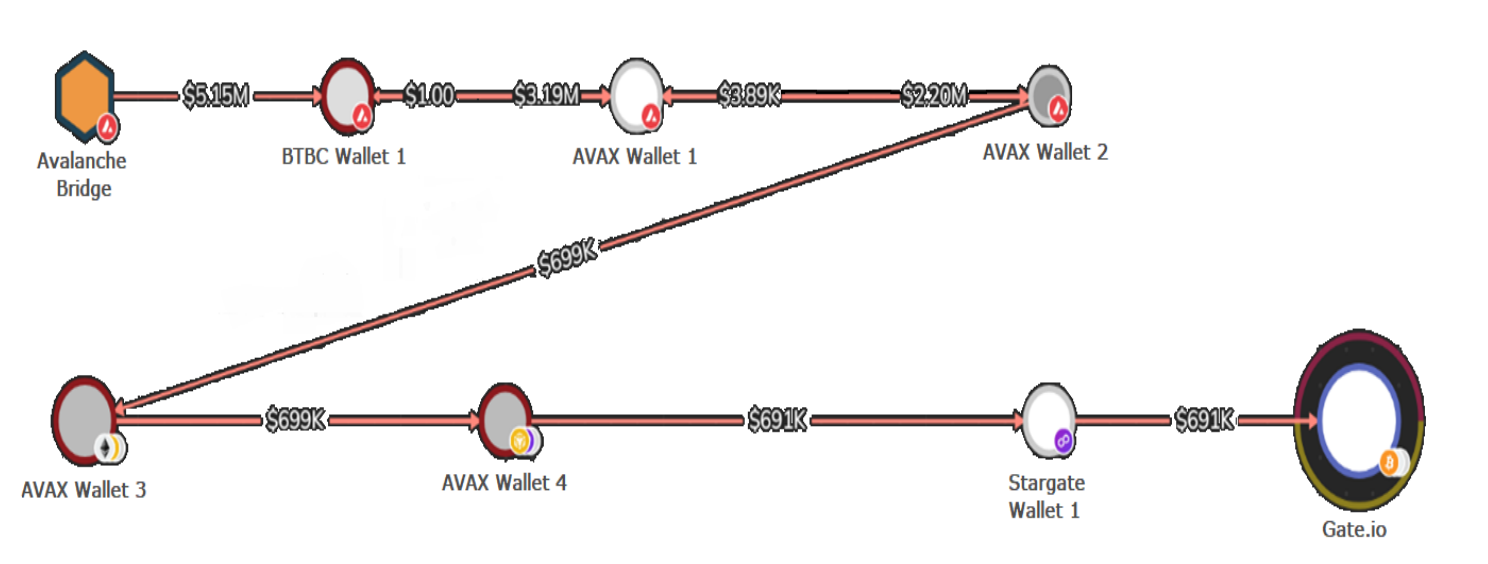
A scheme to move cryptocurrency stolen from Caesars Entertainment. Data: Chainalysis
After the secondary transfer, the funds were directed to Avalanche Bridge, where a part of them was blocked by the Ava Labs team. The remaining cryptocurrency from the extortionists was directed to the Stargate protocol before being moved to the Gate exchange, where the assets were also blocked.

Useful material?
 Telegram
  Twitter
 Research
One and the same cryptocurrency address received two completely opposite assessments from different analytics systems: from an ordinary gambling service to an extremely severe criminal offense. This story has become the starting point for a broader conversation about what the scientific standards of blockchain analysis should look like — and why errors in systems like these can shape the fates of real people.
Jul 1, 2026
Research
The blockchain has helped uncover the ties between cryptocurrency fundraising campaigns, exchangers in Syria, and intermediaries in several countries around the world. A telltale pattern has emerged in which the same addresses were used across multiple donation drives at once
Jun 24, 2026
Research
Four Iranian cryptocurrency exchanges accounted for roughly 78% of all digital asset volume tied to the country in 2025. They have now become the focal point of the largest U.S. sanctions campaign against Iran's cryptocurrency infrastructure.
Jun 5, 2026
Research
A financial system is already up and running on public blockchains, with loans, analogues of U.S. Treasuries, and automated capital markets. More than $551 billion has flowed through DeFi protocols — but most of that activity has nothing to do with the real economy and everything to do with the speculative build-up of risk.
May 29, 2026
Research
Around 97% of Chinese suppliers of chemicals used to make fentanyl accept payment in cryptocurrency. The volume of such transactions continues to grow alongside the global market for synthetic drugs
May 22, 2026
Research
For the first time, the new law makes blockchain analytics an officially mandatory tool of financial oversight in the United States. Authorities will also gain the power to restrict transactions with foreign crypto services tied to money-laundering risks.
May 20, 2026
Cryptocurrency rates
-

Bitcoin
$84 636
BTC
-1.56%
-

Ethereum
$2 678.59
ETH
-1.88%
-

BNB Smart Chain
$766.18
BSC
-1.44%
-

Ripple
$1.42
XRP
+1.04%
-

TRON
$0.335161
TRX
+0.31%
-

Zcash
$1 314.49
ZEC
-5.02%
-

Dogecoin
$0.092973
DOGE
-3.19%
-

Cardano
$0.218269
ADA
+2.11%
-

Stellar XLM
$0.184461
XLM
+2.83%
-

Bitcoin Cash
$310.29
BCH
-1.35%