

How North Korean IT specialists bypass sanctions and earn millions
North Korea uses IT specialists with fake identities to work for international companies. The income they generate may be funneled into state programs while bypassing sanctions

18.03.2026
227
7 min
0
The Office of Foreign Assets Control (OFAC) has imposed sanctions on six individuals and two organizations that helped implement schemes involving IT specialists from North Korea. According to estimates, these schemes generated about $800 million in 2024 alone, funds that may have been directed to finance the country’s military programs.
One key intermediary helped convert about $2.5 million into cryptocurrency between mid-2023 and mid-2025. These networks operated across several countries, including Vietnam, Laos, and Spain, using cryptocurrency to move funds.
These measures are part of a broader policy by the U.S. Treasury aimed at disrupting schemes through which North Korea generates revenue while bypassing international sanctions. GetBlock AML Research publishes new details from the investigation into North Korean hacking groups and the cryptocurrency laundering networks connected to them.
Sanctions by OFAC against the IT specialist network
On March 12, 2026, OFAC announced sanctions against six individuals and two entities linked to fraudulent schemes organized by the North Korean government.
These schemes targeted companies, including American firms, and generated significant revenue. According to authorities, the funds were used to finance programs related to weapons of mass destruction and ballistic missile development.
How fake IT employment schemes operate
Schemes involving North Korean IT specialists are considered a complex and growing threat to businesses. People involved in these schemes obtain jobs at foreign companies using forged documents, stolen identities, and fabricated biographies. Outwardly they appear to be ordinary remote employees.
However, a significant portion of their income is reportedly transferred to the state. As a result, hundreds of millions of dollars may be funneled into government programs while bypassing sanctions.
In some cases, these workers also deployed malicious software within company systems to gain access to sensitive information. Such data was sometimes later used to extort money from the companies.
The role of cryptocurrency in North Korea’s sanctions evasion
Cryptocurrency plays a key role in moving funds obtained through these schemes. It allows money to be transferred between countries while bypassing restrictions and oversight.
Under the new sanctions, 21 cryptocurrency addresses across different blockchain networks were identified. This indicates that multiple technologies are being used to conceal the movement of funds.
Intermediaries and companies involved in financial operations
Nguyen Quang Viet, head of a company in Vietnam, provided currency exchange services for North Korean nationals. According to OFAC, between 2023 and 2025 he helped convert about $2.5 million into cryptocurrency, including funds obtained through IT schemes.
These operations were linked to Amnokgang Technology Development Company — a North Korean organization that manages groups of IT workers abroad.
| Addresses associated with Amnokgang Technology Development Company |
| 0xcB74874f1e06Fcf80A306e06e5379A44B488bA2D |
| 0x0330070FD38Ec3bB94F58FA55D40368271E9e54A |
| 0x9Be599d7867f5E1a2D7Ec6dB9710dF2b98A15573 |
| TNrX2FwrHKoo4XACGkmSzqeK4pdnKYn6Z7 |
| TEEYCuGDyeNkuDj4u6GQRXxXo3Nh29r2vP |
| TZB4NrX7k9ZsV6PRc1GigAztLL8WHpLvwP |
| TDe2UNAvuUnTbbDo7518eMe3TXN5qJW8Ft |
North Korean national Yun Song Guk was also sanctioned. Since at least 2023, he has managed a group of IT specialists in Laos.
| Addresses associated with Yun Song Guk |
| 0xb637f84b66876ebf609c2a4208905f9ddac9d075 |
| 0x95584C303FCd48AF5c6B9873015f2AD0ca84EaE3 |
Hoang Minh Quang was also noted for participating in financial operations totaling more than $70,000 related to IT services.
| Address associated with Hoang Minh Quang |
| bc1qyy5pt5cx3zth8xlj92lq5y87dh8xv3nwgs4ncq |
In addition, information was updated regarding Sim Hyon Sop, previously added to the sanctions list and linked to a North Korean banking structure. New cryptocurrency addresses were added to his profile.
How cryptocurrencies are used to evade sanctions
OFAC’s actions are part of a long-term strategy to combat the use of cryptocurrency to bypass sanctions. North Korea increasingly relies on digital assets to generate revenue. This includes:
- employment of IT specialists under false identities
- cyberattacks and hacks
- ransomware attacks
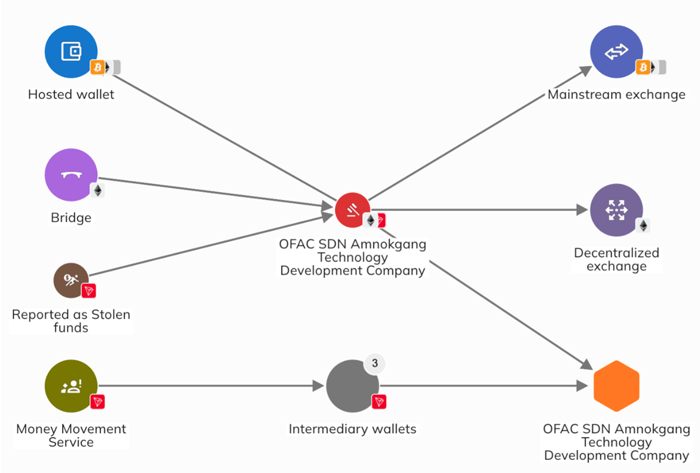
Scheme of illicit crypto asset transfers through addresses linked to Amnokgang Technology Development Company. Visualization by Chainalysis.
Multiple blockchain networks are used to transfer funds, making transactions more difficult to trace.
Risks for businesses and compliance recommendations
Companies working with cryptocurrency should consider these risks. It is recommended to screen counterparties against sanctions lists, pay attention to suspicious employment schemes, and monitor unusual payments.
Particular attention should be paid to transactions linked to Southeast Asian countries, where such networks were reportedly active. Businesses are also advised to review warnings previously issued by the FBI and other U.S. government agencies to better understand the indicators of such schemes.

Useful material?
 Telegram
  Twitter
 Research
One and the same cryptocurrency address received two completely opposite assessments from different analytics systems: from an ordinary gambling service to an extremely severe criminal offense. This story has become the starting point for a broader conversation about what the scientific standards of blockchain analysis should look like — and why errors in systems like these can shape the fates of real people.
Jul 1, 2026
Research
The blockchain has helped uncover the ties between cryptocurrency fundraising campaigns, exchangers in Syria, and intermediaries in several countries around the world. A telltale pattern has emerged in which the same addresses were used across multiple donation drives at once
Jun 24, 2026
Research
Four Iranian cryptocurrency exchanges accounted for roughly 78% of all digital asset volume tied to the country in 2025. They have now become the focal point of the largest U.S. sanctions campaign against Iran's cryptocurrency infrastructure.
Jun 5, 2026
Research
A financial system is already up and running on public blockchains, with loans, analogues of U.S. Treasuries, and automated capital markets. More than $551 billion has flowed through DeFi protocols — but most of that activity has nothing to do with the real economy and everything to do with the speculative build-up of risk.
May 29, 2026
Research
Around 97% of Chinese suppliers of chemicals used to make fentanyl accept payment in cryptocurrency. The volume of such transactions continues to grow alongside the global market for synthetic drugs
May 22, 2026
Research
For the first time, the new law makes blockchain analytics an officially mandatory tool of financial oversight in the United States. Authorities will also gain the power to restrict transactions with foreign crypto services tied to money-laundering risks.
May 20, 2026
Cryptocurrency rates
-

Bitcoin
$80 992
BTC
-4.28%
-

Ethereum
$2 374.74
ETH
-5.54%
-

BNB Smart Chain
$727.09
BSC
-3.05%
-

Ripple
$1.42
XRP
+1.04%
-

TRON
$0.327958
TRX
-1.4%
-

Zcash
$1 192.17
ZEC
-12.25%
-

Dogecoin
$0.078149
DOGE
-6.25%
-

Cardano
$0.218269
ADA
+2.11%
-

Stellar XLM
$0.184461
XLM
+2.83%
-

Bitcoin Cash
$273.19
BCH
-4.86%